
If you've looked at your child's maths homework or a Year 6 SATs paper, you'll have seen the phrase "formal written method". It sounds technical, but it simply means the standard column layouts for adding, subtracting, multiplying and dividing. These methods are the backbone of primary arithmetic.
I'm Ross, a UK-qualified primary teacher with over ten years in the classroom. In this guide I'll explain what counts as a formal written method, show a worked example of each one, set out when children learn them, and explain how the "informal" methods your child learns first fit in.
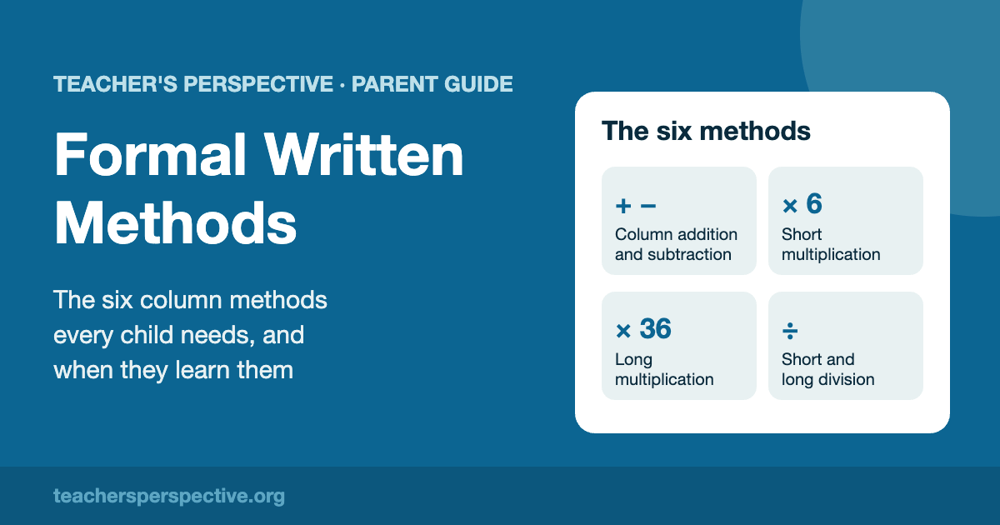
Quick answer: Formal written methods are the six standard column methods for calculating on paper: column addition, column subtraction, short multiplication, long multiplication, short division and long division. In England, children start with column addition and subtraction in Year 3, add short multiplication in Year 4, short division and long multiplication in Year 5, and long division in Year 6. They are tested in the Year 6 SATs arithmetic paper.
In this guide
What is a formal written method?
A formal written method is a set way of laying out a calculation on paper, in columns, so that it works for any size of number. The national curriculum for England lists them in its appendix, and schools are expected to teach them.
They're "formal" because the layout is always the same. Once your child can do column addition with 3-digit numbers, the same steps work for 6-digit numbers or decimals. That's what makes them so powerful, and why I treat them as the core skills every child needs.
▶ Video lesson: the 4 core methods to start with if your child is struggling in maths. Watch on YouTube
The six formal written methods, with examples
1. Column addition
Write the numbers one above the other, lined up by place value, and add each column starting from the ones. If a column makes 10 or more, exchange into the next column. Example: 2,456 + 1,378 = 3,834. See column addition and subtraction and what exchanging means.
2. Column subtraction
Same layout, taking the bottom number from the top. If the top digit is too small, exchange from the column to the left. Example: 5,203 − 2,768 = 2,435. Zeros make this harder, which I cover in column subtraction with zeros.
3. Short multiplication
Multiplying a number by a single digit, in one row. Example: 347 × 6 = 2,082. 7 × 6 = 42, so write 2 and exchange 4 tens. 4 × 6 = 24, plus 4 is 28, so write 8 and exchange 2. 3 × 6 = 18, plus 2 is 20. See short multiplication step by step.
4. Long multiplication
Multiplying by a 2-digit number, using two rows that are then added. Example: 243 × 36. First 243 × 6 = 1,458. Then 243 × 30 = 7,290. Add them: 1,458 + 7,290 = 8,748. See long multiplication step by step.
5. Short division (the bus stop method)
Dividing by a single digit, working from the left. Example: 852 ÷ 4 = 213. 8 ÷ 4 = 2, 5 ÷ 4 = 1 remainder 1, so carry the 1 to make 12, and 12 ÷ 4 = 3. See the bus stop method.
6. Long division
Dividing by a 2-digit number, writing out each subtraction underneath. Example: 864 ÷ 24 = 36. 24 goes into 86 three times (72), leaving 14. Bring down the 4 to make 144, and 24 goes into 144 six times exactly. See long division step by step.
Teacher tip: Before your child starts any written method, ask them to estimate the answer. For 243 × 36, that's about 240 × 40 = 9,600.
If their final answer is nowhere near the estimate, they know to check. All six methods are part of the 15 core skills in my free parent guide.
Get the free guideWhen do children learn each formal written method?
This is what the national curriculum in England expects:
| Method | Year group | Expected by the end of the year |
|---|---|---|
| Column addition | Year 3, then Year 4 | Up to 3-digit numbers in Year 3, up to 4-digit in Year 4 |
| Column subtraction | Year 3, then Year 4 | Up to 3-digit numbers in Year 3, up to 4-digit in Year 4 |
| Short multiplication | Year 4 | 2-digit and 3-digit numbers by a 1-digit number |
| Short division | Year 5 | Up to 4-digit numbers by a 1-digit number, with remainders |
| Long multiplication | Year 5, then Year 6 | Up to 4-digit by 2-digit numbers |
| Long division | Year 6 | Up to 4-digit by 2-digit numbers |
Many schools introduce some of these earlier than the table shows, especially the bus stop method in Year 4. If you want the full picture for a year group, see my guides to Year 3, Year 4, Year 5 and Year 6.
Informal methods, and why they come first
Before the formal methods, children usually learn "informal" or "expanded" methods that show what's happening to each part of the number:
- Partitioning, splitting numbers into hundreds, tens and ones
- Number lines for adding and subtracting
- The grid method and the expanded method for multiplication
- Chunking for division
These aren't wrong, and they build understanding. But they're slower, and they get very hard to manage with big numbers. The aim is for every child to move on to the formal methods by the end of primary school. If your child is in Year 5 or 6 and still relies on the grid method or chunking, it's a sign they need help making that step. I explain why the methods look so different from what you learned in why maths is taught differently now.
Formal written methods in the Year 6 SATs
The Year 6 SATs include a 30-minute arithmetic paper made up almost entirely of calculations, many of which are designed to be done with a formal written method. Some long multiplication and long division questions are worth 2 marks, and a child can still get 1 mark if they use the correct formal method but make a small slip. That's a strong reason to always show the working. See my guide to the Year 6 SATs arithmetic paper.
Common mistakes with formal written methods
- Columns drifting out of line. Squared paper, one digit per square, fixes this.
- Forgetting the exchanged digit in addition and multiplication.
- Subtracting the smaller digit from the larger instead of exchanging.
- Forgetting the placeholder zero on the second row of long multiplication.
- Slow times tables. Every multiplication and division method depends on them. See times tables by year group.
There's more on these in 7 common maths mistakes children make.
How to help your child with formal written methods at home
- Ask the school which methods they use. Layouts vary slightly, and it helps to match them.
- Work in the right order. Addition, then subtraction, then short multiplication, short division, long multiplication and finally long division.
- Start small. Use 2-digit numbers until the steps are automatic, then make the numbers bigger.
- Estimate first, check after. Use the inverse operation to check, for example multiply to check a division.
- Five calculations a day. Short, regular practice is what builds fluency.
Frequently asked questions
What are the formal written methods in maths?
They are the standard column methods for calculating on paper: column addition, column subtraction, short multiplication, long multiplication, short division and long division.
What is the formal written method for multiplication?
For multiplying by a 1-digit number, it's short multiplication, done in a single row. For multiplying by a 2-digit number, it's long multiplication, which uses two rows that are then added together.
What is the formal written method for division?
For dividing by a 1-digit number, it's short division, often called the bus stop method. For dividing by a 2-digit number, it's long division, where each subtraction is written out underneath.
Is the grid method a formal written method?
No. The grid method is an informal method that helps children understand multiplication. Children are expected to move on to short and long multiplication, which are the formal written methods.
When do children learn long division?
In England, long division is taught in Year 6, when children divide numbers with up to 4 digits by a 2-digit number.
Get all 15 core skills in one place
The formal written methods make up most of the 15 core arithmetic skills every child needs by the end of primary school. My free parent guide lists all 15 in the order they're taught.
Use it to see where your child is now, and what to practise next.
Get the free guideKeep going
Sources and further reading
- National curriculum in England: mathematics programmes of study (Department for Education)

