
Year 6 is the last year of primary school, and for most families it means one thing: SATs. But the maths your child learns this year matters far beyond one week in May. It's the foundation they carry into secondary school, where teachers will assume all of it is secure.
Year 6 adds a few genuinely new things, like long division, ratio and algebra. Most of the year, though, is about pulling everything from Year 3 to Year 5 together and using it quickly and accurately.
I'm Ross, a UK-qualified primary teacher with over ten years in the classroom. Here's what the national curriculum expects by the end of Year 6, explained in plain English, along with what the SATs involve and how to help if your child is finding it hard.
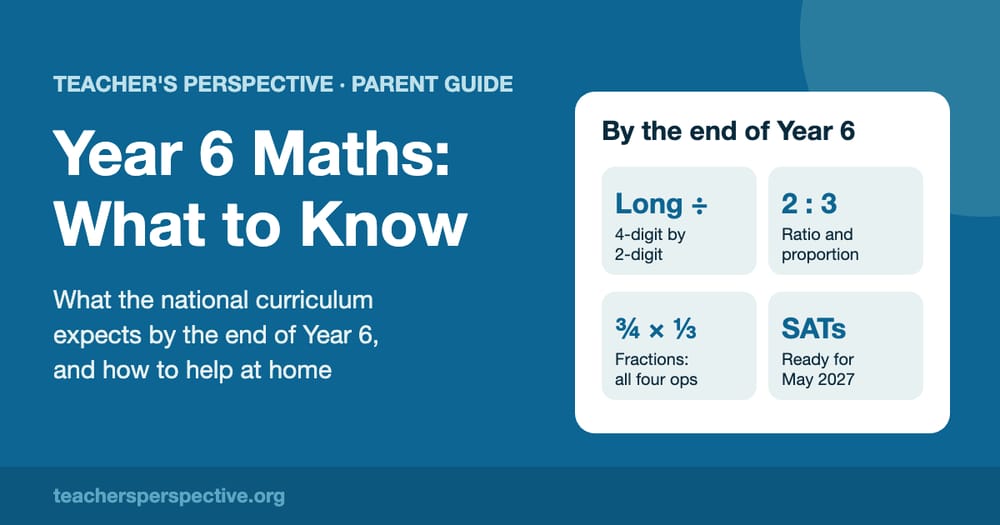
Quick answer: By the end of Year 6, children in England are expected to work with numbers up to 10,000,000, use long multiplication and long division, apply the order of operations, add, subtract, multiply and divide fractions, convert between fractions, decimals and percentages, solve ratio problems and use simple algebra. All of this is tested in the Key Stage 2 SATs in May.
In this guide
The big picture
Children in Year 6 are usually 10 at the start of the year and turn 11 during it. Year 6 maths has two jobs: to finish the primary curriculum, and to make every method fast and reliable enough to use under test conditions.
| Area | The headline expectation by the end of Year 6 |
|---|---|
| Place value | Read, write, order and round numbers up to 10,000,000, and calculate across zero with negative numbers |
| Multiplying | Long multiplication: up to 4 digits × 2 digits |
| Dividing | Long division: up to 4 digits ÷ 2 digits, with remainders shown in different ways |
| Order of operations | Use brackets and the correct order (often called BIDMAS) |
| Fractions | Add and subtract any fractions, multiply simple fractions, and divide a fraction by a whole number |
| Ratio and algebra | Solve ratio and scaling problems, and use simple formulae and missing number problems |
The Year 6 maths SATs
In May of Year 6, every child in England sits the Key Stage 2 tests. In 2027 the maths papers are on Wednesday 12 May (papers 1 and 2) and Thursday 13 May (paper 3). There are three maths papers:
| Paper | What it involves |
|---|---|
| Paper 1: Arithmetic | 30 minutes, 40 marks. Straight calculations with no words, such as long division, fractions and decimals |
| Paper 2: Reasoning | 40 minutes, 35 marks. Word problems, puzzles and questions where children explain their thinking |
| Paper 3: Reasoning | 40 minutes, 35 marks. More of the same |
Raw marks are turned into a scaled score from 80 to 120. A scaled score of 100 or more means your child has met the expected standard. Results are sent to schools in early July.
The arithmetic paper is where children can pick up marks most reliably, because it tests the written methods directly. My guides to the Year 6 SATs arithmetic paper and the reasoning papers go through each one in detail.
Number, place value and calculation
By the end of Year 6 your child should be able to:
- Read, write, order and compare numbers up to 10,000,000 and round any whole number.
- Use negative numbers in context and work out intervals across zero, for example the difference between −4°C and 9°C.
- Multiply numbers up to 4 digits by a 2-digit number using long multiplication.
- Divide numbers up to 4 digits by a 2-digit number using long division, and show remainders as a whole number, a fraction or a decimal, or by rounding, depending on the question.
- Use short division where it's quicker.
- Find common factors, common multiples and prime numbers.
- Use the order of operations, including brackets, to work out calculations like 3 + 4 × 5.
- Do mental calculations with mixed operations and large numbers.
Long division is the big new method
Long division is the method that worries parents most, and it's usually taught in the autumn or spring term of Year 6. It looks frightening, but it's really just short division with the working written out. A child who is fluent with times tables and the bus stop method will pick it up quickly. A child who isn't will find it almost impossible.
See my guides to long division step by step, the chunking method, remainders as fractions and decimals and BIDMAS.
Year 6 is built on the 15 core skills. Long multiplication, long division, fractions and decimals all depend on the 15 core skills every child aged 7 to 11 needs. When one of them is missing, the Year 6 methods fall apart.
My free guide for parents shows all 15 core skills in order, so you can see exactly which ones your child has and which one to work on before the SATs.
Get the free 15 Core Skills guideFractions, decimals and percentages
Fractions are the area I see Year 6 children lose the most marks on. By the end of the year your child should be able to:
- Simplify fractions, and compare and order fractions, including fractions greater than 1.
- Add and subtract fractions with different denominators, and mixed numbers.
- Multiply simple pairs of proper fractions, such as ½ × ¼ = ⅛.
- Divide proper fractions by whole numbers, such as ⅓ ÷ 2 = ⅙.
- Work out fractions of amounts and simple fraction-decimal equivalents, such as ⅜ = 0.375.
- Multiply numbers with up to two decimal places by whole numbers, and divide with answers to two decimal places.
- Convert between fractions, decimals and percentages, and work out percentages of amounts.
My guides to adding fractions, multiplying and dividing fractions, fractions of amounts, multiplying decimals, dividing decimals and working out percentages each take one of these step by step.
Ratio, proportion and algebra
These two topics are brand new in Year 6. They sound like secondary school maths, but at this level they're mostly about spotting patterns and using times tables.
- Ratio and proportion: solving problems like "a recipe for 4 people uses 300 g of flour, how much for 6?", scaling shapes up and down, and sharing amounts in a ratio such as 2:3.
- Algebra: using simple formulae, describing number sequences, finding missing numbers, and finding pairs of numbers that work, such as a + b = 10.
For more, see my guide to ratio and proportion.
Measurement, shape and data
| Area | What Year 6 children should be able to do |
|---|---|
| Measurement | Convert between units, including miles and kilometres, and use decimals up to three places |
| Area and volume | Find the area of triangles and parallelograms, and the volume of cuboids |
| Angles and shape | Find missing angles in triangles, quadrilaterals and other polygons, and name the parts of a circle (radius, diameter, circumference) |
| Coordinates | Plot and read points in all four quadrants, and translate and reflect shapes |
| Data | Read and draw pie charts and line graphs, and calculate the mean (average) |
Signs your child may be behind
Lots of children feel wobbly in Year 6, especially in the run-up to SATs. These signs, if they keep coming up, suggest a deeper gap:
- They still aren't quick with times tables, so every long multiplication or division takes ages.
- They can't do short division reliably, so long division never gets off the ground.
- They don't know how to find equivalent fractions, so adding fractions with different denominators goes wrong.
- They lose track of the decimal point when multiplying or dividing decimals.
- Practice test scores are well below 100 and aren't improving.
The fix is rarely more Year 6 practice papers. It's going back to the skill that's missing, usually from Year 3, 4 or 5, and closing that gap first. My article is my child behind in maths? has a quick four-question check, and my Year 5 guide shows what should already be in place.
How to help at home
- Little and often beats cramming. Ten focused minutes a day does more than an hour on a Sunday.
- Prioritise arithmetic. The arithmetic paper rewards accurate written methods. Practise one or two calculations of each type every day.
- Talk through word problems. For reasoning questions, ask your child what the question wants before they calculate anything.
- Keep it calm. SATs measure the school as much as the child. Anxiety makes children forget methods they know, so keep the pressure low at home.
- Think beyond May. Secondary school maths builds straight on these methods. Securing them now pays off for years.
If you'd like a ready-made plan, my Arithmetic Mastery course teaches every method on the arithmetic paper in short videos your child can pause and rewatch. For more ideas, see my guide to helping your child with maths at home.
Keep going
Frequently asked questions
What should a Year 6 child know in maths?
By the end of Year 6, children should work with numbers up to 10,000,000, use long multiplication and long division, use the order of operations, calculate with fractions, convert between fractions, decimals and percentages, and solve simple ratio and algebra problems.
When are the Year 6 maths SATs in 2027?
The 2027 Key Stage 2 maths tests are on Wednesday 12 May (papers 1 and 2) and Thursday 13 May (paper 3).
What is the expected standard in the Year 6 SATs?
A scaled score of 100 or more. Scores range from 80 to 120, so 100 means your child has met the standard expected at the end of primary school.
Is long division taught in Year 6?
Yes. Long division, dividing up to 4-digit numbers by 2-digit numbers, is taught in Year 6. It builds directly on short division and times tables.
Is algebra taught in Year 6?
Yes, at a simple level. Children use letters to stand for unknown numbers, use simple formulae and solve missing number problems.
Get all 15 core skills in one place
Every Year 6 method depends on the 15 core skills. These are the written methods and facts every child aged 7 to 11 needs to master to succeed in maths.
My free guide for parents shows all 15, in order, so you can spot exactly where your child is and what to practise before the SATs.
Download the free guideSources and further reading
- Department for Education, National curriculum in England: mathematics programmes of study
- Standards and Testing Agency, Key stage 1 and key stage 2 test dates
- Department for Education, New curriculum to give young people the skills for life and work (the revised curriculum starts in September 2028)

