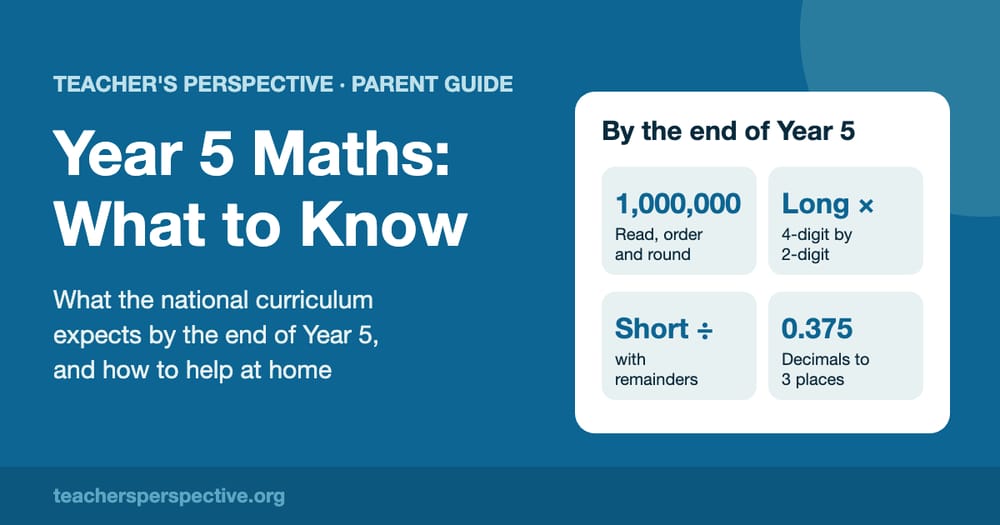

Year 5 is the year primary maths gets big. Numbers stretch up to a million, decimals go to three places, and long multiplication appears for the first time. A lot of parents tell me this is the year homework suddenly stops making sense to them, never mind their child.
The good news is that almost everything in Year 5 is built from a small set of skills your child has already met. If those are secure, Year 5 is very manageable. If they aren't, this is usually the year the gaps start to show.
I'm Ross, a UK-qualified primary teacher with over ten years in the classroom. Below I'll walk you through what the national curriculum expects by the end of Year 5, in plain English, plus the signs your child might need some help and what to do about it.
Quick answer: By the end of Year 5, children in England are expected to read and order numbers up to 1,000,000, add and subtract large numbers with column methods, multiply up to 4-digit numbers by 2-digit numbers using long multiplication, divide by a 1-digit number using short division, and work confidently with fractions, decimals to three places and simple percentages. They should already know all their times tables to 12 × 12 from Year 4.
In this guide
The big picture
Year 5 is the first year of upper Key Stage 2. Children are usually 9 at the start of the year and turn 10 during it. There is no national test in Year 5, but that doesn't make it a quiet year. Year 6 teachers spend most of their year practising and applying what was taught in Year 5, ready for the SATs in May.
So the honest way to think about Year 5 is this: it's where the methods for the Year 6 SATs are actually taught. Here's the headline list.
| Area | The headline expectation by the end of Year 5 |
|---|---|
| Place value | Read, write, order and round numbers up to 1,000,000 |
| Adding and subtracting | Column methods with numbers of more than 4 digits |
| Multiplying | Long multiplication: up to 4 digits × 2 digits |
| Dividing | Short division: up to 4 digits ÷ 1 digit, with remainders |
| Fractions | Equivalent fractions, mixed numbers, adding and subtracting related fractions |
| Decimals and percentages | Decimals to 3 places, and what per cent means |
Number and place value
In Year 4 children worked with numbers up to 10,000. Year 5 pushes that to 1,000,000. By the end of the year your child should be able to:
- Read and write numbers up to 1,000,000 and say the value of each digit.
- Count forwards and backwards in steps of powers of 10 (for example 10, 100, 1,000 or 10,000) from any number.
- Round any number up to 1,000,000 to the nearest 10, 100, 1,000, 10,000 or 100,000.
- Use negative numbers in context, such as temperatures, and count through zero.
- Read Roman numerals up to 1,000 (M), and recognise years written in Roman numerals.
Place value is the hidden skill behind nearly everything else in Year 5. A child who can't confidently say what the 4 means in 347,215 will struggle with rounding, column methods and decimals. If this feels shaky, my guides to place value, rounding numbers, negative numbers and Roman numerals are a good place to start.
Addition and subtraction
By the end of Year 5, children should add and subtract whole numbers with more than 4 digits using the formal written methods (column addition and column subtraction). They should also add and subtract mentally with increasingly large numbers, for example 12,462 − 2,300.
They're expected to use rounding to check whether an answer is sensible, and to solve multi-step word problems where they have to decide which operation to use.
The method itself isn't new. Column addition and subtraction were taught in Year 3 and Year 4. What's new is the size of the numbers and the number of exchanges. If your child still gets muddled when subtracting across a zero, read my guide to column subtraction with zeros and my main guide to column addition and subtraction.
Multiplication and division
This is the biggest jump in Year 5. By the end of the year your child should be able to:
- Identify multiples and factors, including finding all the factor pairs of a number.
- Know what prime numbers are and recall the primes up to 19, and work out whether a number up to 100 is prime.
- Recognise square numbers and cube numbers, and use the notation ² and ³.
- Multiply numbers up to 4 digits by a 1-digit or 2-digit number using a formal written method, including long multiplication for 2-digit numbers.
- Divide numbers up to 4 digits by a 1-digit number using short division, and interpret remainders in context.
- Multiply and divide whole numbers and decimals by 10, 100 and 1,000.
Long multiplication arrives
Long multiplication is new in Year 5, and it's where I see the most tears at the kitchen table. The method itself is just two rows of short multiplication added together. So if long multiplication is going wrong, the real problem is almost always one step back: shaky times tables, or short multiplication that isn't secure yet.
Start with my short multiplication guide, then move on to long multiplication step by step. For division, my bus stop method guide covers short division from the very first step.
Year 5 is built on the 15 core skills. Place value, the column methods, times tables, short multiplication and short division are all part of the 15 core skills every child aged 7 to 11 needs.
My free guide for parents shows all 15 core skills in order, so you can see exactly which ones your child has and which one to work on next.
Get the free 15 Core Skills guideFractions, decimals and percentages
Year 5 is a heavy year for fractions, and it's also the year percentages appear. By the end of the year your child should be able to:
- Compare and order fractions where the denominators are multiples of the same number (for example halves, quarters and eighths).
- Find equivalent fractions, including tenths and hundredths.
- Convert between mixed numbers and improper fractions, such as 2⅓ and 7/3.
- Add and subtract fractions with the same denominator, and with denominators that are multiples of the same number.
- Multiply proper fractions and mixed numbers by whole numbers.
- Read, write, order and compare decimals with up to three decimal places, and round decimals to the nearest whole number and to one decimal place.
- Understand that per cent means "out of 100", and know that 50% = ½ = 0.5, 25% = ¼ = 0.25 and 20% = ⅕ = 0.2.
Fractions only make sense to a child who is fluent with times tables, because finding equivalent fractions is really just multiplying and dividing. If fractions are a struggle, my guides to equivalent fractions, mixed numbers and improper fractions, adding fractions and adding and subtracting decimals break each one down.
Measurement, shape and data
These areas get less attention at home, but they still matter. In short, by the end of Year 5:
| Area | What Year 5 children should be able to do |
|---|---|
| Measurement | Convert between metric units (such as km and m, kg and g, litres and ml), and know rough imperial equivalents like inches and pints |
| Perimeter and area | Find the perimeter of shapes made of rectangles, and the area of rectangles in cm² and m² |
| Volume | Estimate volume and capacity, for example using 1 cm³ cubes |
| Angles | Name acute, obtuse and reflex angles, measure them with a protractor, and know angles on a straight line add to 180° and around a point to 360° |
| Shape | Identify 3D shapes from 2D drawings, and reflect and translate shapes on a grid |
| Data | Read and solve problems using line graphs and tables, including timetables |
Signs your child may be behind
Every child develops at their own pace, and one bad week of homework doesn't mean anything. But these signs, if they keep happening, are worth paying attention to in Year 5:
- They still count on their fingers for times tables facts, or can't recall facts like 7 × 8 quickly.
- They avoid or freeze at column subtraction when there are zeros in the number.
- They can't explain what each digit is worth in a large number or a decimal.
- Long multiplication or short division answers are wildly wrong and they don't notice.
- They say "I'm rubbish at maths" or get upset before even starting homework.
Almost always, the problem isn't Year 5 content at all. It's a gap from Year 3 or Year 4 that never got closed, usually times tables, place value or a written method. Find that gap and Year 5 suddenly gets much easier. My article is my child behind in maths? has a quick four-question check you can do at home tonight.
How to help at home
- Keep times tables ticking over. Five minutes a day of mixed facts keeps them sharp. They are the engine for long multiplication, short division and fractions.
- Ask "how do you know?" When your child gets an answer, ask them to explain it. Explaining builds understanding far faster than doing more questions.
- Use real numbers. House prices, football attendances and populations are great for practising reading and rounding big numbers. Shop receipts are perfect for decimals.
- Check the method, not just the answer. If an answer is wrong, look for where the method broke down. It's usually the same step every time.
- Go back a step when stuck. If long multiplication isn't working, practise short multiplication. If short division isn't working, practise times tables and the division facts that go with them.
If you'd rather follow a set plan, my Arithmetic Mastery course teaches all 15 core methods on short videos your child can pause and rewatch. For more ideas, see my guide to helping your child with maths at home.
Keep going
Frequently asked questions
What should a Year 5 child know in maths?
By the end of Year 5, children should read and order numbers up to 1,000,000, use column addition and subtraction with large numbers, multiply using long multiplication, divide using short division, and work with fractions, decimals to three places and simple percentages.
What times tables should a Year 5 child know?
All of them up to 12 × 12. The national curriculum expects times tables to be secure by the end of Year 4, so in Year 5 children are expected to use them quickly to multiply, divide and work with fractions.
How old is a child in Year 5?
Children in Year 5 in England are usually 9 at the start of the school year and turn 10 during it.
Is there a test in Year 5?
There is no national test in Year 5. Many schools set their own assessments, often at the end of each term, to check progress before Year 6 and the SATs.
Do Year 5 children learn long multiplication?
Yes. Long multiplication of up to 4-digit numbers by 2-digit numbers is introduced in Year 5. Long division follows in Year 6.
Get all 15 core skills in one place
Year 5 is where the 15 core skills are put to work on bigger numbers. These are the written methods and facts every child aged 7 to 11 needs to master to succeed in maths.
My free guide for parents shows all 15, in order, so you can spot exactly where your child is and what to practise next.
Download the free guideSources and further reading
- Department for Education, National curriculum in England: mathematics programmes of study
- Department for Education, New curriculum to give young people the skills for life and work (the revised curriculum starts in September 2028)

