
Year 4 is a big year in primary maths. Numbers get bigger, the written methods get more formal, and in June every child sits the times tables check. Yet most parents only find out what their child was supposed to learn when a report or a parents' evening says they're "working towards".
The good news is that the expectations aren't a secret. They're set out in the national curriculum for England, and once you know what they are, it's much easier to spot where your child is secure and where they need help.
I'm Ross, a UK-qualified primary teacher with over ten years in the classroom. In this guide I'll go through what a Year 4 child is expected to know in maths, area by area, in plain English. I'll also flag the skills that matter most, the signs your child might be falling behind, and simple things you can do at home.
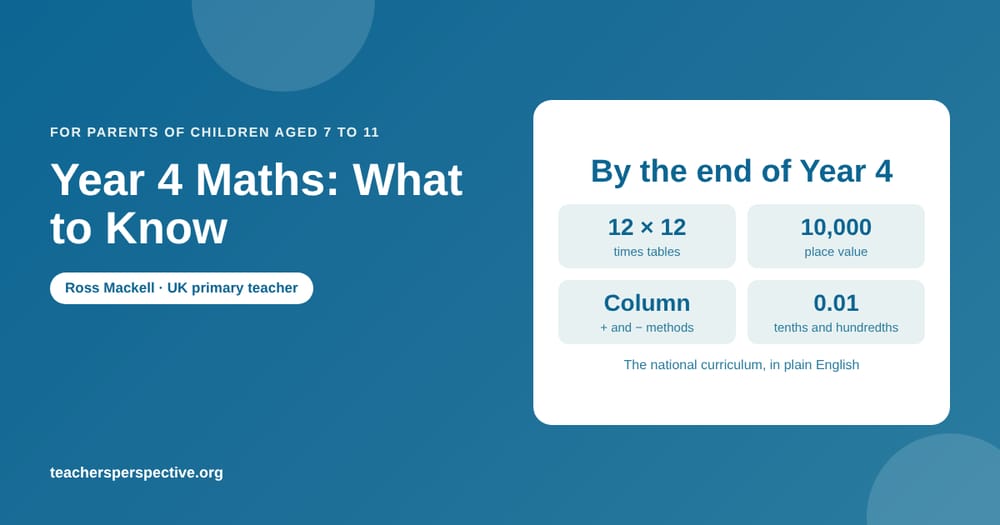
Quick answer: By the end of Year 4, children in England are expected to know their times tables up to 12 × 12, work with numbers up to 10,000, add and subtract 4-digit numbers using column methods, multiply 2-digit and 3-digit numbers by a 1-digit number, and understand tenths, hundredths and equivalent fractions. They also learn perimeter, area, time, angles, coordinates and bar charts.
In this guide
The big picture
Year 4 is the last year of lower Key Stage 2. The national curriculum says that by the end of Year 4, children should have memorised their multiplication tables up to and including 12 × 12, and should be able to use written methods accurately with increasingly large whole numbers.
That's why Year 4 matters so much. Everything in Years 5 and 6, including long multiplication, long division, fractions of amounts and the SATs arithmetic paper, assumes these skills are already secure. A child who leaves Year 4 without them doesn't just stay a little behind. The gap tends to grow.
| Area | The headline expectation by the end of Year 4 |
|---|---|
| Place value | Read, write, order and round numbers up to 10,000 |
| Addition and subtraction | Column addition and subtraction with up to 4 digits |
| Times tables | Recall all facts up to 12 × 12 |
| Multiplication | Multiply 2-digit and 3-digit numbers by a 1-digit number using the formal written method |
| Fractions and decimals | Equivalent fractions, tenths and hundredths, adding fractions with the same denominator |
| Measures and shape | Perimeter, area by counting squares, 12 and 24-hour time, angles, coordinates |
Number and place value
In Year 3 children worked with numbers up to 1,000. In Year 4 they move up to 4-digit numbers. Your child should be able to:
- Say the value of each digit in a 4-digit number. In 3,472 the 3 is worth 3,000, the 4 is worth 400, the 7 is worth 70 and the 2 is worth 2.
- Find 1,000 more or less than a number.
- Order and compare numbers beyond 1,000.
- Round any number to the nearest 10, 100 or 1,000.
- Count in multiples of 6, 7, 9, 25 and 1,000.
- Count backwards through zero into negative numbers.
- Read Roman numerals up to 100.
Place value is the foundation for every written method, so it's worth getting right. Here's a short lesson from my Arithmetic Mastery course on 4-digit numbers that you can watch with your child.
▶ Video lesson: what are 4-digit numbers? (3 minutes). Watch on YouTube
For more, see my guides to place value and rounding numbers.
Addition and subtraction
By the end of Year 4, children should add and subtract numbers with up to 4 digits using the formal written methods of column addition and column subtraction, including exchanging (what you might remember as carrying and borrowing).
They should also estimate first and use the inverse to check. For example, after working out 4,215 − 1,738 = 2,477, they can check by adding 2,477 + 1,738 to get back to 4,215. They'll also solve two-step word problems and decide which operation to use.
Column subtraction across zeros, like 4,003 − 1,267, is where most Year 4 children come unstuck. My guide to column addition and subtraction shows how to fix it, and inverse operations explains the checking habit.
Multiplication, division and times tables
This is the headline skill of Year 4. Children are expected to:
- Recall multiplication and division facts for all times tables up to 12 × 12.
- Use known facts to multiply and divide mentally, including multiplying by 0 and 1, dividing by 1, and multiplying three numbers together.
- Recognise factor pairs, and know that 6 × 7 is the same as 7 × 6.
- Multiply 2-digit and 3-digit numbers by a 1-digit number using the formal written layout, for example 346 × 7.
- Solve problems involving multiplying and adding, scaling and simple correspondence problems.
The Year 4 times tables check
In June of Year 4, every child in England takes the multiplication tables check (MTC). It's an online check of 25 questions, with 6 seconds to answer each one, covering the tables from 2 to 12. There's no pass mark, but it shows clearly whether your child's recall is automatic. My guide to the Year 4 times tables check explains how it works.
Learning tables up to 12 × 12 sounds like a lot, but once your child knows their 1s, 2s, 5s and 10s and understands that the order doesn't matter, there are only 36 facts left. I show you which ones in this video:
▶ Video: how to learn times tables fast, with only 36 facts to learn (9 minutes). Watch on YouTube
Formal division with remainders (the bus stop method) is mostly taught in Year 5, but many schools introduce it in Year 4. See short multiplication, the grid method and the bus stop method for step-by-step help. If your child is still unsure what multiplying actually means, start with multiplication as repeated addition.
Most of Year 4 is built on the 15 core skills. Place value, column methods, times tables and short multiplication are all part of the 15 core skills every child aged 7 to 11 needs.
My free guide for parents shows all 15 core skills in order, so you can see exactly which one is holding your child back.
Get the free 15 Core Skills guide →Fractions and decimals
Year 4 is the year decimals properly arrive. Children are expected to:
- Recognise and show families of equivalent fractions, such as 1/2 = 2/4 = 4/8.
- Count up and down in hundredths, and understand that hundredths come from dividing something into 100 equal parts.
- Add and subtract fractions with the same denominator, such as 3/8 + 2/8 = 5/8.
- Find non-unit fractions of amounts where the answer is a whole number, such as 3/4 of 20 = 15. See fractions of amounts.
- Write any number of tenths or hundredths as a decimal, and know that 1/4 = 0.25, 1/2 = 0.5 and 3/4 = 0.75.
- Divide 1-digit and 2-digit numbers by 10 and 100, and name the value of each digit as ones, tenths and hundredths. See multiplying and dividing by 10, 100 and 1000.
- Round decimals with one decimal place to the nearest whole number, and compare decimals up to two decimal places.
- Solve simple money and measure problems with decimals up to two decimal places.
Measurement, shape and statistics
These areas get less attention at home, but they appear in tests and in everyday life.
| Area | What Year 4 children learn |
|---|---|
| Measurement | Convert between units (such as km to m), find the perimeter of rectangles and rectilinear shapes, find area by counting squares, and work with money in £ and p |
| Time | Read, write and convert between analogue and digital 12 and 24-hour clocks, and convert hours to minutes, minutes to seconds, years to months and weeks to days |
| Shape | Classify triangles and quadrilaterals, identify acute and obtuse angles, and find lines of symmetry |
| Position and direction | Plot coordinates in the first quadrant, and describe translations such as "2 left, 3 up" |
| Statistics | Read and draw bar charts and time graphs, and answer questions using tables and pictograms |
Signs your child may be behind
Every child develops at a different pace, and a wobble in one topic isn't a crisis. But these signs, especially in the spring or summer term of Year 4, are worth acting on:
- They still count on their fingers for most times tables facts.
- They can't tell you the value of each digit in a number like 6,085.
- Column subtraction falls apart whenever there's an exchange, especially across a zero.
- They don't know which operation to use in a word problem.
- They avoid maths homework or say "I'm just not a maths person".
Almost always, the problem isn't the topic they're stuck on. It's an earlier skill that was never fully secure. A child struggling with short multiplication usually has a times tables gap or a place value gap underneath it. My guide to the real reason your child is struggling in maths explains this in more detail.
How to help at home
- Make times tables a daily habit. Five minutes a day beats an hour at the weekend. Focus on the 36 facts, not all 144.
- Talk about place value. Read prices, house numbers and distances out loud and ask what each digit is worth.
- Ask them to teach you. If your child can explain the column method to you, they understand it. If they can't, you've found the gap.
- Use real time and money. Bus timetables, cooking times and shopping totals are all Year 4 maths.
- Fix the foundations first. If a topic keeps going wrong, step back to the skill underneath it rather than doing more of the same.
For more ideas, see my guide on how to help your child with maths at home.
Keep going
Frequently asked questions
What should a Year 4 child know in maths?
By the end of Year 4, children should know their times tables up to 12 × 12, work with numbers up to 10,000, use column addition and subtraction with up to 4 digits, multiply 2-digit and 3-digit numbers by a 1-digit number, and understand tenths, hundredths and equivalent fractions.
What times tables should a Year 4 child know?
All of them up to 12 × 12, including the related division facts. This is checked in the multiplication tables check in June of Year 4.
How old is a child in Year 4?
Children in Year 4 in England are 8 at the start of the school year and turn 9 during it.
Do Year 4 children learn long division?
No. Long division is taught in Year 6. Short division (the bus stop method) is mainly a Year 5 skill, although many schools introduce it in Year 4.
Is the Year 4 times tables check a test my child can fail?
There is no pass mark. Your child's school receives their score out of 25 and will usually share it with you, but it's a check to show who needs more support rather than a pass or fail test.
Get all 15 core skills in one place
Year 4 is where the 15 core skills either click or start to slip. These are the written methods and facts every child aged 7 to 11 needs to master to succeed in maths.
My free guide for parents shows all 15, in order, so you can see exactly where your child is and what comes next.
Get the free 15 Core Skills guide →Sources and further reading

