
Your child sits down with their maths homework. You lean over to help, show them the way you were taught, and they burst into tears: "That's not how we do it at school!" Ten minutes of homework turns into forty minutes of stress, and you both walk away feeling worse.
If that sounds familiar, you're not doing anything wrong. The written methods taught in UK primary schools have changed since most of us were at school, and nobody hands parents the instructions.
I'm Ross, a UK-qualified primary teacher with over ten years in the classroom. In this guide I'll show you how to help your child with maths at home, even if you aren't confident with maths yourself: how to find the real gap, the 15 methods that matter most, the three step routine I use with every child, what to say when they get stuck, the mistakes parents make with the best intentions, and a simple weekly plan.
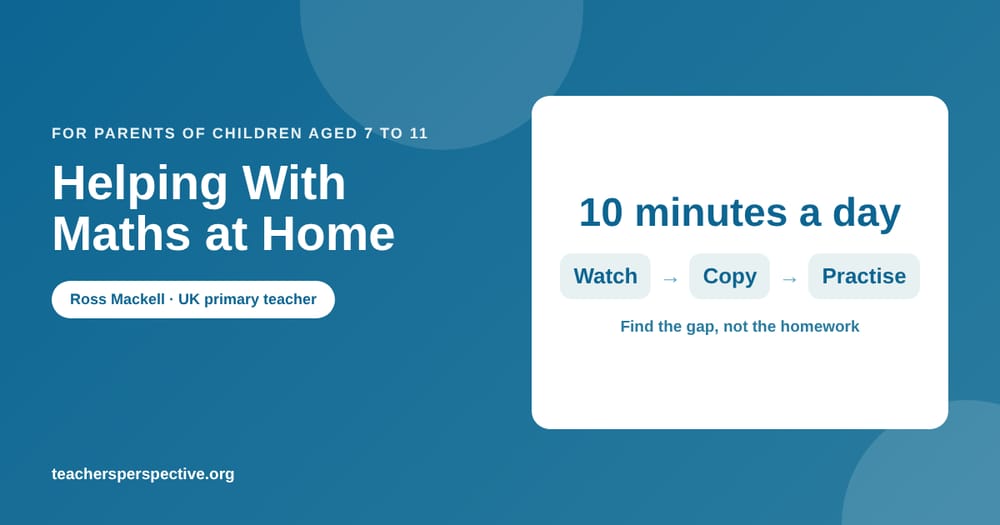
Quick answer: To help your child with maths at home, stop focusing on this week's homework and find the first written method they can't do confidently. Teach that method using the school way, in short sessions of about ten minutes a day, using three steps: watch a clear example, copy it step by step, then practise a few on their own. Keep it calm, praise effort, and move to the next method only when the current one is secure.
In this guide
- Why helping with maths homework feels so hard
- Step 1: Find the gap, not the homework
- Step 2: Learn the methods in the right order
- Step 3: Watch, copy, practise
- Step 4: Ten minutes a day, same time
- Step 5: What to say when they get stuck
- 5 mistakes parents make (and what to do instead)
- A simple weekly plan
- Frequently asked questions
Why helping with maths homework feels so hard
There are three reasons most parents find this difficult, and none of them is "you're bad at maths".
The methods have changed. Your child might be using partitioning, the grid method or chunking, which most parents never learned. Showing them your way can feel like you're telling them their teacher is wrong. I explain the reasons in why maths is taught differently now.
The homework isn't where the problem is. Homework is set on what the class is learning this week. If your child is stuck, the real gap is often a method from a year or two earlier. You can help with the homework all evening and still not touch the thing that's holding them back.
Emotions run high. Children try harder to look clever in front of their parents than in front of a teacher. When they get something wrong at home, it feels bigger. That's why calm matters more than explanation.
Step 1: Find the gap, not the homework
This is the most important step and the one almost everyone skips. Instead of asking "can they do this homework?", ask "what's the first method they can't do confidently?"
Try this. Give your child a few calculations from earlier years and watch how they work them out:
| Try this | What it checks | Warning sign |
|---|---|---|
| 46 + 10 and 346 + 100 | Place value | Counting on in ones |
| 7 + 8 | Number bonds | Counting on fingers |
| 352 + 476 | Column addition | Lining numbers up from the left |
| 503 − 168 | Column subtraction | Taking the smaller digit from the bigger one |
| 6 × 7 | Times tables | Counting up in sixes |
| 34 × 6 | Short multiplication | Drawing groups or dots |
| 96 ÷ 4 | Short division | Repeated subtraction or guessing |
The first one that wobbles is where you start. It might feel too easy for their year group. That's fine. A secure foundation moves them forward much faster than practising work that sits on top of a gap.
Step 2: Learn the methods in the right order
There are only 15 core written methods your child needs for primary school, and they build on each other. Division relies on times tables. Times tables rely on counting in steps and place value. Column subtraction relies on understanding that 503 is 5 hundreds, 0 tens and 3 ones.
These are the 15, in the order I teach them:
Adding and subtracting
- Add and subtract 10
- Add and subtract 100
- Add and subtract numbers over 100
- Add and subtract 1000
- Add and subtract 3-digit numbers
- Add and subtract 4-digit numbers
- Add and subtract decimals
- Add and subtract fractions
Multiplying
- Times tables
- Multiply 2-digit by 1-digit
- Multiply 3-digit by 1-digit
- Multiply 3 numbers together
Dividing and fractions
- Divide 2-digit by 1-digit
- Multiply and divide by 10, 100 and 1000
- Find fractions of an amount
If your child is stuck on number 13, the answer is rarely more division practice. Go back and check 9 to 11 first.
You don't have to learn all of this yourself.
That's exactly why I made Arithmetic Mastery 2.0. I teach all 15 methods on video, the same way they're taught in UK schools, in 91 short lessons of about four and a half minutes. Your child watches me, copies me, then practises. A starting assessment shows you exactly where to begin, so you're not guessing. You don't need to be good at maths. You just sit nearby and keep things calm.
See inside Arithmetic Mastery 2.0 for £49 →Step 3: Watch, copy, practise
Remember learning your spellings at school? Look, cover, write, check. It wasn't exciting, but it worked. Maths methods are learned in the same way. This is the three step routine I use with every child:
- Watch. Your child watches one clear example worked through slowly, start to finish, with every step said out loud. One method only.
- Copy. Straight away, they do the same question alongside the example, step for step. This is the step most people skip, and it's why children fall apart when they try on their own.
- Practise. They do three to five similar questions by themselves. Same method, no surprises, no tricky twists yet.
Only when they can do it without thinking do you add harder questions or word problems.
Step 4: Ten minutes a day, same time
Short and regular beats long and occasional, every time. Ten minutes a day, five days a week, is far more powerful than an hour on Sunday afternoon.
- Pick a time and stick to it. After a snack, before screens, works for lots of families.
- Stop while it's still going well. Ending on a success means they'll be happier to start tomorrow.
- One method per session. Don't try to fix everything at once.
- Keep a simple tick chart. Children love seeing a row of ticks build up across the week.
Step 5: What to say when they get stuck
What you say in the moment matters more than how much maths you know. These phrases keep things calm and keep your child thinking:
| Instead of | Try |
|---|---|
| "That's wrong." | "Talk me through what you did." |
| "It's easy, look." | "This one's tricky. Let's do the first step together." |
| "We did this yesterday!" | "Let's watch it once more, then you try." |
| "Just think about it." | "What's the first thing we write down?" |
| "Well done, you're so clever." | "Well done, you kept going even when it was hard." |
| "I was rubbish at maths too." | "I'm learning this method with you." |
That last one matters. Children pick up on our feelings about maths very quickly. Saying "I'm learning too" is honest and helpful. Saying "I was never any good at it" gives them permission to give up.
5 mistakes parents make (and what to do instead)
Mistake 1: Teaching your own method
You show them the way you learned it, and now they have two methods fighting in their head.
Instead: learn the school method together. Ask your child's teacher which written methods the school uses, or watch a lesson that teaches it the school way.
Mistake 2: Only helping with homework
Homework gets done, but the gap underneath never closes.
Instead: spend ten minutes a day on the first method your child can't yet do, separately from homework.
Mistake 3: Moving on too quickly
They got three right on Monday, so you move on. By Thursday it's gone.
Instead: a method is secure when they can do it on a different day, without help, without hesitating. Check again a week later.
Mistake 4: Doing it for them
It's late, everyone's tired, and you end up writing the answers yourself.
Instead: if you're both tired, stop. Five calm minutes is worth more than thirty stressful ones.
Mistake 5: Relying on apps
Apps are great for practising facts, but most of them test rather than teach. If a method was never taught properly, being tested on it a hundred times won't give it to them.
Instead: teach the method first, then use apps for practice. For times tables in particular, see how to learn times tables fast.
A simple weekly plan
| Day | 10 minute session |
|---|---|
| Monday | Watch and copy a new method |
| Tuesday | Watch again quickly, then practise 3 to 5 questions |
| Wednesday | Practise 5 questions without the example |
| Thursday | Mixed practice: 3 of this week's method, 2 from last week |
| Friday | Mini check: 5 questions, no help. All right? Move on next week |
| Weekend | Rest, or a maths game such as times tables in the car |
Follow this for 15 weeks, one method a week, and your child will have covered every core written method in primary school. Some will take a few days, others a couple of weeks. That's normal.
Keep going
Frequently asked questions
How can I help my child with maths if I'm not good at maths?
You don't need to be good at maths to help. Your job is to keep sessions short, calm and regular. Let a clear video or worksheet teach the school method, sit with your child while they watch, copy and practise, and praise their effort rather than speed.
How long should my child practise maths at home each day?
About ten minutes a day, five days a week, is enough for most primary children. Short, regular practice works better than long sessions, especially for children who are anxious about maths.
Why does my child's school teach maths differently?
UK schools now teach methods like partitioning, the grid method and chunking first, because they show why a calculation works. Children then move on to the faster column methods. Learning the school method avoids confusing your child with two different ways.
My child is in Year 5 or 6 and behind in maths. Is it too late?
No. Older children often move through the earlier methods quickly once they're taught properly, and the confidence carries them into the methods they missed. Start with a quick check to find the first method that isn't secure.
What's the best way to help my child catch up in maths at home?
Find the first written method your child can't do confidently, teach it in the school way, and practise it for ten minutes a day before moving on. Arithmetic Mastery 2.0 does this for all 15 core methods, with a starting assessment, 91 video lessons and a 30 day money back guarantee.
Let me be the teacher, so you don't have to
You don't need to relearn primary maths to help your child. You need the 15 methods taught clearly, in the right order, with a routine you can actually keep going.
Arithmetic Mastery 2.0 is exactly that. I teach every method on video, your child watches, copies and practises, and you sit nearby and watch it happen. Ten minutes a day is enough.
£49. One payment. Lifetime access. Improvement in 30 days or your money back.
Get Arithmetic Mastery 2.0 for £49 →Sources and further reading
- Department for Education, National curriculum in England: mathematics programmes of study
- Department for Education, Mathematics guidance: key stages 1 and 2
- Ross Mackell, Teacher's Perspective on YouTube

