
You've just been quoted £40 an hour for a maths tutor. Once a week, every week, for "as long as it takes". You do the sum in your head and wince. Is that normal? And more importantly, is it going to work?
I'm Ross, a UK-qualified primary teacher with over ten years in the classroom. I've also tutored children one to one, so I've seen tutoring from both sides: when it changes everything, and when parents spend hundreds of pounds and their child is still stuck on the same thing in July.
In this guide I'll give you honest UK prices for a primary maths tutor, what that adds up to over a term and a year, when a tutor is worth every penny, when it isn't the best first step, the questions to ask before you hire anyone, and the cheaper alternatives that actually work.
Quick answer: A primary maths tutor in the UK typically costs around £25 to £40 an hour online and £30 to £50 an hour in person, with qualified teachers and London tutors often charging £50 or more. One session a week works out at roughly £400 to £600 a term and over £1,000 across a school year. A tutor is worth it when they find and fix the specific methods your child is missing. If they only help with this week's homework, you can pay for months without the gap closing.
In this guide
How much does a maths tutor cost in the UK?
Prices vary a lot depending on where you live, whether lessons are online or in person, and who the tutor is. These are typical ranges for primary maths (ages 7 to 11):
| Type of tutor | Typical price per hour |
|---|---|
| Student or graduate tutor, online | £20 to £30 |
| Experienced tutor, online | £25 to £40 |
| Experienced tutor, in person | £30 to £50 |
| Qualified teacher | £40 to £60 |
| London or tutoring agency | £50 to £80+ |
A few things push the price up: travel time for home visits, 11+ or SATs specialists, and agencies that take a cut. A few things bring it down: online lessons, shorter 30 or 45 minute sessions, and small group tutoring.
What it adds up to over a term and a year
The hourly price is what parents focus on, but the number that matters is the total. Most tutors recommend one session a week, and most parents keep going for at least a term.
| Hourly rate | 1 term (12 weeks) | School year (38 weeks) |
|---|---|---|
| £25 | £300 | £950 |
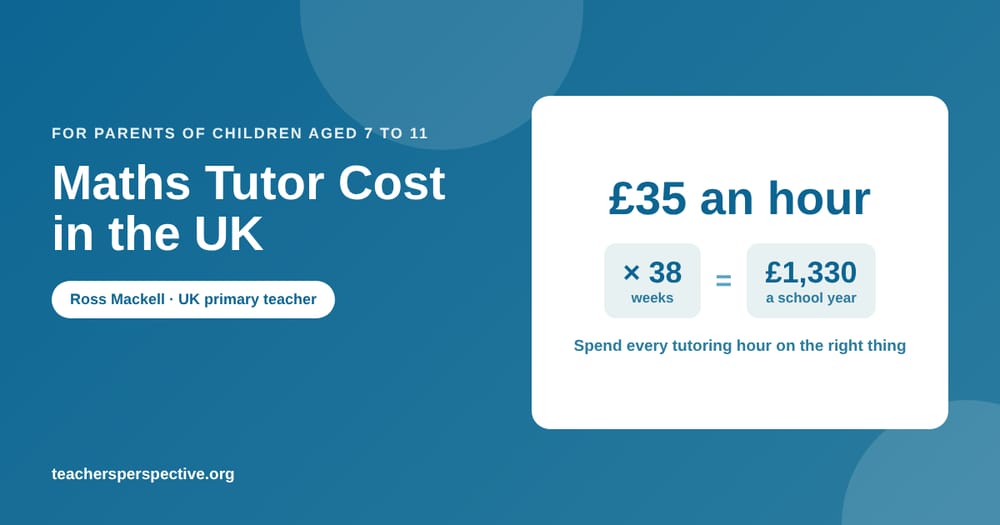
| £35 | £420 | £1,330 |
| £45 | £540 | £1,710 |
| £60 | £720 | £2,280 |
That isn't a reason not to get a tutor. It's a reason to make sure every one of those hours is spent on the right thing.
What you're really paying for
When tutoring works, parents usually think it's because of the one to one attention. That helps, but in my experience it isn't the main thing. A good tutor gives your child three things:
- A diagnosis. They find out exactly which method your child is missing, which is often years further back than the homework suggests.
- The right order. They teach the missing methods in sequence, so each one builds on the last.
- Routine. Same time, every week, with someone checking. Children practise because someone is expecting them to.
Notice that none of those three needs to cost £40 an hour. They need to happen, consistently, in the right order.
When a maths tutor is worth it
A tutor is a great choice when:
- Your child needs a person in the room to stay on task. Some children won't engage with anything on a screen. A calm adult beside them makes all the difference.
- There's a specific deadline such as the 11+, and you want someone who knows that exam inside out.
- You've already tried structured practice at home and it hasn't been possible to keep it going.
- The tutor starts with an assessment and can tell you, in plain words, which methods your child is missing and the plan to fix them.
When a tutor isn't the best first step
Here's the pattern I see most often. A parent hires a tutor because homework has become a battle. Each week the child brings that week's homework to the session. The tutor helps them get it done. Everyone feels better. And six months later the child is still stuck.
That happens because primary maths is really two things. There's reasoning: word problems, "explain your answer", multi-step questions. And there's arithmetic: the written methods themselves. Reasoning is built on top of arithmetic. If your child can't do column subtraction or doesn't really understand place value, helping with this week's word problems won't fix it. The gap is underneath.
There are only 15 core written methods a child aged 7 to 11 needs. If the gap is one of those, you don't need weekly expensive sessions to find it. You need the methods taught clearly, in order, with practice, and that can happen at your kitchen table.
Before you commit £1,000+ to a year of tutoring, try this first.
Arithmetic Mastery 2.0 is my complete video course for children aged 7 to 11. I teach all 15 written methods myself, in the exact order they need to be learned, in 91 short lessons of about four and a half minutes. There's a starting assessment to show you where the gaps are, and a mini test after every module. It costs £49, once, which is about the price of a single hour with a tutor, and it comes with a 30 day money back guarantee.
See what's inside Arithmetic Mastery 2.0 for £49 →6 questions to ask before you hire a tutor
If you do go for a tutor, these questions will tell you quickly whether they'll fix the gap or just help with homework:
- "How will you find out what my child is missing?" You want to hear the word assessment. A good answer is specific: "I'll check their place value, number facts and each written method."
- "What will you work on in the first four weeks?" Look for a plan, not "whatever homework they bring".
- "Do you teach the same written methods as school?" Methods have changed since we were at school. Mixing methods confuses children. See why maths is taught differently now.
- "How will I know it's working?" Ask how progress is measured, and how often you'll get feedback.
- "What should we do between sessions?" One hour a week isn't enough on its own. Ten minutes a day in between is what makes it stick.
- "When will we know we can stop?" A good tutor is working towards not being needed.
Tutor vs apps vs worksheets vs a structured course
| Option | Typical cost | Teaches the method? | Finds the gap? | Works in the right order? |
|---|---|---|---|---|
| Private tutor | £300 to £700 a term | Yes | Usually | Depends on the tutor |
| Maths apps | Free to £10 a month | Rarely, mostly tests | Sometimes | Not usually |
| Worksheets and workbooks | £5 to £20 | No, practice only | No | Sometimes |
| YouTube videos | Free | Yes, one at a time | No | You have to work it out |
| Arithmetic Mastery 2.0 | £49 once | Yes, every method on video | Yes, starting assessment | Yes, all 15 in order |
Apps and worksheets have their place, but most of them test your child over and over. Testing isn't teaching. If a method was never taught properly, being tested on it a hundred more times won't give it to them.
What I'd do as a parent
If my own child was struggling in maths, this is the order I'd go in:
- Find the gap. Work out which written method is the first one that wobbles. It's usually further back than you think.
- Teach the methods in order using a structured course, ten minutes a day, for 30 days. Watch, copy, practise.
- Then decide about a tutor. If your child needs more, you'll now know exactly what to ask the tutor to focus on, and you won't be paying £40 an hour for them to discover it.
Keep going
Frequently asked questions
How much does a maths tutor cost per hour in the UK?
A primary maths tutor in the UK typically costs £25 to £40 an hour online and £30 to £50 an hour in person. Qualified teachers, specialists and tutors in London often charge £50 to £80 an hour.
Is a maths tutor worth it for a primary school child?
It can be, if the tutor assesses your child first and teaches the specific written methods they're missing, in order. If sessions are mostly spent helping with that week's homework, the underlying gap often stays open.
How many tutoring sessions does a child need?
Most tutors suggest one session a week for at least a term. Progress depends far more on what happens between sessions. Ten minutes of practice a day makes a bigger difference than adding a second hour a week.
Are online maths tutors cheaper?
Yes. Online tutors are usually £5 to £15 an hour cheaper than in person because there's no travel time. For most primary children, online tutoring works well, as long as the child will stay focused on a screen.
What is a cheaper alternative to a maths tutor?
A structured video course that teaches every written method in order is the closest alternative. Arithmetic Mastery 2.0 covers all 15 core methods for ages 7 to 11 in 91 short lessons for a one off £49, with a 30 day money back guarantee.
Close the gap for the price of one tutoring session
Your child isn't bad at maths. They're missing a small, specific set of methods. There are only 15, and every one of them can be taught.
Arithmetic Mastery 2.0 teaches all 15, step by step, in the right order, in about ten minutes a day. You don't need to teach any of it. I'm the teacher. Your job is to sit nearby and keep things calm.
£49. One payment. Lifetime access. Improvement in 30 days or your money back.
Get Arithmetic Mastery 2.0 for £49 →Sources and further reading
- The Tutor Link, Primary school maths tutor prices
- Tutorful, How much does a maths tutor cost?
- Department for Education, National curriculum in England: mathematics programmes of study
- Ross Mackell, Teacher's Perspective on YouTube

