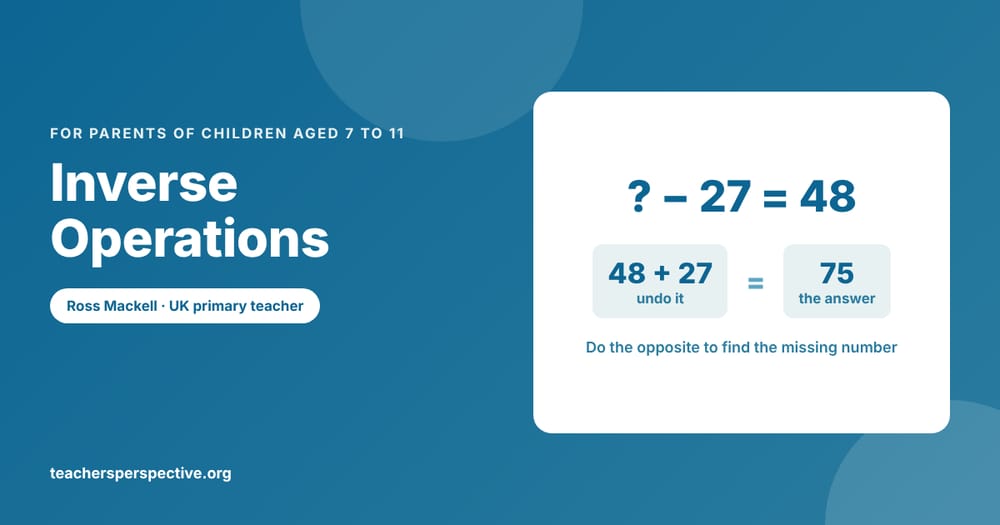

Give your child this: ? − 27 = 48. A lot of children look at the minus sign and do 48 − 27 = 21. But 21 − 27 isn't 48. The answer is 75, and the tool that gets them there is called an inverse operation.
Inverse operations sound technical, but the idea is simple: some operations undo each other. Once your child understands that, they can check their own answers, solve missing number problems and work backwards through two-step puzzles, all of which turn up from Year 1 right through to the Year 6 SATs.
I'm Ross, a UK-qualified primary teacher with over ten years in the classroom. In this guide I'll explain what inverse operations are, how fact families work, how to use the inverse to check answers, how to solve missing number problems, how they come up in SATs, the mistakes I see most often, and practice questions with answers.
Quick answer: Inverse operations are opposites that undo each other. Addition and subtraction are inverses, and multiplication and division are inverses. If 75 − 27 = 48, then 48 + 27 = 75. Children use inverse operations to check answers (after 352 − 168 = 184, check 184 + 168 = 352) and to find missing numbers (? × 7 = 56, so 56 ÷ 7 = 8).
In this guide
What your child needs first
Inverse operations aren't a new method. They are a way of using the facts and methods your child already has. These need to be in place:
- Number bonds. Knowing 7 + 3 = 10 means also knowing 10 − 3 = 7. See number bonds to 10, 20 and 100.
- Times tables. Every times table fact gives you two division facts for free. If facts are slow, start with how to learn times tables fast.
- Written methods. To check bigger calculations your child needs column addition and subtraction.
In the national curriculum, children meet missing number problems such as 7 = ? − 9 in Year 1. In Year 2 they learn that addition and subtraction are inverses and use this to check calculations and solve missing number problems. In Years 3 and 4 they estimate and use inverse operations to check answers, and in Year 6 the same thinking leads into simple algebra.
What are inverse operations?
An inverse operation is the opposite operation. It takes you back to where you started. If you add 5 to 12 you get 17, and if you then subtract 5 you're back at 12. If you multiply 6 by 4 you get 24, and dividing by 4 takes you back to 6.
A useful way to explain it: it's like walking forwards 5 steps and then backwards 5 steps. You end up where you started. That's why inverse operations are so good for checking. If your answer is right, undoing the calculation should land you back on the number you started with.
Fact families
A fact family is a set of three numbers that are linked by an operation. Every family gives you four facts. Showing your child the whole family at once is the clearest way to see inverse operations in action:
| Family | The four facts |
|---|---|
| 8, 5, 40 | 8 × 5 = 40, 5 × 8 = 40, 40 ÷ 8 = 5, 40 ÷ 5 = 8 |
| 27, 48, 75 | 27 + 48 = 75, 48 + 27 = 75, 75 − 27 = 48, 75 − 48 = 27 |
| 6, 9, 54 | 6 × 9 = 54, 9 × 6 = 54, 54 ÷ 6 = 9, 54 ÷ 9 = 6 |
Notice the pattern. In an addition family, the biggest number is the whole and the other two are the parts. In a multiplication family, the biggest number is the product. Spotting which number is the whole is the key to everything that follows.
Using the inverse to check answers
This is the habit I most want every child to have. After a calculation, do the inverse. If you get back to the starting number, the answer is right.
Example 1: Check 352 − 168 = 184
- The inverse of subtracting 168 is adding 168.
- Work out 184 + 168 with column addition.
- 184 + 168 = 352, which is the number we started with.
- The answer 184 is correct.
Example 2: Check 23 × 6 = 138
- The inverse of multiplying by 6 is dividing by 6.
- Work out 138 ÷ 6 using short division.
- 138 ÷ 6 = 23, which is the number we started with.
- The answer 138 is correct.
Missing number problems
Before solving any missing number problem, ask your child one question: is the missing number the whole, or one of the parts? A quick bar model sketch makes this clear. If the whole is missing, you put the parts together. If a part is missing, you take away (or divide).
Example 3: ? − 27 = 48
- Something take away 27 leaves 48. The missing number is the whole.
- To find the whole, put the parts back together: 48 + 27.
- 48 + 27 = 75.
- Check: 75 − 27 = 48. The answer is 75.
Example 4: 63 − ? = 25
- This time 63 is the whole. The missing number is one of the parts.
- To find a missing part, take the other part away from the whole: 63 − 25.
- 63 − 25 = 38.
- Check: 63 − 38 = 25. The answer is 38.
Examples 3 and 4 both have a minus sign, but one needs adding and one needs subtracting. That's why the "whole or part?" question matters more than the sign.
Example 5: ? × 7 = 56
- Something multiplied by 7 makes 56. 56 is the whole (the product).
- Use the inverse: 56 ÷ 7.
- 56 ÷ 7 = 8. The answer is 8.
Example 6: 3 × ? + 4 = 19 (working backwards)
- Two things happened to the missing number: it was multiplied by 3, then 4 was added.
- Undo them in reverse order. Undo the + 4 first: 19 − 4 = 15.
- Then undo the × 3: 15 ÷ 3 = 5.
- Check: 3 × 5 + 4 = 19. The answer is 5.
I tell children it's like getting undressed: you put your socks on before your shoes, so you take your shoes off first. Undo the last thing first.
Inverse operations are really a test of number facts. Number bonds, times tables and the written methods are part of the 15 core skills every child aged 7 to 11 needs, and they sit underneath every missing number question.
My free guide for parents shows all 15 core skills in order, so you can see exactly which one is holding your child back.
Get the free 15 Core Skills guide →Inverse operations in SATs
Missing number questions turn up in the Year 6 SATs reasoning papers, and the inverse is also the best way for your child to check their answers on the arithmetic paper. These are the question types to practise:
| Question type | Example | Answer |
|---|---|---|
| Find the starting number | ? − 350 = 1,275 | 1,625 |
| Find a missing part | 5,000 − ? = 2,360 | 2,640 |
| Missing factor | ? × 12 = 144 | 12 |
| Missing dividend | ? ÷ 8 = 15 | 120 |
| Two steps | 4 × ? − 6 = 30 | 9 |
| Check someone's work | Ali says 912 − 387 = 535. Is he right? | No: 535 + 387 = 922, so the answer is 525 |
For more on how the arithmetic paper is set out, see the guide to the Year 6 SATs arithmetic paper.
5 common mistakes and how to fix them
Mistake 1: Doing the operation they can see
Your child sees ? − 27 = 48 and works out 48 − 27 = 21.
The fix: ignore the sign for a moment and ask "is the missing number the whole or a part?" Here it's the whole, so add the parts: 48 + 27 = 75. Then put the answer back in to check.
Mistake 2: Using the inverse when they shouldn't
Your child has learned "do the opposite", so for 63 − ? = 25 they add: 63 + 25 = 88.
The fix: sketch the bar model. 63 is the whole, so the missing number is a part: 63 − 25 = 38. Putting 88 back in (63 − 88) shows straight away it can't be right.
Mistake 3: Swapping the numbers in a division
For 72 ÷ ? = 9, your child does 9 ÷ 72, or multiplies 72 × 9.
The fix: write out the fact family for 72, 9 and 8. Division doesn't work in any order, but the family shows that 72 ÷ 9 = 8, so the missing number is 8.
Mistake 4: Undoing two steps in the wrong order
For 3 × ? + 4 = 19, your child divides 19 by 3 first and gets stuck with a remainder.
The fix: shoes before socks. Undo the last thing that happened first: subtract 4, then divide by 3.
Mistake 5: "Checking" without really checking
Your child writes a check underneath but copies the answer instead of working it out, or makes the same slip twice.
The fix: the check is a new calculation. It must be worked out fresh, and the result must match the starting number. If it doesn't, go back and find the mistake.
Practice questions
Same three steps I use for every skill: watch, copy, practise. Do the first one out loud yourself, then let your child have a go at a similar one before they try the rest on their own. Cover the last column and ask your child to fill in the gaps.
| Question | Answer |
|---|---|
| ? + 36 = 91 | 55 |
| ? − 45 = 120 | 165 |
| 200 − ? = 128 | 72 |
| ? × 6 = 54 | 9 |
| ? ÷ 4 = 25 | 100 |
| 96 ÷ ? = 8 | 12 |
| Check: 734 − 278 = 456. Right or wrong? | Right: 456 + 278 = 734 |
| 5 × ? − 7 = 38 | 9 |
Bonus question: I think of a number, double it and add 15. I get 51. What was my number? (Answer: 18. Undo the last step first: 51 − 15 = 36, then 36 ÷ 2 = 18.)
Ten minutes, a few times a week, is plenty. A fun extra: play "think of a number" in the car. Give your child two steps and the answer, and let them work backwards to find your number. Then swap roles.
Keep going
Frequently asked questions
What are inverse operations?
Inverse operations are opposite operations that undo each other. Addition and subtraction are inverses, and multiplication and division are inverses. For example, 12 + 5 = 17 and 17 − 5 = 12.
What is the inverse of multiplication?
The inverse of multiplication is division. If 6 × 4 = 24, then 24 ÷ 4 = 6. The inverse of addition is subtraction.
How do you use inverse operations to check an answer?
Do the opposite calculation using your answer. If you get back to the number you started with, the answer is right. To check 352 − 168 = 184, work out 184 + 168. It equals 352, so the answer is correct.
What is a fact family?
A fact family is a group of three numbers linked by an operation, giving four related facts. For 8, 5 and 40: 8 × 5 = 40, 5 × 8 = 40, 40 ÷ 8 = 5 and 40 ÷ 5 = 8.
What year do children learn inverse operations?
In England, children solve missing number problems from Year 1, and learn in Year 2 that addition and subtraction are inverses. In Years 3 and 4 they use inverse operations to check answers, and in Year 6 the same idea leads into simple algebra.
Get all 15 core skills in one place
Inverse operations are easy once number bonds, times tables and the written methods are secure. The 15 core skills are the written methods and facts every child aged 7 to 11 needs to master to succeed in maths.
My free guide for parents shows all 15, in order, so you can see exactly where your child is and what comes next.
Get the free 15 Core Skills guide →Sources and further reading
- Department for Education, National curriculum in England: mathematics programmes of study (addition and subtraction, multiplication and division, Years 1 to 4; algebra, Year 6)
- Standards and Testing Agency, Key stage 2 mathematics test framework
- Ross Mackell, Teacher's Perspective on YouTube

