
A mum once told me about the meltdowns happening at home every evening over maths homework. Her son was in the bottom group of my class. They had tried a tutor three times a week. They had tried apps. Nothing was working, and every evening ended in tears.
I've heard versions of that story from parents for over ten years. And in most cases, the real reason a child is struggling is not what the family thinks it is.
I'm Ross, a UK-qualified primary teacher. In this guide I'll explain what I found when I looked closely at my own class data, the signs that point to the real problem, and a simple plan you can start at home this week.
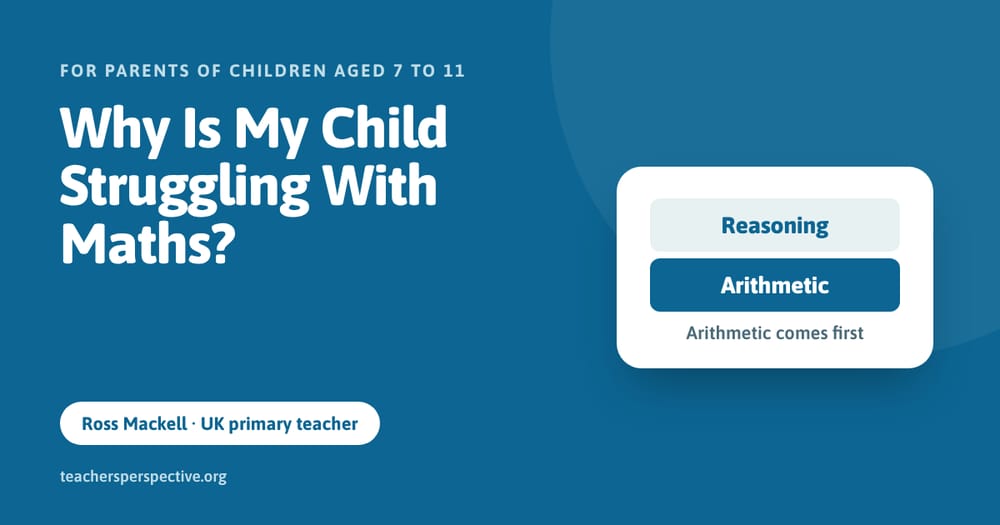
Quick answer: Most children who struggle with maths aren't struggling with all of maths. They're missing parts of the foundation: the written methods for adding, subtracting, multiplying and dividing (arithmetic). Reasoning and problem solving are built on top of those methods, so a gap underneath makes everything above it feel hard. Find the gap, fix it with short daily practice, and the rest usually improves too.
In this guide
What I found in my class data
In UK primary schools, children are assessed in two main areas of maths: arithmetic (can you carry out the calculation?) and reasoning (can you use maths to solve a problem?).
The usual explanation in staffrooms is that reasoning is simply harder, so only the strongest children do well in it. But when I sat down with my tracking sheet, I noticed something else. The children who did well in reasoning were almost always the ones who were secure in arithmetic. I couldn't find a single child who was strong at reasoning but weak at arithmetic.
So I tried something with the boy from the story. For a few weeks, he practised only arithmetic. No word problems, no tricks, no apps. Just the written methods, one at a time, until each one was solid.
His arithmetic improved, as you'd expect. What surprised me was that his reasoning improved a lot too, even though he hadn't practised it. And the evening meltdowns at home faded, because maths had stopped feeling impossible.
Why arithmetic comes first
Think about what a typical Year 4 word problem asks a child to do:
"A school buys 6 boxes of pencils. Each box has 48 pencils. 75 pencils are given out. How many are left?"
To answer that, a child has to understand the problem and calculate 48 × 6 and calculate 288 − 75. If the multiplication or the subtraction takes all their effort, there's nothing left over for the thinking. They don't look like they're struggling with multiplication. They look like they "can't do word problems".
That's why I always tell parents that arithmetic comes before reasoning. Reasoning relies on calculations that feel automatic. When the calculations are secure, the child has room to think.
The same is true for almost every topic. Fractions use division. Percentages use multiplying and dividing by 10 and 100. Area uses multiplication. A gap in the basics shows up everywhere, which is why a struggling child can seem to be struggling with everything at once.
7 signs the problem is the foundations
- They count on their fingers for simple facts like 7 + 8 or 6 × 4 well past Year 3.
- They get the method right but the answer wrong because of a slip with a times table fact or a subtraction.
- They're very slow, and run out of time on tests even when they know what to do.
- They can't explain where a digit comes from, for example why we carry, or what the 7 is worth in 4,762.
- They do well in the "number" lessons but fall apart on word problems.
- They say "I'm just not a maths person", or avoid homework altogether.
- Their scores drop each year, even though they seem to be trying.
If two or three of these sound familiar, the gap is very likely in the foundations, and the good news is that foundations are the most teachable part of maths.
Not sure where the gap is? My free guide for parents shows the 15 core skills every child aged 7 to 11 needs to master to succeed in maths, in order.
Work through the list with your child and you'll quickly see which skill is holding them back.
Get the free 15 Core Skills guide →What usually doesn't fix it
None of these are bad on their own. But if the foundation is missing, they rarely solve the problem:
- More of the same homework. If a child can't yet do the method, repeating it badly just builds frustration.
- Games and apps. Some are fun, but many reward fast tapping more than careful working. Children often end up guessing.
- Tutoring that follows the current class topic. A good tutor can make a huge difference, but if sessions keep chasing this week's topic, the gap underneath stays open.
- Waiting for it to click. Maths builds on itself, so gaps usually grow rather than close on their own. I explain why in why children who are behind in maths rarely catch up on their own.
What to do: a 4-step plan for home
1. Find the gap
Go back further than feels necessary. If your child is in Year 5, check they can do column addition and subtraction confidently before worrying about fractions. Start easy and work up until the mistakes start. That's the gap.
2. Fix one skill at a time
Pick the earliest skill that isn't secure and work only on that. Use the same three steps I use in class: watch (you show one example out loud), copy (they do a very similar one), practise (three or four on their own).
3. Keep it short and regular
Ten to fifteen minutes a day beats an hour on Sunday. Short sessions stop maths turning into a battle, and daily practice is what makes methods automatic.
4. Move on only when it's secure
Three correct in a row, on a different day, without help. Then move to the next skill. Celebrate each one. Small wins are what rebuild confidence.
These guides walk through the most common gaps step by step:
- What is place value? (the root of most problems)
- Column addition and subtraction
- How to learn times tables fast
- Short multiplication step by step
- The bus stop method for short division
When to talk to the school
Do speak to your child's teacher if you're worried. Ask which skills they think are not yet secure, and what you can practise at home. Teachers are usually glad when parents ask that question.
If your child has persistent difficulty with very basic number sense, such as recognising which of two numbers is bigger or understanding what a number means, despite lots of support, ask the school whether an assessment would be helpful. A small number of children have dyscalculia, a specific learning difficulty with numbers, and they benefit from specialist support.
For most children, though, the problem isn't ability. It's missing building blocks, and building blocks can be put back.
Keep going
Frequently asked questions
Why is my child struggling with maths?
In most cases it's because parts of the foundation are missing, usually place value, number facts or one of the written methods for adding, subtracting, multiplying and dividing. Because every topic builds on these, a small gap can make a child struggle across lots of topics at once.
Is it normal for a child to be bad at maths?
Many children find maths hard at some point, and it's very common. But being "bad at maths" is usually a sign of gaps, not a fixed ability. When the gaps are found and practised, most children improve a lot.
How can I help my child who is struggling with maths?
Find the earliest skill that isn't secure, then practise just that skill for 10 to 15 minutes a day. Show one example, let your child copy a similar one, then give them a few to try alone. Move on only when they get three in a row right.
Should I get a tutor for my child?
A good tutor can help, especially if they start by finding and fixing gaps rather than repeating the current class topic. Short daily practice at home is also very effective, and the two work well together.
Could my child have dyscalculia?
Possibly, but it's much less common than simple gaps. If your child still struggles with very basic number sense after lots of support, talk to the school about whether an assessment would be useful.
Get all 15 core skills in one place
The foundation every child needs is 15 core skills: the written methods every child aged 7 to 11 needs to master to succeed in maths.
My free guide for parents shows all 15, in order, so you can see exactly where your child is and what comes next.
Get the free 15 Core Skills guide →
