
Every year at parents' evening, I have some version of the same conversation. "They're a bit behind in maths, but they'll catch up, won't they?"
Sometimes they do. But I'd be doing parents a disservice if I said that was the usual outcome. In over ten years of teaching, I've seen that children who are behind in maths rarely catch up just by moving into the next year group. More often, the gap gets a little wider each year.
That's not a reason to panic. It's a reason to act, because the thing that closes the gap is simpler than most parents expect. I'm Ross, a UK-qualified primary teacher, and this guide explains why the gap grows and the one change that makes the biggest difference.
Quick answer: Children who are behind in maths often stay behind because each year's maths is built on the year before. New topics assume the old ones are secure, so a gap in the basics makes every new topic harder. The one change that helps most is going back to secure the foundations (place value, number facts and the written methods) with short, regular practice at home.
In this guide
Why the gap grows each year
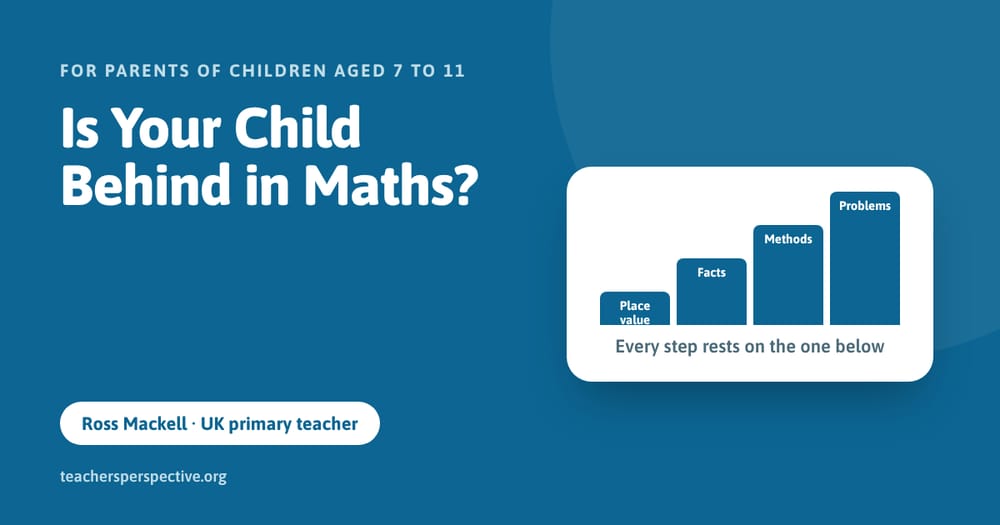
Maths is like a staircase. Every step rests on the one below it:
- Column addition depends on place value and number bonds.
- Short multiplication depends on times tables and column addition.
- Division depends on times tables and subtraction.
- Fractions, decimals and percentages depend on multiplication and division.
The national curriculum moves on every year whether a child is ready or not. So a child who didn't fully secure, say, column subtraction in Year 3 starts Year 4 a step behind. Year 4 topics assume subtraction is easy, so they find those harder too. By Year 5 there are two or three missing steps, and the child starts to believe they're "just not a maths person".
That last part matters. Once a child decides they're bad at maths, they try less, and the gap grows faster. Fixing the skills also fixes the confidence.
How to tell if your child is behind
Here's a rough guide to what the national curriculum in England expects. If your child is a year or more behind on these, the foundations are worth checking.
| By the end of | Most children can... |
|---|---|
| Year 3 | Add and subtract 3-digit numbers in columns. Know the 3, 4 and 8 times tables. |
| Year 4 | Know all times tables to 12 × 12. Multiply 2- and 3-digit numbers by a 1-digit number. |
| Year 5 | Multiply and divide up to 4-digit numbers by a 1-digit number. Begin long multiplication. |
| Year 6 | Use long multiplication and long division. Work confidently with fractions, decimals and percentages. |
Other signs: counting on fingers for simple facts, running out of time in tests, or getting the method right but the answer wrong because of a small slip.
What school can (and can't) do
Teachers care enormously, and many do brilliant work. But a class teacher has around thirty children and a full curriculum to cover. There's only so much time to go back and fill an individual child's gaps while the rest of the class moves on.
That isn't anyone's fault. It's just the reality of a busy classroom. And it means the children who make the most progress are very often the ones who get a little extra practice at home, on the specific skills they're missing.
The best thing you can do is work with the school. Ask your child's teacher: "Which maths skills aren't secure yet, and what could we practise at home?" Most teachers are delighted to be asked.
The one thing to change
Here it is: stop following the homework, and go back to the foundations.
When a child is behind, it's natural to help with whatever they're doing in class this week. But this week's topic assumes the earlier steps are secure. If they aren't, the homework just shows the gap again without closing it.
Instead:
- Find the earliest skill that isn't secure. Start easier than you think you need to.
- Practise that one skill for 10 to 15 minutes a day. Show one example, let them copy one, then give them a few to try alone.
- Move on only when it's solid. Three in a row, without help, on a different day.
- Repeat, one step up the staircase at a time.
It feels slower at first, but it's much faster in the end. Each secure step makes the next one easier, and the child starts to feel capable again. My guide to helping your child catch up at home includes a 4-week plan you can follow.
Which step is your child missing? My free guide shows the 15 core skills every child aged 7 to 11 needs to master to succeed in maths, in order, so you can find the gap quickly.
Get the free 15 Core Skills guide →Where to start: addition
If you're not sure where to begin, start with addition. It's the gateway skill. Subtraction is addition in reverse, multiplication is repeated addition, and every written method uses adding somewhere.
Check three things:
- Number bonds: can they answer 6 + 7 or 9 + 8 instantly, without counting?
- Place value: do they know that the 4 in 347 is worth 40?
- Column addition: can they do 478 + 365 correctly, including carrying?
If any of these wobble, that's your starting point. My guide to column addition and subtraction shows exactly how it's taught in UK schools now, and the mistakes to look for.
This isn't your fault
If your child is behind, it isn't because you've failed them, and it almost certainly isn't because they can't do maths. Gaps happen for all sorts of reasons: a missed week, a topic that moved too fast, a year with lots of disruption.
What matters is what happens next. A few minutes a day on the right skills, in the right order, really can turn things around. I've watched it happen with children who were sure they'd never be good at maths.
Keep going
Frequently asked questions
Will my child catch up in maths on their own?
Some children do, but many don't, because each year's maths builds on the last. If the gap is in the basics, it tends to grow. Short, focused practice on the missing skills is usually needed to close it.
How do I know if my child is behind in maths?
Compare what they can do with the national curriculum for their year group, and ask their teacher which skills aren't secure. Signs include counting on fingers for simple facts, running out of time in tests, and finding most new topics hard.
What should I do if my child is behind in maths?
Go back to the earliest skill they're unsure of, often place value, number facts or column methods, and practise it for 10 to 15 minutes a day until it's secure. Then move on to the next skill.
Is it too late to help my child catch up in maths?
No. It's easier when gaps are small, so earlier is better, but children can close gaps at any age with the right practice. Working on the foundations helps in every later topic.
Get all 15 core skills in one place
Closing the gap starts with the foundations: the 15 core skills every child aged 7 to 11 needs to master to succeed in maths.
My free guide for parents shows all 15, in order, so you can see exactly where your child is and what comes next.
Get the free 15 Core Skills guide →
