
Your child is told that 4 × 3 is "four lots of three". They nod. Then they're given 6 × 7 and start counting on their fingers from one. Somewhere along the way, multiplication became a list of facts to memorise rather than an idea they understand.
Repeated addition is where multiplication starts. When a child really understands that multiplying means adding equal groups, times tables make sense, arrays make sense, and the written methods they meet later in Years 4, 5 and 6 make sense too.
I'm Ross, a UK-qualified primary teacher with over ten years in the classroom. In this guide I'll explain what repeated addition is, the three pictures children use to show it, when they learn it, how it leads into times tables, the point where it stops being enough, and practice questions with answers. There's also a short video lesson you can watch with your child.
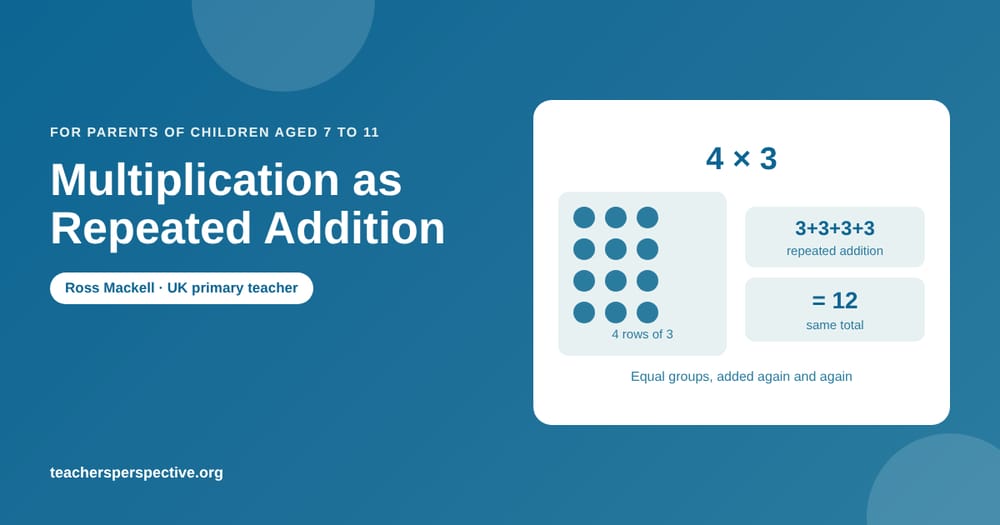
Quick answer: Multiplication as repeated addition means adding the same number again and again. 4 × 3 means 4 groups of 3, which is 3 + 3 + 3 + 3 = 12. Children learn it first with equal groups, arrays and jumps on a number line, then use it to understand their times tables before moving on to faster written methods.
In this guide
What is repeated addition?
Repeated addition is adding the same number over and over. If you have 5 bags with 2 apples in each bag, you could count every apple one at a time. Or you could add the bags: 2 + 2 + 2 + 2 + 2 = 10.
Multiplication is simply a quicker way of writing that. Instead of 2 + 2 + 2 + 2 + 2, we write 5 × 2 = 10: five groups of two.
The key word is equal. Repeated addition only works when every group is the same size. 3 + 3 + 3 is multiplication (3 × 3). 3 + 4 + 2 is not, because the groups are different sizes. It's worth asking your child, "Are all the groups the same?" before they reach for the × sign.
You'll hear teachers read 5 × 2 in different ways: "five times two", "five groups of two", "five lots of two" or "two, five times". Don't worry if the wording at school sounds different to how you learned it. Because 5 × 2 and 2 × 5 give the same answer, what matters most is that your child can picture the equal groups.
Watch the video lesson
In this lesson from my Arithmetic Mastery course I show how to multiply using repeated addition, step by step. It's a good one to watch together, pause, and have your child try the next one before you press play again.
▶ Video lesson: multiplying with repeated addition (7 minutes). Watch on YouTube
Three ways to show multiplication
Children in UK primary schools are taught to show multiplication with pictures before they use numbers alone. These three pictures all show 4 × 3 = 12.
1. Equal groups
Draw 4 circles and put 3 dots in each circle. Count the groups (4), count what's in each group (3), then find the total (12). This is the most natural starting point because children can do it with real objects: 4 plates with 3 grapes on each.
2. Arrays
An array is a set of objects arranged in rows and columns. For 4 × 3, draw 4 rows with 3 dots in each row.
● ● ●
● ● ●
● ● ●
● ● ●
Arrays are brilliant because they show something groups can't. Turn the array on its side and you get 3 rows of 4. Same dots, same total. That's how children see that 4 × 3 = 3 × 4, which halves the number of times table facts they need to learn. Arrays also lead directly into the grid method, which is really just a big array split into parts.
3. Jumps on a number line
Start at 0 and make 4 jumps of 3: 3, 6, 9, 12. Where you land is the answer. Number lines connect multiplication to counting in steps, which is exactly how children build their times tables.
| Picture | 4 × 3 looks like | Best for |
|---|---|---|
| Equal groups | 4 circles, 3 dots in each | Starting out, real objects, word problems |
| Array | 4 rows of 3 dots | Seeing that 4 × 3 = 3 × 4, and later the grid method |
| Number line | 4 jumps of 3 from 0 | Counting in steps and learning times tables |
When do children learn it?
The national curriculum for England builds multiplication up gradually across primary school. Here's roughly where repeated addition fits in:
| Year | What children learn |
|---|---|
| Year 1 | Count in 2s, 5s and 10s. Solve simple multiplication problems using objects, pictures and arrays. |
| Year 2 | Learn the 2, 5 and 10 times tables. Use the × and = signs. Learn that multiplication can be done in any order. |
| Year 3 | Learn the 3, 4 and 8 times tables. Start multiplying 2-digit numbers by 1-digit numbers, moving towards written methods. |
| Year 4 | Know all times tables up to 12 × 12. Use the formal written method to multiply 2-digit and 3-digit numbers by a 1-digit number. |
If your child is in Year 3 or 4 and still unsure what multiplication actually means, going back to repeated addition is not a step backwards. It's usually the quickest way forward, because everything after it is built on top of it.
From repeated addition to times tables
Times tables are repeated addition that has been practised so many times it becomes instant. Counting in 3s (3, 6, 9, 12, 15...) is the 3 times table said out loud. So the path usually looks like this:
- Add the groups. 3 + 3 + 3 + 3 = 12.
- Count in steps. 3, 6, 9, 12. Four jumps, so 4 × 3 = 12.
- Use a fact you know. "I know 2 × 3 = 6, so 4 × 3 is double that: 12."
- Just know it. 4 × 3 = 12, straight away.
Each step is faster than the one before. Children who skip straight to step 4 often have nothing to fall back on when they forget a fact. Children who understand step 1 can always rebuild the answer.
The good news is that there are fewer facts to learn than it looks. Once your child knows their 1s, 2s, 5s and 10s, and understands that 4 × 3 is the same as 3 × 4, there are only 36 facts left. I explain exactly which ones in this video, and in my guide on how to learn times tables fast.
▶ Video: how to learn times tables fast, with only 36 facts to learn (9 minutes). Watch on YouTube
When repeated addition stops being enough
Repeated addition is how children understand multiplication. It's not how they should calculate big multiplications. Try 7 × 48 by adding 48 seven times and you'll see why: it's slow, and every extra addition is another chance to make a mistake.
So by Year 3 and 4, children move on to faster methods that still rest on the same idea:
- Partitioning: 7 × 48 = (7 × 40) + (7 × 8) = 280 + 56 = 336. See my guide to partitioning.
- The grid method: the same partitioning, laid out in a grid. See the grid method.
- Short multiplication: the formal written method expected by the end of Year 4. See short multiplication step by step.
A good rule of thumb: once your child can explain that 6 × 4 means six groups of four, and can show it with an array, it's time to move them on.
Multiplication is one of the 15 core skills. Repeated addition, times tables and the written methods that follow are all part of the 15 core skills every child aged 7 to 11 needs.
My free guide for parents shows all 15 core skills in order, so you can see exactly which one is holding your child back.
Get the free 15 Core Skills guide →5 common mistakes and how to fix them
Mistake 1: Adding the two numbers instead
Your child sees 4 × 3 and writes 7.
The fix: draw it. "Four groups of three" with dots in circles makes it obvious the answer is bigger than 7. Ask them to read the sign out loud as "groups of" for a while.
Mistake 2: Using unequal groups
In a word problem, your child multiplies even though the groups are different sizes, for example three children with 2, 4 and 5 sweets.
The fix: before multiplying, ask "Are all the groups the same size?" If not, it's an addition question.
Mistake 3: Losing count of the groups
Your child adds 3 + 3 + 3 + 3 + 3 for 4 × 3 because they lost track of how many 3s they'd written.
The fix: count the groups on fingers while counting in steps. Four fingers up, one for each jump: 3, 6, 9, 12.
Mistake 4: Counting every dot one at a time
Your child draws a perfect array and then counts all 24 dots from 1.
The fix: praise the array, then ask them to count the rows in steps instead: 6, 12, 18, 24. This is the bridge from counting to multiplying.
Mistake 5: Thinking 5 × 3 and 3 × 5 are different
Your child knows 3 × 5 = 15 but works out 5 × 3 from scratch.
The fix: build an array, then turn the paper round. Same dots, same answer. This one idea cuts their times tables learning in half.
Practice questions
Ask your child to write each one as a repeated addition first, then give the answer. For the last few, ask them to draw an array or a number line.
| Question | Answer |
|---|---|
| Write 3 × 5 as a repeated addition | 5 + 5 + 5 = 15 (or 3 + 3 + 3 + 3 + 3) |
| Write 4 + 4 + 4 + 4 + 4 + 4 as a multiplication | 6 × 4 = 24 |
| 7 × 2 | 2 + 2 + 2 + 2 + 2 + 2 + 2 = 14 |
| 5 × 6 | 6 + 6 + 6 + 6 + 6 = 30 |
| Is 3 + 3 + 4 a multiplication? Why? | No, the groups are not all the same size |
| An array has 3 rows of 8. What multiplication does it show? | 3 × 8 = 24 (and 8 × 3 = 24) |
| Draw 6 jumps of 4 on a number line. Where do you land? | 24 |
| There are 5 tables with 4 chairs at each. How many chairs? | 5 × 4 = 20 chairs |
| Eggs come in boxes of 6. How many eggs in 4 boxes? | 4 × 6 = 24 eggs |
| If 4 × 7 = 28, what is 7 × 4? | 28, because the order doesn't change the answer |
Five to ten minutes a day, a few times a week, will make a bigger difference than an hour at the weekend.
Keep going
Frequently asked questions
What is multiplication as repeated addition?
It means adding the same number several times. 4 × 5 is the same as 5 + 5 + 5 + 5, which equals 20. Multiplication is a shorter way of writing an addition where every group is the same size.
What is an example of repeated addition?
If there are 3 packs of 6 pencils, you can add 6 + 6 + 6 = 18. As a multiplication, that's 3 × 6 = 18.
What year do children learn repeated addition?
Children start in Year 1 by counting in 2s, 5s and 10s and using objects and arrays. In Year 2 they write multiplications with the × sign and learn the 2, 5 and 10 times tables, building on repeated addition.
What is an array in maths?
An array is a set of objects arranged in equal rows and columns. 3 rows of 4 dots shows 3 × 4 = 12. Arrays help children see that multiplication can be done in any order.
Should my child still use repeated addition in Year 4?
To understand multiplication, yes. To calculate, no. By Year 4 children should know their times tables up to 12 × 12 and use the formal written method for bigger multiplications. If they're stuck, going back to repeated addition can help them rebuild the idea.
Get all 15 core skills in one place
Repeated addition is the first step in multiplication, and multiplication is one of the 15 core skills. These are the written methods and facts every child aged 7 to 11 needs to master to succeed in maths.
My free guide for parents shows all 15, in order, so you can see exactly where your child is and what comes next.
Get the free 15 Core Skills guide →Sources and further reading

