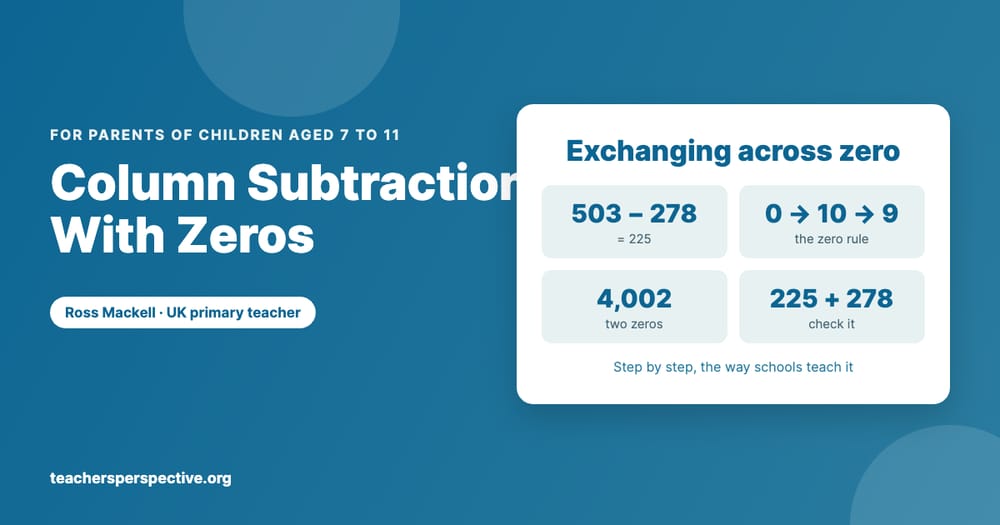

Quick answer: When you need to exchange but the next column is a zero, go one column further left. Take 1 from that column, so the zero becomes 10, then exchange 1 from the 10, so it becomes 9. In 503 − 278, the 5 becomes 4, the 0 becomes 9 and the 3 becomes 13. Then subtract as normal: 13 − 8 = 5, 9 − 7 = 2, 4 − 2 = 2, so the answer is 225.
If your child can do column subtraction most of the time but falls apart when there's a zero in the top number, you're in very good company. Sums like 503 − 278, 600 − 254 and 4,002 − 1,357 are the ones I see go wrong more than any other subtraction in Key Stage 2.
The good news is that it isn't a new method. It's the same exchanging your child already knows, with one extra step. Once they see why the zero turns into a 9, it clicks, and it stays clicked.
This guide shows you exactly what to do, in the same way it's taught in school, so you can sit down with your child tonight and help without confusing them.
In this guide
Why zeros cause the problem
In normal column subtraction, when the top digit is too small, your child exchanges 1 from the next column to the left. For 52 − 17, they can't do 2 − 7, so they take 1 ten from the 5 tens and turn it into 10 ones. The 5 becomes 4 and the 2 becomes 12. Simple.
But look at 503 − 278. In the ones column, 3 − 8 doesn't work, so your child looks to the tens column to exchange. And there's nothing there. The tens column says 0. You can't take 1 ten from no tens.
That's the moment most children freeze, guess, or do something creative. The fix is to understand what the 0 actually means, and that comes down to place value. The number 503 is 5 hundreds, 0 tens and 3 ones. There are no loose tens, but there are 5 hundreds, and any hundred can be swapped for 10 tens.
Step by step: 503 − 278
Here is the method exactly as I teach it. Get your child to say each step out loud the first few times.
Step 1: Write it in columns
Line the numbers up so the hundreds, tens and ones sit in the right columns. The bigger number goes on top.
| 5 | 0 | 3 | |
| − | 2 | 7 | 8 |
Always start with the ones column, on the right.
Step 2: Can you do the ones?
3 − 8? No, 3 is smaller than 8. We need to exchange. Look left to the tens column: it's 0, so there are no tens to exchange.
Step 3: Go one more column left
Move to the hundreds. Take 1 hundred from the 5, so cross out the 5 and write 4. That hundred is worth 10 tens, so cross out the 0 in the tens column and write 10.
Step 4: Now exchange into the ones
Now there are tens to exchange. Take 1 ten from the 10 tens, so cross out the 10 and write 9. That ten becomes 10 ones, so the 3 in the ones column becomes 13.
| 4 | 9 | 13 | |
| − | 2 | 7 | 8 |
The 5 has become 4, the 0 has become 9 (via 10), and the 3 has become 13.
Step 5: Subtract each column
Now every column works. Ones: 13 − 8 = 5. Tens: 9 − 7 = 2. Hundreds: 4 − 2 = 2.
| 4 | 9 | 13 | |
| − | 2 | 7 | 8 |
| 2 | 2 | 5 |
503 − 278 = 225
The shortcut way of thinking about it: 503 is also 50 tens and 3 ones. Take 1 of those 50 tens and you have 49 tens and 13 ones. That's why the 5 and 0 become 4 and 9 together. Some children find this version makes far more sense, so try both.
▶ Video lesson: the column subtraction mistake most children make, and how to fix it. Watch on YouTube
Column subtraction is one of 15 core skills.
Exchanging across zeros only works if the skills underneath it are secure: place value, number bonds and column subtraction without zeros. My free guide for parents shows all 15 core skills, in order, so you can see exactly where your child is and what to practise next.
Get the free 15 Core Skills guide →Two zeros in a row: 4,002 − 1,357
In Year 4 your child will meet four-digit numbers, and sometimes two zeros sit side by side. The idea is the same: keep moving left until you find a digit you can take from.
- Ones: 2 − 7 doesn't work. Tens is 0, hundreds is 0, so go all the way to the thousands.
- Take 1 thousand from the 4, which leaves 3. The hundreds 0 becomes 10.
- Take 1 hundred from the 10, which leaves 9. The tens 0 becomes 10.
- Take 1 ten from the 10, which leaves 9. The ones 2 becomes 12.
| 3 | 9 | 9 | 12 | |
| − | 1 | 3 | 5 | 7 |
| 2 | 6 | 4 | 5 |
4,002 is 400 tens and 2 ones. Take 1 ten and you have 399 tens and 12 ones, so the 4, 0, 0 become 3, 9, 9.
Notice the pattern: every zero you cross over turns into a 9. Once your child spots that, these questions stop being scary.
The 3 mistakes to look out for
| What your child writes | What went wrong | What to say |
|---|---|---|
| 503 − 278 = 375 | Took the smaller digit from the bigger one in every column (8 − 3, 7 − 0, 5 − 2). | "Always start with the top number. If the top is smaller, we exchange." |
| 503 − 278 = 275 | Exchanged straight from the hundreds into the ones (5 became 4, 3 became 13) and left the tens as 0, then did 7 − 0. | "The hundred has to go into the tens first. The 0 becomes 10, then 9." |
| 503 − 278 = 235 | Turned the 0 into 10 but forgot to then take 1 from it for the ones, so did 10 − 7 = 3. | "We used one of those tens. What's left?" |
If you see the first mistake, go back a step. Your child needs to be secure with basic exchanging, like 52 − 17, before zeros will make sense. My step-by-step guide to column addition and subtraction covers that first stage.
How to check the answer
The quickest way for your child to catch their own mistakes is the inverse: add the answer back on to the number they took away. If 503 − 278 = 225, then 225 + 278 should give 503. It does, so the answer is right.
It's also worth getting them to estimate first. 503 − 278 is roughly 500 − 300, so the answer should be a bit more than 200. An answer of 375 or 35 should immediately look wrong. My guide to rounding numbers shows how to teach estimating.
Practice questions (with answers)
Do these with your child after you've watched one worked example together. Cover the answers first.
| Question | Answer |
|---|---|
| 302 − 147 | 155 |
| 600 − 254 | 346 |
| 704 − 368 | 336 |
| 1,000 − 463 | 537 |
| 5,006 − 2,718 | 2,288 |
If they get the first two right on their own, move on. If not, go back to one worked example and do the next one together, step by step.
How to help at home
- Use the same words as school. Say "exchange" rather than "borrow" so your child isn't hearing two different explanations. My guide to why maths is taught differently now explains the newer terms.
- Watch, copy, practise. Do one example while they watch. Do the next one together, with them saying each step. Then let them do two on their own. Most children are asked to practise before they've ever copied a full example.
- Check the foundations. If subtracting single digits like 13 − 8 is slow, the method will always feel hard. Ten minutes on number bonds will speed everything up.
- Little and often. Five questions a day for a week beats a page of thirty on a Sunday.
If column subtraction is one of several things your child is stuck on, my guide Is my child behind in maths? has a 5-minute check to find exactly where the gaps are.
Questions parents ask about subtracting across zeros
How do you do column subtraction when there is a zero?
When the digit you need to exchange from is a zero, there is nothing to take, so you go one more column to the left. Take 1 from that column, which turns the zero into 10. Then exchange 1 from the 10 into the column you are working on, which leaves 9 behind. For 503 − 278, the 5 becomes 4, the 0 becomes 9 and the 3 becomes 13.
Is borrowing the same as exchanging?
Yes. Borrowing is the word most parents learned at school. Schools in England now say exchanging, because you are not borrowing anything back: you are swapping 1 ten for 10 ones, or 1 hundred for 10 tens. The method is the same.
Why does my child get 503 − 278 = 375?
Because in each column they take the smaller digit away from the bigger one, whichever is on top. 8 − 3 = 5, 7 − 0 = 7 and 5 − 2 = 3, which gives 375. It means they haven't yet understood when to exchange. The rule to teach is: always start with the top number, and if the top digit is too small, exchange.
What year do children learn column subtraction with exchanging?
In England, children start using the formal column method for subtraction with numbers up to three digits in Year 3, and up to four digits in Year 4. Subtracting across zeros, like 600 − 254 or 4,002 − 1,357, usually comes up in Year 3 and Year 4 and is practised again before the Year 6 SATs.
Is there an easier way to subtract from 1,000 or 500?
For numbers like 1,000 − 463, a quick trick is to take 1 from both numbers first: 999 − 462 gives the same answer, 537, and needs no exchanging at all. It's a useful check, but children still need the column method for numbers like 5,006 − 2,718.
Get the free 15 Core Skills guide
Column subtraction is one of the 15 written methods every child aged 7 to 11 needs to master. If one of them is shaky, everything built on top of it wobbles too.
My free guide lays out all 15 in the order children need to learn them, so you can see exactly where your child is and what to work on next.
- All 15 core skills, from number bonds to long division
- The order they build on each other
- What each one looks like when it's secure
- Written for parents, by a UK primary teacher
Free. Instant access. No card needed.
Keep going
Sources and further reading

