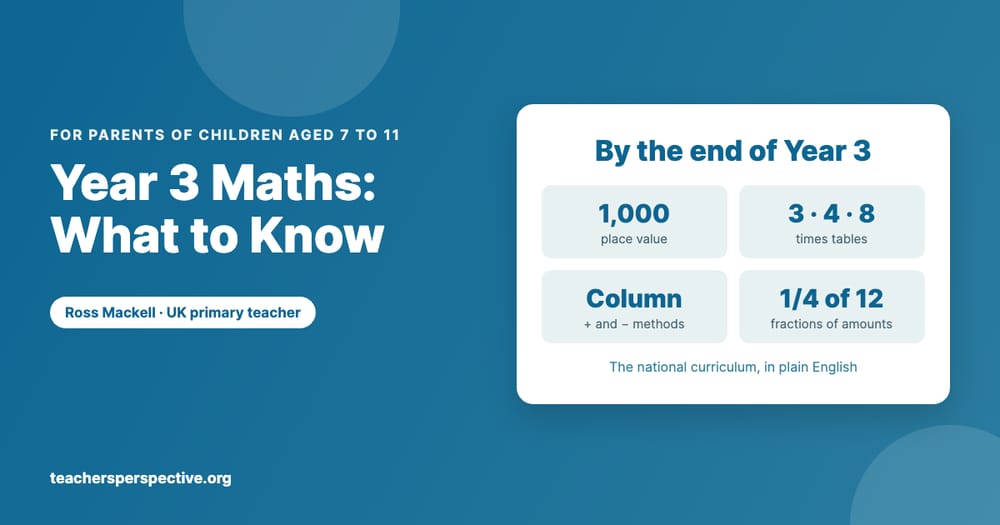

Quick answer: By the end of Year 3 (age 7 to 8), your child should be able to read, write and order numbers up to 1,000, add and subtract 3-digit numbers in columns, know the 3, 4 and 8 times tables, multiply a 2-digit number by a 1-digit number, find simple fractions of amounts and tell the time to the nearest minute. Year 3 is the first year of Key Stage 2, and it is where written methods really begin.
Year 3 is a big jump. In Year 2 a lot of maths is done with objects, pictures and mental strategies. In Year 3 your child starts writing calculations down in columns, learning three new times tables, and working with numbers ten times bigger than before.
I've taught Year 3 and I've taught the year groups above it. The pattern I see every year is the same: the children who are secure in Year 3 cruise through Year 4, and the children who leave Year 3 with one or two shaky methods spend the rest of primary school trying to catch up. So it's worth knowing exactly what is expected.
This guide goes through the Year 3 maths curriculum in plain English, one area at a time, with what it looks like in practice and what to do if your child isn't there yet.
In this guide
The big picture
Here is the whole of Year 3 maths on one page. These are the headline expectations from the national curriculum for England, written the way I'd explain them at parents' evening.
| Area | The headline expectation by the end of Year 3 |
|---|---|
| Place value | Read, write, order and compare numbers up to 1,000. Know what each digit in a 3-digit number is worth. |
| Counting | Count in 4s, 8s, 50s and 100s. Find 10 or 100 more or less than any number. |
| Addition and subtraction | Add and subtract 3-digit numbers using the column method. Add a 3-digit number and ones, tens or hundreds in their head. |
| Times tables | Know the 3, 4 and 8 times tables (plus the 2, 5 and 10 from Year 2) and the matching division facts. |
| Multiplication and division | Multiply a 2-digit number by a 1-digit number, for example 23 x 4, moving from mental methods towards written ones. |
| Fractions | Find fractions of amounts, spot simple equivalent fractions, count in tenths, add and subtract fractions with the same denominator. |
| Measurement | Measure and add lengths, masses and capacities. Work out perimeter. Add and subtract money and give change. |
| Time | Tell the time to the nearest minute, including on clocks with Roman numerals I to XII and 24-hour clocks. |
| Shape and data | Recognise right angles, parallel and perpendicular lines. Read and draw bar charts, pictograms and tables. |
If that looks like a lot, it is. But notice how much of it rests on the same few skills: place value, number bonds and times tables. Get those right and most of the rest follows.
Number and place value
In Year 2 children worked with numbers up to 100. In Year 3 that goes up to 1,000. The key idea is that the 3 in 352 isn't worth 3, it's worth 300. That sounds obvious to us, but it's the single most important idea in primary maths, and it's the one I see missing most often when a child is struggling.
By the end of Year 3 your child should be able to:
- read and write numbers up to 1,000 in digits and in words (for example, 607 is six hundred and seven)
- say what each digit is worth, so 482 is 400 + 80 + 2
- put numbers in order and compare them using < and >
- find 10 more, 10 less, 100 more and 100 less than any number, even across a boundary (for example, 10 more than 395 is 405)
- count in steps of 4, 8, 50 and 100
Splitting a number into hundreds, tens and ones is called partitioning. My guide to partitioning and my guide to place value go into this in more detail, and the video below shows it on the board.
▶ Video lesson: what partitioning is and why place value matters. Watch on YouTube
Addition and subtraction
This is where Year 3 changes the most. Your child will start using the formal written column method for addition and subtraction with numbers up to three digits.
Mental methods first
Before columns, children should be able to add and subtract in their head when one of the numbers is simple: 346 + 7, 346 + 40, 346 + 300. These rely completely on number bonds and place value. If your child still counts on their fingers for 8 + 6, the column method will be slow and full of mistakes, because every column is a small number bond.
Column addition and subtraction
In Year 3, children line numbers up in columns (hundreds, tens, ones) and work from right to left. For addition that means carrying, for example 268 + 157. For subtraction it means exchanging, which many parents call borrowing, for example 423 − 168.
Column subtraction with exchanging is the method I see go wrong more than any other. The classic mistake is taking the smaller digit from the bigger one in each column, whichever is on top. I explain exactly how to fix it in this video, and my step-by-step guide to column addition and subtraction has worked examples you can copy.
▶ Video lesson: the column subtraction mistake most children make, and how to fix it. Watch on YouTube
Year 3 children should also estimate an answer first and use the inverse to check it. If 423 − 168 = 255, then 255 + 168 should give 423. My guide to inverse operations shows how to teach this.
Year 3 is where the written methods start.
Column addition, column subtraction, times tables and multiplying a 2-digit number by a 1-digit number are all part of the 15 core written methods I teach in Arithmetic Mastery 2.0. Each one is a short video lesson your child watches, copies and practises, in the order they need it. £49, one payment, lifetime access.
See what's inside Arithmetic Mastery 2.0 →Multiplication and division
The Year 3 times tables
Year 3 adds the 3, 4 and 8 times tables. Your child should already know the 2, 5 and 10 times tables from Year 2. The 4 and 8 times tables are a gift, because they are just doubling: double the 2 times table to get the 4s, double again to get the 8s.
Children should know the division facts too. If they know 3 x 8 = 24, they should also know 24 ÷ 3 = 8 and 24 ÷ 8 = 3. My guide on how to learn times tables fast shows you which facts to learn in which order, and it's a lot fewer than you think.
Year 3 matters for times tables because of what comes next. In June of Year 4, every child in England sits the multiplication tables check, which covers every table up to 12 x 12. A child who leaves Year 3 secure in the 2s, 3s, 4s, 5s, 8s and 10s is in a strong position.
Multiplying and dividing bigger numbers
Year 3 children start to multiply a 2-digit number by a 1-digit number, like 23 x 4. Most schools teach this through repeated addition and arrays first, then the grid method (20 x 4 = 80, 3 x 4 = 12, 80 + 12 = 92). Some schools move on to short multiplication by the end of the year, others leave it for Year 4.
Division works the same way in reverse: 2-digit numbers divided by 1-digit numbers, using times table facts. Formal short division (the bus stop method) usually comes later, but the times table facts it needs are built now.
Fractions
Fractions in Year 3 are about understanding what a fraction is, not doing complicated calculations. By the end of the year your child should be able to:
- find fractions of an amount, for example 1/4 of 12 or 3/4 of 12 (my fractions of amounts guide shows the method)
- count up and down in tenths, for example 1/10, 2/10, 3/10 (writing tenths as decimals like 0.3 comes in Year 4)
- spot simple equivalent fractions using diagrams, for example 1/2 = 2/4
- add and subtract fractions with the same denominator within one whole, for example 5/7 + 1/7 = 6/7
- compare and order fractions with the same denominator, and unit fractions like 1/3 and 1/5
A quick test: ask your child which is bigger, 1/3 or 1/5. Lots of Year 3 children say 1/5 because 5 is bigger than 3. If yours does, that's normal, and it's worth fixing now with a pizza or a bar of chocolate cut into pieces.
Measurement, money and time
Year 3 measurement leans heavily on addition and subtraction, which is another reason column methods matter so much. Your child will:
- measure, compare, add and subtract lengths (m, cm, mm), masses (kg, g) and volumes (l, ml)
- work out the perimeter of simple shapes by adding up the sides
- add and subtract amounts of money and give change, using £ and p
- tell the time to the nearest minute on an analogue clock, including clocks with Roman numerals from I to XII
- use 12-hour and 24-hour clocks, am and pm, and know there are 60 seconds in a minute and how many days are in each month
Time is the one parents most often tell me their child finds hard. The easiest way to help is free: wear a watch with hands, or put an analogue clock in the kitchen, and ask the time a few times a day.
Shape and statistics
In geometry, Year 3 children learn that an angle is an amount of turn. They recognise right angles, know that two right angles make a half turn and four make a full turn, and say whether an angle is bigger or smaller than a right angle. They also learn horizontal, vertical, parallel and perpendicular lines, and draw 2-D shapes and make 3-D ones.
In statistics, they read and draw bar charts, pictograms and tables, and answer one-step and two-step questions about them, such as how many more children chose football than swimming.
Signs your child may be behind in Year 3 maths
Every child develops at a different pace, and a wobbly week isn't a problem. But these are the signs I'd want a parent to notice, because each one points to a specific gap:
| What you notice | What it usually means |
|---|---|
| Counts on fingers for sums like 7 + 8 | Number bonds to 10 and 20 aren't secure yet |
| Writes 300402 for three hundred and forty-two | Place value isn't secure |
| Gets 423 − 168 = 345 | Taking the smaller digit from the bigger one instead of exchanging |
| Counts up in 4s on fingers to answer 4 x 7 | Times tables are being worked out, not remembered |
| Homework that should take 10 minutes takes 40 | A method is missing, so every question is a struggle |
| "I'm rubbish at maths" | Confidence has started to drop, usually after a gap has been there a while |
If several of these sound familiar, my guide Is my child behind in maths? walks you through a 5-minute check you can do at home to find exactly where the gap is.
How to help your Year 3 child at home
You don't need to be good at maths to help, and you don't need hours. Here is what I tell parents:
- Fix the foundations first. If number bonds or place value are shaky, start there, even if the class has moved on. Everything in Year 3 is built on them.
- Learn the method the school uses. Children get confused when home and school do it differently. My guide on why maths is taught differently now explains the methods you'll see.
- Watch, copy, practise. Show one worked example. Do the next one together, step by step. Then let them do two or three on their own. Most children are asked to practise before they've ever copied a full example.
- Little and often. Ten minutes a day beats an hour on Sunday. Short sessions keep it calm and the method sticks.
- Times tables in the car. Two minutes of 3s, 4s or 8s on the school run adds up to hours over a term.
For a fuller plan, my guide on how to help your child with maths at home has a simple weekly routine.
Questions parents ask about Year 3 maths
What should a Year 3 child know in maths?
By the end of Year 3 a child should read, write and order numbers up to 1,000, add and subtract 3-digit numbers using the column method, know the 3, 4 and 8 times tables, multiply a 2-digit number by a 1-digit number, find simple fractions of amounts, add fractions with the same denominator, tell the time to the nearest minute and work with money in pounds and pence.
Which times tables should my child know in Year 3?
Year 3 adds the 3, 4 and 8 times tables to the 2, 5 and 10 times tables learned in Year 2. Children should be able to recall the facts and the matching division facts, so 4 x 8 = 32 also means 32 ÷ 4 = 8.
Do Year 3 children learn column addition and subtraction?
Yes. The national curriculum says Year 3 children should add and subtract numbers with up to three digits using the formal written column methods. This is often the first year children meet exchanging (borrowing) in column subtraction.
Is there a test at the end of Year 3?
No. There is no national test in Year 3. Your child's teacher assesses them during the year and reports to you, usually as working towards, working at, or working at greater depth within the expected standard. The first national maths check after Key Stage 1 is the Year 4 multiplication tables check.
My child is behind in Year 3 maths. Can they catch up?
Yes, and Year 3 is a very good time to do it. Most Year 3 gaps come from a small number of missing methods, usually number bonds, place value or column methods. Find the earliest one that isn't secure, teach it properly, then practise little and often. Ten minutes a day is enough.
Get every Year 3 written method taught for you
Arithmetic Mastery 2.0 is my complete course for parents of children aged 7 to 11. I teach all 15 written methods your child needs for primary school, in the exact order they must be learned, starting with the ones Year 3 is built on.
Your child watches me demonstrate, copies along with me, then practises on their own. You don't have to teach any of it. Ten minutes a day is enough.
- 91 short video lessons covering all 15 methods
- A starting assessment so you know exactly where the gaps are
- A mini test after every module and printable practice for every method
- Lifetime access for one payment of £49
Do one lesson a day for 30 days. If you don't see visible progress, email me for a full refund.
Keep going
Sources and further reading

