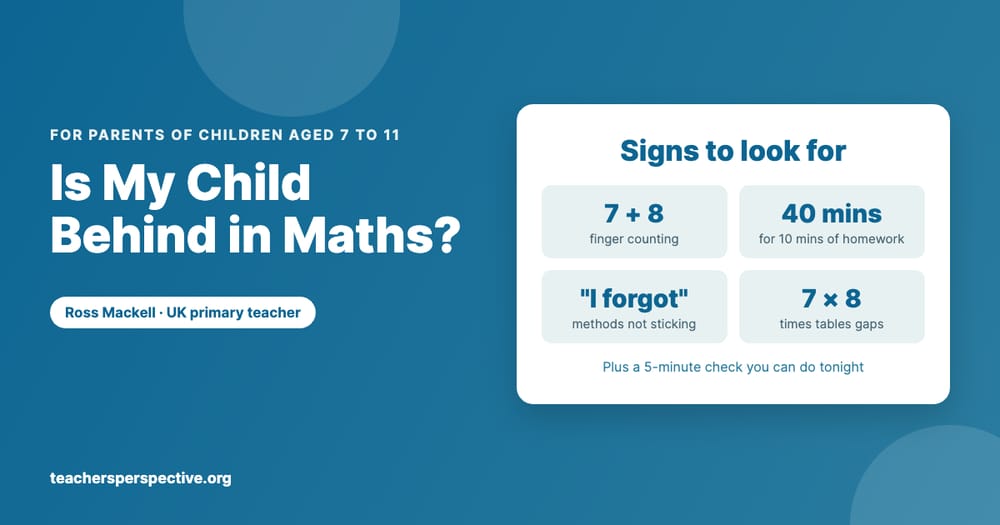

Quick answer: Your child may be behind in maths if they still count on their fingers for simple facts, take far longer than they should over homework, forget methods they could do last week, or say "I can't do maths". In primary school this almost always means one or two written methods never fully landed, not that your child is bad at maths. Find the earliest gap, teach that one method properly, and practise for ten minutes a day.
If you're reading this, you've probably had that feeling. Homework that should take ten minutes has turned into tears. Your child got a question right on Monday and has no idea how to do it on Wednesday. Or a school report has just said "working towards" and you're not sure what that really means.
I'm a UK primary teacher and I've been teaching for over ten years. I've sat in a lot of parents' evenings having this exact conversation. So here is what I actually tell parents: how to tell if your child is behind, why it happens, a simple check you can do tonight, and what to do next.
In this guide
What "behind" actually means in primary maths
In England, schools measure your child against the expected standard for their year group, set out in the national curriculum. Reports usually say your child is working towards, working at, or working at greater depth within the expected standard. "Working towards" is the school's way of saying behind.
You are not alone if that's what your report says. In the 2025 Year 6 SATs, 74% of pupils met the expected standard in maths. That means roughly one child in four left primary school below it. In a class of 30, that's about seven or eight children.
The important thing to understand is that maths is cumulative. Every method is built on the ones before it. So being behind in maths is rarely about this year's work. It's usually about a gap from a year or two ago that is now making this year's work impossible.
7 signs your child is behind in maths
Marks only tell you so much. The best clues come from watching how your child works. These are the seven signs I look for:
1. They count on their fingers for simple facts
Finger counting is completely normal in Reception and Year 1. By Year 3, a child who still counts on their fingers for 7 + 8 or 13 − 6 is missing number bonds. Every bigger calculation is built from these facts, so everything is slow and full of small errors.
2. Ten minutes of homework takes forty
When a method is secure, practice questions are quick. When it isn't, every single question is a puzzle to solve from scratch. Long, tearful homework is one of the clearest signs that a method is missing.
3. They forget methods they could do last week
"I forgot how to do it" is a big one. It usually means the method was copied once in class but never practised until it stuck. It also happens when the method rests on an earlier skill that isn't secure.
4. They guess, then watch your face
A child who isn't sure will write an answer and look at you to see if it's right. They're reading your reaction instead of trusting the method, because they don't have one they trust.
5. They don't know their times tables by Year 4
Every child in England sits the Year 4 multiplication tables check in June. If your child is working out 7 x 8 by counting up in 7s in Year 4 or above, short multiplication, short division and fractions will all be harder than they need to be.
6. They say "I'm rubbish at maths"
This one worries parents most, and rightly so. But in my experience, children don't start out hating maths. They start hating it after a gap has been there long enough that they keep getting things wrong. Fix the gap and the confidence comes back. My guide on what to do when your child hates maths goes into this.
7. The school says they're working towards, or puts them in a group
If your child has been moved into an intervention group, or the report says working towards, the school has already spotted it. That's useful information, not a reason to panic. Your job now is to find out exactly which methods are missing.
▶ Video: the 5 stages every parent goes through when their child struggles with maths, and what to do at each one. Watch on YouTube
Why children fall behind in maths
It is almost never about intelligence. In my classroom, the children who fall behind are often bright, capable children. Here is what usually happens:
- One method never fully landed. Maybe they were off sick the week column subtraction was taught, or it just didn't click. The class moved on, because it had to.
- Everything built on it started to wobble. Column subtraction is needed for long division. Times tables are needed for fractions. A small gap in Year 3 becomes a big problem in Year 5.
- There's no time to go back in class. With 30 children in a class and a packed curriculum, a teacher simply can't reteach every gap for every child. I know, because I'm the teacher at the front trying.
- Methods at home don't match school. Many parents learned different methods, which can confuse children. My guide on why maths is taught differently now explains the methods schools use today.
The good news hidden in all this: if being behind is caused by missing methods, then catching up is a matter of finding and teaching those methods. There are only 15 core written methods in primary arithmetic, so the list is shorter than you think.
None of this means your child is bad at maths. It means a method is missing.
Arithmetic Mastery 2.0 starts with an assessment that shows you exactly which of the 15 core methods your child is missing, then teaches each one on video, in the right order. Your child watches, copies and practises. You don't have to teach any of it. £49, one payment, lifetime access.
Find your child's gaps with Arithmetic Mastery 2.0 →A 5-minute check you can do at home tonight
You don't need a test paper. Sit with your child, give them these questions one at a time on paper, and watch how they work, not just whether the answer is right. Stop as soon as one becomes a real struggle. That's where to start.
| Question | What it checks | Usually secure by |
|---|---|---|
| 8 + 7 and 14 − 6 | Number bonds to 20 | End of Year 2 |
| What is the 4 worth in 2,437? | Place value | Year 3 to 4 |
| 346 + 278 | Column addition with carrying | Year 3 |
| 503 − 267 | Column subtraction with exchanging across a zero | Year 3 to 4 |
| 7 x 8 and 56 ÷ 7 | Times tables and division facts | Year 4 |
| 243 x 6 | Short multiplication | Year 4 to 5 |
| 3/4 of 28 | Fractions of amounts | Year 4 to 5 |
Answers: 15 and 8, 400, 624, 236, 56 and 8, 1,458, 21.
Watch for finger counting, long pauses, crossing out, and "I don't know where to start". If your child gets the answer right but takes a minute over 8 + 7, that's still a gap. Speed matters, because a child who has to work out every small fact has no brain space left for the method.
For a full picture of what each year expects, see my guides to Year 3 maths and Year 4 maths.
Is it dyscalculia, or just gaps?
Parents often ask me this. Dyscalculia is a specific learning difficulty that affects a child's basic sense of number. It's real, but it's much less common than ordinary gaps. Most children who struggle with maths simply haven't been taught a method in a way that stuck, or haven't practised it enough.
A good rule of thumb: try consistent, well-ordered help first, a few minutes every day for six to eight weeks. If your child is still struggling to understand quantities at a very basic level after that, talk to the school's SENCo about an assessment.
How to help your child catch up in maths
This is the plan I give parents. It works because it fixes the cause, not the symptoms.
1. Find the earliest gap
Use the check above. The earliest skill your child struggles with is where you start, even if it's from two years ago. Practising this week's homework won't help if the problem is underneath it.
2. Teach one method at a time, in order
Don't try to fix everything at once. Get number bonds secure, then place value, then column addition, and so on. Each method makes the next one easier. Order matters more than speed.
3. Use watch, copy, practise
Show one fully worked example (watch). Do the next question together, step by step (copy). Then let them do two or three on their own (practise). Skipping the copy step is the most common reason children fall apart when they try alone.
4. Ten minutes a day
Short and daily beats long and weekly. Ten calm minutes means your child stays focused, you avoid arguments, and the method gets practised often enough to stick. My guide on how to help your child with maths at home has a simple weekly routine.
5. Celebrate the method, not the mark
Praise them for setting the column out correctly or exchanging properly, even if they slip on the arithmetic. What changes first isn't usually the marks. It's the willingness to try.
If you're weighing up a tutor, my guide to how much a maths tutor costs in the UK covers prices and the questions to ask before you hire one.
What to ask your child's teacher
Teachers are usually very happy to help a parent who wants to support at home. Ask these three questions:
- Which specific skills or methods is my child not secure in yet?
- Are they working towards, at, or above the expected standard right now?
- Which method does the class use for this, so I can practise the same one at home?
The answer to the first question is gold. "Struggling with maths" is hard to fix. "Not secure in column subtraction with exchanging" is something you can fix in a couple of weeks.
Questions parents ask
How do I know if my child is behind in maths?
Look at how they work, not just their marks. Counting on fingers for simple facts after Year 2, homework taking far longer than it should, forgetting a method they could do last week, and guessing then watching your face are all signs a method is missing. Their school report will also say if they are working towards the expected standard.
Can a child catch up in maths?
Yes. Most children who are behind in primary maths are missing a small number of specific written methods or facts, not maths as a whole. Once you find the earliest gap and teach that method properly, everything built on top of it starts to work again. With ten minutes a day, many parents see a difference within a few weeks.
How far behind is too far behind in maths?
It is never too late in primary school. A child in Year 5 or Year 6 who is missing Year 3 methods can close the gap, but it takes longer because more has been built on top of the gap. The sooner you start, the faster it goes.
Is it dyscalculia or is my child just behind?
Most children who struggle with maths do not have dyscalculia. They have gaps. Dyscalculia is a specific learning difficulty where a child struggles to understand numbers at a basic level, even with good teaching and plenty of practice. If your child still struggles after consistent, well-sequenced help, speak to the school's SENCo about an assessment.
What should I ask my child's teacher if I think they are behind in maths?
Ask three things: which specific skills or methods your child is not secure in yet, whether they are working towards, at, or above the expected standard, and what you can practise at home that matches the method the class uses.
Should I get a tutor if my child is behind in maths?
A good tutor can help, but it is expensive over a year and only works if they find and fix the earliest gap rather than repeating this week's homework. Many parents can close gaps themselves with the right method taught in the right order and ten minutes a day.
Take a look inside Arithmetic Mastery 2.0
If you'd like the gaps found and taught for you, this is a walkthrough of my course: the lessons, the modules and the assessments, exactly as your child will see them.
▶ Video: a look inside Arithmetic Mastery 2.0. Watch on YouTube
Help your child catch up, ten minutes a day
Arithmetic Mastery 2.0 teaches all 15 written methods your child needs for primary school, step by step, in the exact order they must be learned. I recorded every lesson myself, slowly and clearly, so you can close the gaps at your own kitchen table.
It starts with an assessment, so you know exactly where your child is, and you don't have to teach any of it yourself.
- 91 short video lessons covering all 15 methods
- A starting assessment to find the gaps, and a final assessment to see the before and after
- A mini test after every module and printable practice for every method
- Lifetime access. No subscription, nothing to cancel
Improvement in 30 days or your money back. Do one lesson a day for 30 days. If you don't see visible progress, email me for a full refund.
Keep going
Sources and further reading

