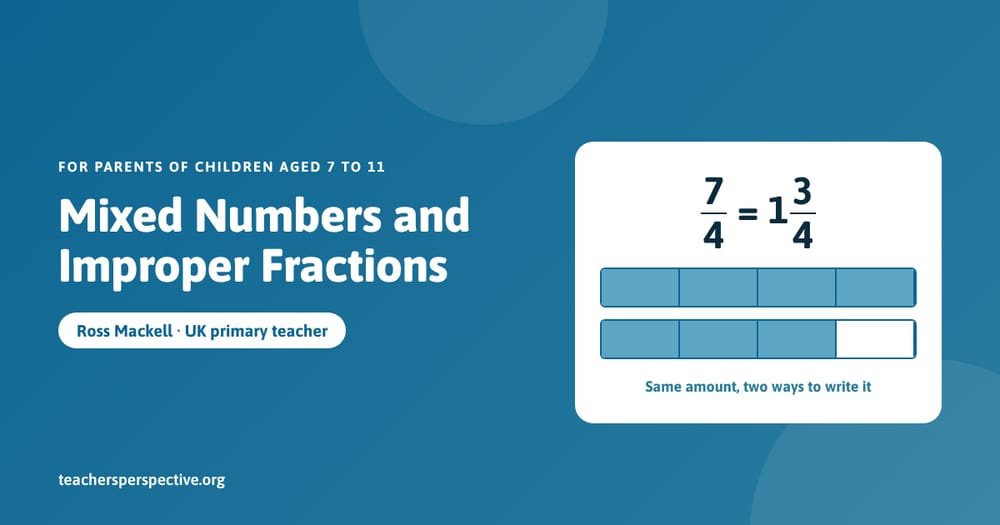

Is 114 a proper answer? Lots of children think a fraction where the top is bigger than the bottom must be a mistake. It isn't. 114 is exactly the same amount as 234, and being able to switch between the two is one of the most useful fraction skills your child will learn.
Improper fractions and mixed numbers turn up everywhere in upper primary maths: adding fractions, multiplying fractions, word problems and the SATs arithmetic paper. Children who can convert quickly find all of those easier. Children who can't get stuck halfway through questions they otherwise understand.
I'm Ross, a UK-qualified primary teacher with over ten years in the classroom. In this guide I'll show you what each one means, how to convert in both directions, where your child will actually use it, the mistakes I see most often, and practice questions with answers.
Quick answer: a mixed number is a whole number and a fraction together, like 234. An improper fraction has a numerator bigger than its denominator, like 114. To turn an improper fraction into a mixed number, divide the top by the bottom: 11 ÷ 4 = 2 remainder 3, so 114 = 234. To go back, multiply the whole number by the denominator and add the numerator: 2 × 4 + 3 = 11, so 234 = 114.
In this guide
What your child needs first
Converting between mixed numbers and improper fractions draws on skills your child should already have. If one of these is shaky, that's where to start.
- Knowing what a fraction means. That the denominator (bottom number) tells you how many equal parts make one whole, and the numerator (top number) tells you how many parts you have.
- Times tables. Every conversion uses multiplication or division by the denominator. Quick recall makes this skill quick too. See how to learn times tables fast.
- Division with remainders. Turning 175 into a mixed number is just 17 ÷ 5. If remainders are new, the bus stop method is the place to start.
In the national curriculum, children learn to recognise mixed numbers and improper fractions and convert from one to the other in Year 5. They then use them when adding, subtracting and multiplying fractions in Years 5 and 6.
What mixed numbers and improper fractions are
There are three kinds of fraction your child will meet:
| Type | What it means | Example |
|---|---|---|
| Proper fraction | Less than one whole. The top is smaller than the bottom. | 34 |
| Improper fraction | One whole or more. The top is bigger than (or equal to) the bottom. | 74 |
| Mixed number | Whole numbers and a fraction written together. | 134 |
The key idea is that an improper fraction and a mixed number can be two ways of writing the same amount. 74 and 134 are equal. Neither one is more correct than the other. Each is more useful in different situations.
Seeing it with fraction bars
Before any rules, show your child a picture. Here's 74, which means seven quarters. Four quarters fill one whole bar, and there are three quarters left over.
Drawing a few of these at the start makes the rules make sense. Once your child can see that four quarters make a whole, the division method below stops feeling like a trick.
Improper fractions to mixed numbers
The question to ask is: how many wholes can I make, and what's left over? That's a division.
Example 1: 114
- Divide the numerator by the denominator: 11 ÷ 4.
- 4 goes into 11 two times (4 × 2 = 8), with 3 left over. So 11 ÷ 4 = 2 remainder 3.
- The answer to the division is the whole number: 2. The remainder goes on top of the fraction, and the denominator stays the same: 34.
- So 114 = 234.
Example 2: 175
- 17 ÷ 5 = 3 remainder 2 (because 5 × 3 = 15, and 17 − 15 = 2).
- So 175 = 325.
Example 3: 104
- 10 ÷ 4 = 2 remainder 2.
- So 104 = 224.
- 24 can be simplified to 12, so the final answer is 212.
Always check whether the fraction part can be simplified at the end. If simplifying isn't secure yet, see equivalent fractions and simplifying.
Example 4: 124
12 ÷ 4 = 3 with no remainder. So 124 is exactly 3. When there's no remainder, the improper fraction is a whole number.
Fractions fall apart if times tables and division are shaky. Both are part of the 15 core skills every child aged 7 to 11 needs.
My free guide for parents shows all 15 core skills in order, so you can see exactly which one is holding your child back.
Get the free 15 Core Skills guide →Mixed numbers to improper fractions
Now the question is: how many parts are there altogether? Every whole is made of as many parts as the denominator says.
Example 5: 234
- Multiply the whole number by the denominator: 2 × 4 = 8. Two wholes are eight quarters.
- Add the numerator: 8 + 3 = 11. That's 11 quarters altogether.
- Keep the same denominator: 114.
Some children remember this as multiply, add, keep: multiply the whole number by the bottom, add the top, keep the bottom the same.
Example 6: 423
- 4 × 3 = 12. Four wholes are twelve thirds.
- 12 + 2 = 14.
- So 423 = 143.
Example 7: 312
- 3 × 2 = 6, and 6 + 1 = 7.
- So 312 = 72. Seven halves.
A quick way to check: convert your answer back. 72 is 7 ÷ 2 = 3 remainder 1, which is 312. If you get back where you started, it's right.
Where your child will use it
Converting isn't the end goal. It's a tool your child needs for bigger fraction questions.
Adding fractions that go over one whole
34 + 24 = 54. That's a correct answer, but it's usually tidied up into a mixed number: 114. See how to add fractions for the full method, including different denominators.
Multiplying a mixed number by a whole number
This is a Year 5 and 6 skill that appears on the arithmetic paper. For 125 × 3:
- Convert to an improper fraction: 1 × 5 + 2 = 7, so 125 = 75.
- Multiply the numerator by 3: 75 × 3 = 215.
- Convert back: 21 ÷ 5 = 4 remainder 1, so the answer is 415.
For more on this, see how to multiply and divide fractions.
5 common mistakes and how to fix them
Mistake 1: 234 = 54
Your child adds the whole number to the numerator instead of multiplying first. They've treated 2 wholes as 2 quarters.
The fix: ask "how many quarters are in one whole?" Then "so how many in two wholes?" Drawing the bars once usually sorts this for good.
Mistake 2: Changing the denominator
Your child works out 2 × 4 + 3 = 11, then writes 118 or 1111.
The fix: the denominator is the size of the pieces, and converting doesn't change the size of the pieces. Quarters stay quarters. The bottom number never changes.
Mistake 3: Putting the remainder over the wrong number
For 114, your child gets 2 remainder 3, then writes 2311.
The fix: the remainder is how many pieces are left over, and the pieces are still quarters. So it goes over 4.
Mistake 4: Thinking an improper fraction is wrong
Some children believe 94 can't be a real answer and get confused or freeze.
The fix: show them it's just more than one whole. Nine quarters is two full bars and one more quarter. It's a perfectly good number, it's just written differently from 214.
Mistake 5: Forgetting to simplify
224 is correct, but 212 is simpler. In tests, questions often ask for the answer in its simplest form.
The fix: make "can I simplify?" the last question your child asks every time they finish a fraction question.
Practice questions
Same three steps I use for every skill: watch, copy, practise. Do the first one out loud yourself, then let your child have a go at a similar one before they try the rest on their own. Cover the last column and ask your child to fill in the gaps.
| Question | Convert to | Answer |
|---|---|---|
| 94 | Mixed number | 214 |
| 135 | Mixed number | 235 |
| 227 | Mixed number | 317 |
| 146 | Mixed number (simplest form) | 213 |
| 123 | Improper fraction | 53 |
| 338 | Improper fraction | 278 |
| 512 | Improper fraction | 112 |
Bonus question: what is 214 × 3? (Answer: 214 = 94, and 94 × 3 = 274, which is 634.)
Ten minutes, a few times a week, is plenty. Only move on when they're getting three in a row right.
Keep going
Frequently asked questions
What is an improper fraction?
An improper fraction is a fraction where the numerator (top number) is bigger than or equal to the denominator (bottom number), like 74 or 55. It means one whole or more.
What is a mixed number?
A mixed number is a whole number and a proper fraction written together, like 134. It means one whole and three quarters.
How do you turn an improper fraction into a mixed number?
Divide the numerator by the denominator. The answer is the whole number, and the remainder goes over the original denominator. For example, 175: 17 ÷ 5 = 3 remainder 2, so it's 325.
How do you turn a mixed number into an improper fraction?
Multiply the whole number by the denominator, add the numerator, and keep the same denominator. For example, 234: 2 × 4 + 3 = 11, so it's 114.
What year do children learn mixed numbers and improper fractions?
In England, children convert between mixed numbers and improper fractions in Year 5, and use them when adding, subtracting and multiplying fractions in Years 5 and 6, including on the KS2 SATs arithmetic paper.
Get all 15 core skills in one place
Mixed numbers and improper fractions click once times tables, division and the basics of fractions are secure. The 15 core skills are the written methods and facts every child aged 7 to 11 needs to master to succeed in maths.
My free guide for parents shows all 15, in order, so you can see exactly where your child is and what comes next.
Get the free 15 Core Skills guide →Sources and further reading
- Department for Education, National curriculum in England: mathematics programmes of study (fractions, Years 5 and 6)
- Standards and Testing Agency, Key stage 2 mathematics test framework
- Ross Mackell, Teacher's Perspective on YouTube

