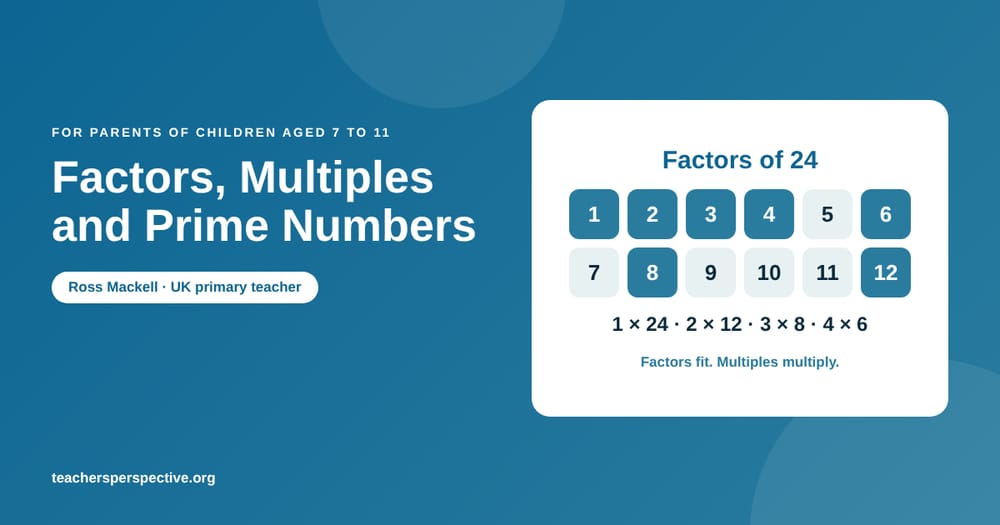

Ask your child for the factors of 24 and you might get 1, 2, 3, 4, 6, 8, 12 and 24. Or you might get 24, 48, 72. If it's the second one, they've mixed up factors and multiples, and that's one of the most common mix-ups in primary maths.
Factors, multiples and prime numbers sound like three separate topics, but they're really one idea looked at from different sides. They sit underneath simplifying fractions, finding common denominators, division and plenty of SATs reasoning questions. Children who understand them find a lot of upper primary maths easier.
I'm Ross, a UK-qualified primary teacher with over ten years in the classroom. In this guide I'll explain what each word means, show you the simple methods your child is taught, the mistakes I see most often, and give you practice questions with answers.
Quick answer: a factor is a number that divides into another number exactly, with nothing left over. The factors of 12 are 1, 2, 3, 4, 6 and 12. A multiple is the answer you get when you multiply a number by a whole number: the multiples of 3 are 3, 6, 9, 12 and so on. A prime number has exactly two factors, 1 and itself, like 2, 3, 5, 7 and 11. One easy way to remember it: factors fit into a number, multiples come out of the times table.
In this guide
What your child needs first
Every part of this topic leans on one skill above all others:
- Times tables. Finding factors is just times tables backwards. If your child has to count up in 7s to check whether 7 is a factor of 56, this topic will feel slow and frustrating. See how to learn times tables fast.
- Division facts. Knowing that 56 ÷ 7 = 8 is the same fact as 7 × 8 = 56. If division with remainders is new, the bus stop method is a good place to start.
In the national curriculum, children start finding factor pairs in Year 4. In Year 5 they learn the words factor, multiple, prime, composite, square and cube numbers, and they recall the prime numbers up to 19. In Year 6 they use common factors and common multiples, which is where it links up with fractions.
Factors and multiples: the difference
Use 12 as an example and the difference becomes clear.
| Word | What it means | Example with 12 |
|---|---|---|
| Factor | A number that divides into 12 exactly | 1, 2, 3, 4, 6, 12 |
| Multiple | A number in a times table | 12 is a multiple of 1, 2, 3, 4, 6 and 12. The multiples of 12 are 12, 24, 36, 48... |
| Factor pair | Two numbers that multiply to make 12 | 1 × 12, 2 × 6, 3 × 4 |
Notice that 3 is a factor of 12, and 12 is a multiple of 3. It's the same fact, said from the other side. A number has a small, fixed list of factors, but its multiples go on forever.
A memory hook that works for a lot of children: factors fit, multiples multiply. Factors fit inside a number. Multiples are what you get when you keep multiplying.
How to find all the factors of a number
The trick schools teach is to work in factor pairs, starting at 1 and working upwards. This stops your child missing any out.
Example 1: the factors of 24
- Start with 1. 1 × 24 = 24, so write down 1 and 24.
- Try 2. 2 × 12 = 24, so write down 2 and 12.
- Try 3. 3 × 8 = 24, so write down 3 and 8.
- Try 4. 4 × 6 = 24, so write down 4 and 6.
- Try 5. 24 ÷ 5 doesn't work exactly, so 5 isn't a factor.
- The next number to try is 6, but 6 is already on the list. When you reach a number you've already got, you've found them all.
So the factors of 24 are 1, 2, 3, 4, 6, 8, 12 and 24. Writing them as a rainbow helps: put the pairs at either end and join them with arches, 1 with 24, 2 with 12, 3 with 8, 4 with 6.
Example 2: the factors of 36
- 1 × 36, 2 × 18, 3 × 12, 4 × 9.
- 5 doesn't work.
- 6 × 6 = 36. The pair is the same number twice, so only write 6 once.
The factors of 36 are 1, 2, 3, 4, 6, 9, 12, 18 and 36. That's nine factors, an odd number. Only square numbers have an odd number of factors, because one of their pairs is a number times itself. That's a lovely fact to share with a curious child.
Factors are only quick if times tables are quick. Times tables recall is one of the 15 core skills every child aged 7 to 11 needs.
My free guide for parents shows all 15 core skills in order, so you can see exactly which one is holding your child back.
Get the free 15 Core Skills guide →Multiples and common multiples
Multiples are simply the times table of a number. The multiples of 6 are 6, 12, 18, 24, 30, 36 and so on.
A common multiple is a number that appears in two times tables. The lowest common multiple (LCM) is the smallest one.
Example 3: the lowest common multiple of 4 and 6
- List the multiples of 4: 4, 8, 12, 16, 20, 24...
- List the multiples of 6: 6, 12, 18, 24, 30...
- The first number on both lists is 12. So the lowest common multiple is 12.
This is exactly what your child is doing when they find a common denominator to add fractions. For adding a quarter and a sixth, they need a number both 4 and 6 go into, and 12 is the smallest.
The opposite idea is the highest common factor (HCF), the biggest number that divides into both. For 12 and 18, the factors of 12 are 1, 2, 3, 4, 6, 12 and the factors of 18 are 1, 2, 3, 6, 9, 18. The biggest number on both lists is 6. That's what your child uses to simplify a fraction like 12/18 down to 2/3 in one step.
Prime numbers
A prime number has exactly two factors: 1 and itself. 7 is prime because the only way to make it is 1 × 7. 8 isn't prime, because 2 × 4 also makes 8. A number with more than two factors is called a composite number.
Here are the prime numbers up to 100. Children in Year 5 are expected to know the ones up to 19 by heart.
| Range | Prime numbers |
|---|---|
| 1 to 20 | 2, 3, 5, 7, 11, 13, 17, 19 |
| 21 to 50 | 23, 29, 31, 37, 41, 43, 47 |
| 51 to 100 | 53, 59, 61, 67, 71, 73, 79, 83, 89, 97 |
Three facts that come up again and again in tests:
- 1 is not a prime number. It only has one factor (itself), not two.
- 2 is the only even prime number. Every other even number can be divided by 2.
- Not every odd number is prime. 9, 15, 21, 27, 51 and 91 all catch children out. 91 is 7 × 13, and 51 is 3 × 17.
How to check if a number is prime
For any number up to 100, your child only needs to test 2, 3, 5 and 7. If none of those divide in exactly, the number is prime. For example, with 53: it's odd, so not 2. Its digits add to 8, which isn't in the 3 times table, so not 3. It doesn't end in 0 or 5, so not 5. 7 × 7 = 49 and 7 × 8 = 56, so not 7. So 53 is prime.
Prime factors and factor trees
Every composite number can be broken down into prime numbers multiplied together. These are its prime factors. Schools usually teach this with a factor tree.
Example 4: the prime factors of 60
- Split 60 into any factor pair, say 6 × 10.
- 6 isn't prime, so split it: 2 × 3. Both are prime, so circle them.
- 10 isn't prime, so split it: 2 × 5. Both are prime, so circle them.
- Collect the circled numbers: 2 × 2 × 3 × 5 = 60.
The nice thing is that it doesn't matter how you start. If your child splits 60 into 4 × 15 instead, they still end up with 2 × 2 × 3 × 5. That surprises a lot of children, and it's worth letting them try it both ways to see.
5 common mistakes and how to fix them
Mistake 1: Mixing up factors and multiples
Asked for the factors of 8, your child writes 8, 16, 24, 32.
The fix: ask "is your answer bigger or smaller than 8?" Factors are never bigger than the number. Repeat the hook: factors fit, multiples multiply.
Mistake 2: Missing a factor
Your child lists the factors of 24 as 2, 3, 4, 6, 8 and 12, and forgets 1 and 24.
The fix: always start with the pair 1 × the number. It's the easiest pair, and it's the one most often left out.
Mistake 3: Thinking 1 is prime
It feels like it should be, but it isn't. A prime has exactly two different factors, and 1 only has one.
The fix: make it a quick-fire question at home: "Is 1 prime?" until "no, it only has one factor" comes back instantly.
Mistake 4: Thinking every odd number is prime
Your child says 9, 21 or 27 is prime because it's odd.
The fix: test with 3 and 7 every time. The digit-sum check for 3 (add the digits, and if the total is in the 3 times table, so is the number) catches most of these.
Mistake 5: Writing a square number's factor twice
For 16, your child writes 1, 2, 4, 4, 8, 16.
The fix: each factor only gets written once. 4 × 4 is one pair, but it gives you one factor.
Practice questions
Same three steps I use for every skill: watch, copy, practise. Do the first one out loud yourself, then let your child have a go at a similar one before they try the rest on their own. Cover the last column and ask your child to fill in the gaps.
| Question | Answer |
|---|---|
| List all the factors of 18 | 1, 2, 3, 6, 9, 18 |
| List the first five multiples of 7 | 7, 14, 21, 28, 35 |
| Is 57 a prime number? | No. 57 = 3 × 19 |
| Is 53 a prime number? | Yes |
| What is the highest common factor of 16 and 24? | 8 |
| What is the lowest common multiple of 6 and 8? | 24 |
| Write 30 as a product of its prime factors | 2 × 3 × 5 |
| Which number between 40 and 50 has exactly two factors and ends in 1? | 41 |
Bonus question: I'm a square number and a multiple of 4. I'm between 50 and 70. What am I? (Answer: 64. It's 8 × 8, and 64 ÷ 4 = 16.)
Ten minutes, a few times a week, is plenty. Only move on when they're getting three in a row right.
Keep going
Frequently asked questions
What is the difference between a factor and a multiple?
A factor divides into a number exactly, so it's always the same size or smaller. A multiple is in the number's times table, so it's always the same size or bigger. 4 is a factor of 12, and 12 is a multiple of 4.
Is 1 a prime number?
No. A prime number has exactly two factors, 1 and itself. The number 1 only has one factor, so it isn't prime. It isn't composite either.
What are the prime numbers up to 20?
2, 3, 5, 7, 11, 13, 17 and 19. Children in England are expected to recall these in Year 5.
How do you find the factors of a number?
Work in pairs, starting at 1. Try 1, 2, 3 and so on, writing down each pair that multiplies to make the number. Stop when you reach a number that's already on your list.
What year do children learn factors and prime numbers?
In England, children find factor pairs in Year 4. In Year 5 they learn factors, multiples, prime numbers, prime factors, square and cube numbers. In Year 6 they use common factors and common multiples, including in fractions and the KS2 SATs.
Get all 15 core skills in one place
Factors, multiples and primes click once times tables and division facts are fast. The 15 core skills are the written methods and facts every child aged 7 to 11 needs to master to succeed in maths.
My free guide for parents shows all 15, in order, so you can see exactly where your child is and what comes next.
Get the free 15 Core Skills guide →Sources and further reading
- Department for Education, National curriculum in England: mathematics programmes of study (multiplication and division, Years 4, 5 and 6)
- Standards and Testing Agency, Key stage 2 mathematics test framework
- Ross Mackell, Teacher's Perspective on YouTube

