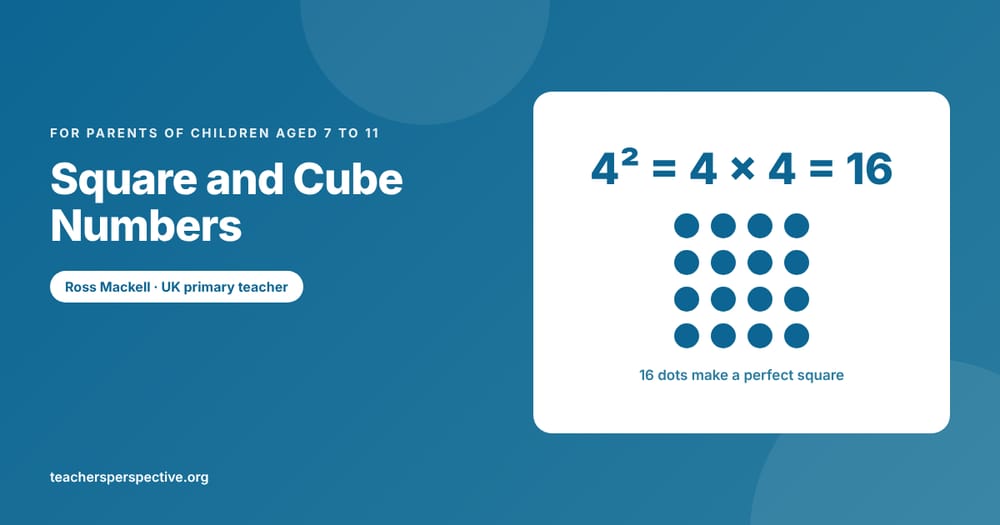

Ask your child what 5² is. A lot of children say 10. Some say 52. The answer is 25, and that one little number in the corner trips up children every year in the Year 6 SATs.
Square numbers and cube numbers come in properly in Year 5, and they turn up again and again after that: in the SATs arithmetic paper, in area and volume, and in secondary school algebra. The good news is that they're quick to learn once your child understands what the small 2 and 3 actually mean.
I'm Ross, a UK-qualified primary teacher with over ten years in the classroom. In this guide I'll explain what square and cube numbers are, the picture that makes them make sense, the ones worth learning by heart, how they come up in SATs, the mistakes I see most often, and practice questions with answers.
Quick answer: a square number is what you get when you multiply a number by itself. 4 × 4 = 16, so 16 is a square number, written 4² ("four squared"). A cube number is what you get when you multiply a number by itself and then by itself again. 2 × 2 × 2 = 8, so 8 is a cube number, written 2³ ("two cubed"). The small number tells you how many times to write the number down and multiply, not what to multiply by. So 5² = 5 × 5 = 25, not 5 × 2 = 10.
In this guide
What your child needs first
Square and cube numbers are built on two things:
- Times tables up to 12 × 12. Every square number up to 144 is a times table fact. If your child knows their tables, they already know the square numbers. They just don't know them by that name yet. If the tables aren't secure, start with how to learn times tables fast.
- Multiplying by a 1-digit number. For cube numbers, your child needs to work out things like 16 × 4 or 25 × 5 in their head or with short multiplication.
In the national curriculum, children are expected to recognise and use square numbers and cube numbers, and the notation for squared (²) and cubed (³), in Year 5. In Year 6 they use them in calculations, including in the order of operations, and they appear on the SATs arithmetic paper.
What square numbers are
The clue is in the name. A square number is a number of dots (or counters, or tiles) that you can arrange into a perfect square.
| Square | How it looks | Calculation | Square number |
|---|---|---|---|
| 1² | 1 row of 1 | 1 × 1 | 1 |
| 2² | 2 rows of 2 | 2 × 2 | 4 |
| 3² | 3 rows of 3 | 3 × 3 | 9 |
| 4² | 4 rows of 4 | 4 × 4 | 16 |
| 5² | 5 rows of 5 | 5 × 5 | 25 |
Get out some coins, pasta or Lego and ask your child to build them. Try to make a square out of 10 counters and they'll find it can't be done: 3 rows of 3 leaves one spare, and 4 rows of 4 needs six more. That's why 10 isn't a square number and 9 and 16 are.
When we write 5², we say "five squared". The 2 is a power, and it tells you how many 5s to multiply together. So 5² means 5 × 5, not 5 × 2.
Example 1: work out 7²
- The small 2 means two 7s multiplied together: 7 × 7.
- 7 × 7 = 49.
Example 2: work out 20²
- Two 20s multiplied together: 20 × 20.
- Use what you know: 2 × 2 = 4, and there are two zeros. 20 × 20 = 400. If that step feels shaky, multiplying by 10, 100 and 1000 explains why.
A nice fact to share
Square numbers are the only numbers with an odd number of factors. 16 has factors 1, 2, 4, 8 and 16, which is five factors, because 4 pairs with itself. If your child has been learning factors, multiples and prime numbers, this is a great one to explore together.
What cube numbers are
Cube numbers are the 3D version. Imagine building a cube out of small blocks, where the length, width and height are all the same.
Example 3: work out 2³
- The small 3 means three 2s multiplied together: 2 × 2 × 2.
- Do it in two steps. 2 × 2 = 4.
- 4 × 2 = 8. A cube 2 blocks long, 2 wide and 2 high uses 8 blocks.
Example 4: work out 4³
- Three 4s multiplied together: 4 × 4 × 4.
- First 4 × 4 = 16 (that's 4², a square number).
- Then 16 × 4 = 64.
Notice the pattern: every cube is a square number times one more lot of the same number. 4³ is 4² × 4. That's a useful way to work them out quickly.
If you have any Lego or building blocks at home, build 2³ and 3³ together. Seeing that 3³ needs 27 blocks, not 9, does more than any explanation.
Square and cube numbers are only as good as your child's times tables. Times tables and short multiplication are two of the 15 core skills every child aged 7 to 11 needs.
My free guide for parents shows all 15 core skills in order, so you can see exactly which one is holding your child back.
Get the free 15 Core Skills guide →The ones to learn by heart
By the end of Year 6, your child should know the square numbers up to 12² and the first five cube numbers without working them out. They should also be able to work out others when needed.
| Number | Squared | Cubed |
|---|---|---|
| 1 | 1 | 1 |
| 2 | 4 | 8 |
| 3 | 9 | 27 |
| 4 | 16 | 64 |
| 5 | 25 | 125 |
| 6 | 36 | 216 |
| 7 | 49 | |
| 8 | 64 | |
| 9 | 81 | |
| 10 | 100 | 1,000 |
| 11 | 121 | |
| 12 | 144 |
Two things worth pointing out to your child:
- 64 is both a square number (8²) and a cube number (4³). So is 1. Questions love asking about these.
- The square numbers go up by odd numbers. 1, 4, 9, 16, 25: the gaps are 3, 5, 7, 9. Children enjoy spotting this, and it helps them check their list.
A good way to practise is the diagonal of a times tables grid. Every number on the line from the top left corner to the bottom right is a square number.
Squares and cubes in SATs
Square and cube numbers usually come up in the Year 6 SATs arithmetic paper in a few different ways. These are the types to practise:
| Question type | Example | Answer |
|---|---|---|
| Work out a square | 9² | 81 |
| Work out a cube | 5³ | 125 |
| Squares in a calculation | 6² + 14 | 50 |
| Squares and cubes together | 3² + 2³ | 17 |
| Order of operations | 4 × 3² | 36 |
Example 5: 4 × 3²
This is where BIDMAS comes in. The I stands for indices, which is the proper name for powers like ² and ³. Indices come before multiplication.
- Work out the power first: 3² = 9.
- Then multiply: 4 × 9 = 36.
- If your child did 4 × 3 = 12 first and then squared it, they'd get 144, which is wrong.
In reasoning papers, your child might also be asked things like "Write a square number that is also a multiple of 5" (25 or 100) or "Find two square numbers that add up to 25" (9 and 16).
5 common mistakes and how to fix them
Mistake 1: Multiplying by the power
Your child writes 5² = 10 or 4³ = 12.
The fix: ask them to write it out in full every time until it sticks. 5² = 5 × 5. 4³ = 4 × 4 × 4. Then build it with counters or blocks. You can't make 5 rows of 5 out of 10 counters.
Mistake 2: Reading the power as a digit
Your child reads 5² as 52.
The fix: say it out loud together: "five squared". Ask them to point at the small number and tell you what job it does. The size difference matters.
Mistake 3: Stopping a cube too early
Your child works out 3³ as 3 × 3 = 9.
The fix: count the 3s. A cube has three of them. Remind them that cubes are 3D, so there's one more multiplication for the height.
Mistake 4: Squaring the wrong part
Your child works out 4 × 3² by doing 4 × 3 = 12, then 12² = 144.
The fix: the power belongs only to the number it's touching. Circle the 3² and work it out first, then do the rest.
Mistake 5: Mixing up squares and square roots
Your child is asked for the square root of 49 and writes 2,401.
The fix: a square root goes backwards. Ask "what number, times itself, makes 49?" The answer is 7. Knowing the squares by heart makes square roots easy.
Practice questions
Same three steps I use for every skill: watch, copy, practise. Do the first one out loud yourself, then let your child have a go at a similar one before they try the rest on their own. Cover the last column and ask your child to fill in the gaps.
| Question | Answer |
|---|---|
| 6² | 36 |
| 11² | 121 |
| 3³ | 27 |
| 10³ | 1,000 |
| 30² | 900 |
| 2³ + 4² | 24 |
| 5 × 2² | 20 |
| Which number squared makes 81? | 9 |
Bonus question: which number between 1 and 100 is both a square number and a cube number, apart from 1? (Answer: 64, because 8² = 64 and 4³ = 64.)
Ten minutes, a few times a week, is plenty. Only move on when they're getting three in a row right.
Keep going
Frequently asked questions
What is a square number?
A square number is the answer you get when you multiply a whole number by itself. For example, 6 × 6 = 36, so 36 is a square number. It's called square because that many dots can be arranged into a perfect square.
What are the square numbers up to 100?
The square numbers up to 100 are 1, 4, 9, 16, 25, 36, 49, 64, 81 and 100. They are 1², 2², 3² and so on up to 10².
What is a cube number?
A cube number is the answer you get when you multiply a whole number by itself, and then by itself again. For example, 3 × 3 × 3 = 27, so 27 is a cube number. The first five cube numbers are 1, 8, 27, 64 and 125.
What does the small 2 mean in maths?
The small raised 2 means "squared". It tells you to multiply the number by itself, so 7² means 7 × 7 = 49. A small raised 3 means "cubed", so 2³ means 2 × 2 × 2 = 8.
What year do children learn square and cube numbers?
In England, children learn to recognise and use square and cube numbers, and the ² and ³ notation, in Year 5. In Year 6 they use them in calculations and order of operations questions, and they often appear on the SATs arithmetic paper.
Get all 15 core skills in one place
Square and cube numbers are easy once times tables are automatic. The 15 core skills are the written methods and facts every child aged 7 to 11 needs to master to succeed in maths.
My free guide for parents shows all 15, in order, so you can see exactly where your child is and what comes next.
Get the free 15 Core Skills guide →Sources and further reading
- Department for Education, National curriculum in England: mathematics programmes of study (multiplication and division, Years 5 and 6)
- Standards and Testing Agency, Key stage 2 mathematics test framework
- Ross Mackell, Teacher's Perspective on YouTube

