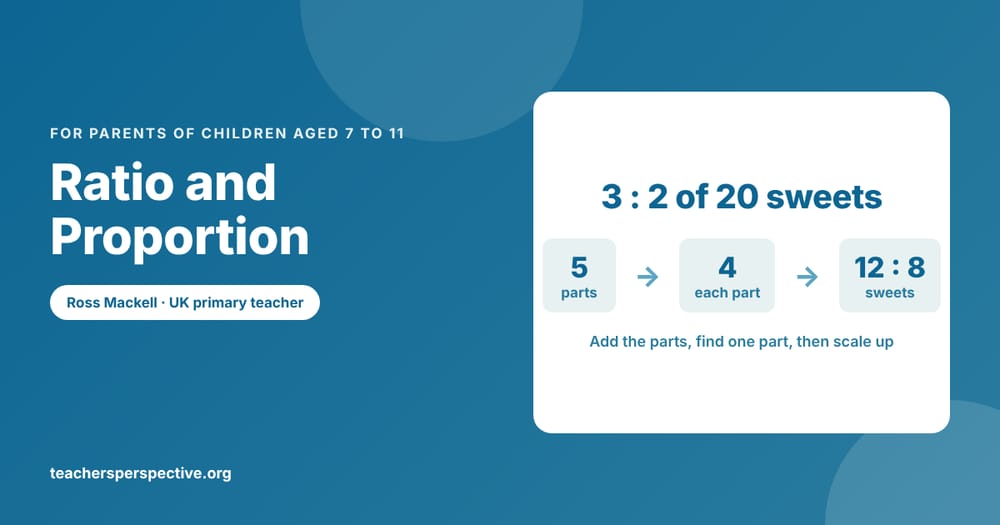

Ask your child to share 20 sweets between two friends in the ratio 3 : 2. A lot of children say one friend gets 3 and the other gets 2. Some guess 10 and 10. The answer is 12 and 8, and once your child sees why, ratio stops being scary and becomes one of the most logical topics in Year 6.
Ratio and proportion is its own section of the Year 6 maths curriculum, and it turns up every year in the SATs reasoning papers. It looks new and grown-up, but underneath it is built on times tables, division and fractions, things your child already knows.
I'm Ross, a UK-qualified primary teacher with over ten years in the classroom. In this guide I'll explain what ratio means, how it differs from a fraction, how to share an amount in a ratio, how proportion and scaling work, how it comes up in SATs, the mistakes I see most often, and practice questions with answers.
Quick answer: A ratio compares one part with another part. 3 : 2 means for every 3 of one thing there are 2 of the other. To share an amount in a ratio, add the parts (3 + 2 = 5), divide the total by the number of parts to find one part (20 ÷ 5 = 4), then multiply each side (3 × 4 = 12 and 2 × 4 = 8). Proportion compares a part with the whole: 12 out of 20 is 3/5. Scaling a recipe is proportion too: find the amount for one, then multiply.
In this guide
What your child needs first
Ratio questions are almost always times tables and division questions in disguise. Before your child starts, check these are secure:
- Times tables and division facts. Sharing 35 in the ratio 4 : 3 means spotting that 35 ÷ 7 = 5. If facts are slow, start with how to learn times tables fast.
- Fractions of amounts. Finding 3/5 of 20 is the same thinking as sharing in a ratio. See how to find a fraction of an amount.
- Simplifying. Simplifying a ratio works exactly like simplifying fractions, using common factors.
In the national curriculum, ratio and proportion is taught as a separate strand in Year 6. The groundwork comes earlier: in Years 3 and 4 children solve scaling and correspondence problems (for example, 3 hats and 4 coats make 12 different outfits), and in Year 5 they scale by simple fractions and work with rates.
What is a ratio?
A ratio tells you how much of one thing there is compared with another. It is written with a colon. If a bag has 3 red beads for every 2 blue beads, the ratio of red to blue is 3 : 2, read as "3 to 2".
Two things matter straight away. First, the order matters: red to blue is 3 : 2, but blue to red is 2 : 3. Second, ratios can be simplified like fractions. If there are 12 red and 8 blue, the ratio 12 : 8 simplifies to 3 : 2, because you can divide both numbers by 4.
Ratio or fraction?
This is where most of the confusion lives. The same bag of beads can be described with a ratio or with fractions, and your child needs to be able to move between them:
| Bag of beads | Ratio (part to part) | Fraction (part to whole) |
|---|---|---|
| 3 red, 2 blue | red : blue = 3 : 2 | 3/5 are red, 2/5 are blue |
| 1 red, 3 blue | red : blue = 1 : 3 | 1/4 are red, 3/4 are blue |
| 4 red, 5 blue | red : blue = 4 : 5 | 4/9 are red, 5/9 are blue |
The trick is to add the parts to find the whole. 3 : 2 has 5 parts altogether, so red is 3 out of 5, which is 3/5. It is never 3/2.
Sharing in a ratio
This is the question type your child will meet most. I teach it with a bar model, because drawing the parts makes the method obvious. Three steps every time: add the parts, find one part, multiply.
Example 1: Share 20 sweets in the ratio 3 : 2
- Draw 3 boxes for the first friend and 2 boxes for the second. That's 3 + 2 = 5 boxes.
- The 20 sweets fill all 5 boxes, so one box is 20 ÷ 5 = 4.
- First friend: 3 × 4 = 12. Second friend: 2 × 4 = 8.
- Check: 12 + 8 = 20. The answer is 12 and 8.
Example 2: Share 35 in the ratio 4 : 3
- 4 + 3 = 7 parts.
- One part is 35 ÷ 7 = 5.
- 4 × 5 = 20 and 3 × 5 = 15.
- The answer is 20 and 15. Check: 20 + 15 = 35.
Example 3: When you know one side, not the total
The ratio of boys to girls in a club is 2 : 5. There are 10 boys. How many girls are there?
- This time you are not given the total. You are given the boys, which are 2 parts.
- 2 parts = 10, so one part is 10 ÷ 2 = 5.
- Girls are 5 parts: 5 × 5 = 25.
- The answer is 25 girls (and 35 children altogether).
Notice the difference between Example 1 and Example 3. Before starting, teach your child to ask one question: do I know the total, or do I know one side? That decides whether they add the parts or not.
Ratio is really a test of times tables and division. Multiplication, division and fractions are part of the 15 core skills every child aged 7 to 11 needs, and they sit underneath every ratio question in Year 6.
My free guide for parents shows all 15 core skills in order, so you can see exactly which one is holding your child back.
Get the free 15 Core Skills guide →Proportion and scaling
Proportion is about keeping things in the same relationship as they get bigger or smaller. Recipes are the classic example, and they are a great way to practise at home. The method is the same as ratio: find the amount for one, then multiply.
Example 4: A recipe for 4 people uses 200 g of flour. How much for 6 people?
- Find the amount for 1 person: 200 ÷ 4 = 50 g.
- Multiply for 6 people: 50 × 6 = 300 g.
- The answer is 300 g.
Example 5: 3 pens cost £1.20. How much do 7 pens cost?
- Find the cost of 1 pen: £1.20 ÷ 3 = 40p.
- Multiply for 7 pens: 7 × 40p = 280p.
- The answer is £2.80.
Sometimes there is a quicker route. To go from 4 people to 8 people you can just double. To go from 4 to 6 you could halve (for 2 people) and then times by 3. Let your child find these shortcuts, but make sure the "find one, then multiply" method is secure first, because it works every time.
Ratio in SATs
Ratio isn't on the arithmetic paper, but it comes up in the Year 6 SATs reasoning papers. These are the question types to practise:
| Question type | Example | Answer |
|---|---|---|
| Share in a ratio | Share 45 sweets in the ratio 4 : 5 | 20 and 25 |
| Find the other side | Red to blue is 2 : 3. There are 12 red. How many blue? | 18 |
| Find the total | Cats to dogs is 3 : 1. There are 9 cats. How many animals altogether? | 12 |
| Scale a recipe | Pancakes for 4 use 120 g of flour. How much for 10 people? | 300 g |
| Ratio and fractions | 1 in every 4 beads is red. How many red beads in a bag of 36? | 9 |
| Scale factor | A shape is enlarged by scale factor 3. A side of 4 cm becomes? | 12 cm |
For more on how the SATs papers are set out, see the guide to the Year 6 SATs arithmetic paper.
5 common mistakes and how to fix them
Mistake 1: Using the ratio numbers as the answer
Your child shares 20 in the ratio 3 : 2 and writes 3 and 2.
The fix: the numbers in a ratio are parts, not amounts. Always check that the answers add back up to the total. 3 + 2 is 5, not 20, so something is missing.
Mistake 2: Turning 3 : 2 into the fraction 3/2
Your child is asked what fraction of the beads are red and writes 3/2.
The fix: a fraction needs the whole on the bottom. Add the parts first: 3 + 2 = 5, so red is 3/5.
Mistake 3: Getting the order the wrong way round
The question asks for the ratio of girls to boys, and your child writes boys to girls.
The fix: label the bar model with words, not just numbers, and write the ratio in the same order as the question.
Mistake 4: Adding instead of multiplying when scaling
A recipe for 4 needs 200 g of flour, so your child adds 2 to make it for 6 people: 202 g.
The fix: scaling is multiplying, not adding. Find the amount for 1 person, then multiply. A quick sense check helps: 6 people should need a lot more flour than 4, not 2 g more.
Mistake 5: Adding the parts when you don't need to
Boys to girls is 2 : 5 and there are 10 boys. Your child does 10 ÷ 7 and gets stuck.
The fix: ask "do I know the total, or one side?" Here you know the boys, which is 2 parts, so one part is 10 ÷ 2 = 5.
Practice questions
Same three steps I use for every skill: watch, copy, practise. Do the first one out loud yourself, then let your child have a go at a similar one before they try the rest on their own. Cover the last column and ask your child to fill in the gaps.
| Question | Answer |
|---|---|
| Simplify 10 : 15 | 2 : 3 |
| Simplify 24 : 16 | 3 : 2 |
| Share 30 in the ratio 1 : 2 | 10 and 20 |
| Share 56 in the ratio 3 : 4 | 24 and 32 |
| Share £40 in the ratio 3 : 5 | £15 and £25 |
| Boys to girls is 3 : 4. There are 12 girls. How many boys? | 9 |
| 4 apples cost 80p. How much do 9 apples cost? | £1.80 |
| Red to blue is 2 : 7. What fraction are red? | 2/9 |
Bonus question: the ratio of cats to dogs at a shelter is 5 : 3. There are 6 more cats than dogs. How many animals are there altogether? (Answer: 24. The difference is 2 parts, so 2 parts = 6 and one part = 3. There are 8 parts altogether, and 8 × 3 = 24.)
Ten minutes, a few times a week, is plenty. A fun extra: cook together and scale a recipe up or down, or count the colours in a packet of sweets and write the ratio.
Keep going
Frequently asked questions
What is a ratio in maths?
A ratio compares one amount with another. It is written with a colon, so 3 : 2 means for every 3 of one thing there are 2 of the other. The order matters: 3 : 2 is not the same as 2 : 3.
What is the difference between ratio and proportion?
A ratio compares part to part, such as 3 red beads to 2 blue beads (3 : 2). Proportion compares a part to the whole, such as 3 out of 5 beads being red (3/5). Proportion is also used for scaling, where every amount is multiplied by the same number, like doubling a recipe.
How do you share an amount in a ratio?
Add the parts of the ratio, divide the total by that number to find one part, then multiply each side of the ratio by one part. To share 20 in the ratio 3 : 2: 3 + 2 = 5, 20 ÷ 5 = 4, so the shares are 12 and 8.
How do you simplify a ratio?
Divide both sides by the same number, ideally the highest common factor. 12 : 8 simplifies to 3 : 2 because both numbers divide by 4. It works the same way as simplifying fractions.
What year do children learn ratio?
In England, ratio and proportion is taught as its own topic in Year 6 and appears in the SATs reasoning papers. Children prepare for it earlier through scaling and correspondence problems in Years 3 and 4 and scaling by simple fractions in Year 5.
Get all 15 core skills in one place
Ratio is easy once times tables, division and fractions are secure. The 15 core skills are the written methods and facts every child aged 7 to 11 needs to master to succeed in maths.
My free guide for parents shows all 15, in order, so you can see exactly where your child is and what comes next.
Get the free 15 Core Skills guide →Sources and further reading
- Department for Education, National curriculum in England: mathematics programmes of study (ratio and proportion, Year 6; multiplication and division, Years 3 to 5)
- Standards and Testing Agency, Key stage 2 mathematics test framework
- Ross Mackell, Teacher's Perspective on YouTube

