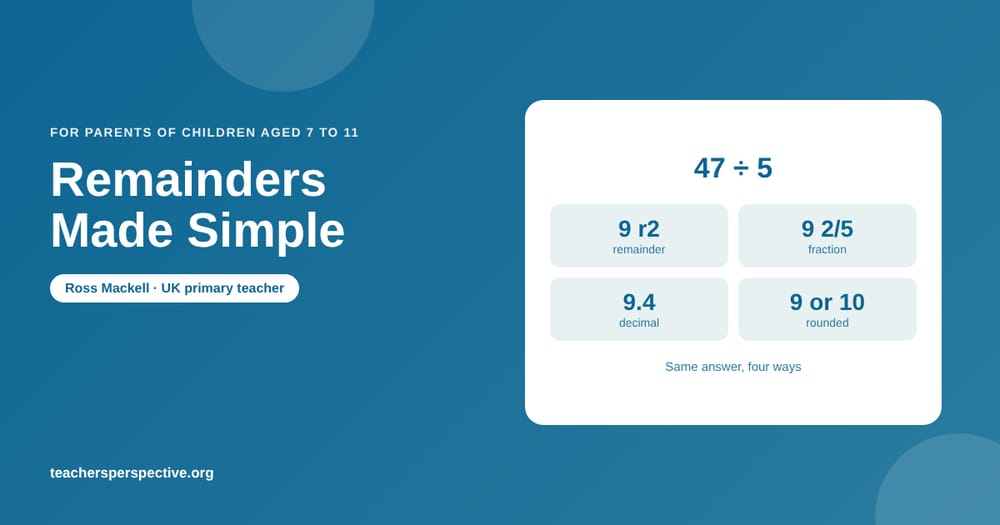

Your child works out 47 ÷ 5 and writes 9 r2. Then the worksheet asks for the answer as a decimal, and they freeze. Or a word problem asks how many minibuses are needed for 30 children, and they confidently write 3.75 minibuses.
Remainders look simple, but they trip up a lot of children in Years 5 and 6. The division is usually fine. It's knowing what to do with the bit left over that causes the trouble.
I'm Ross, a UK-qualified primary teacher with over ten years in the classroom. In this guide I'll explain what a remainder is, the four ways children are expected to write one, how to turn a remainder into a fraction or a decimal, how to decide what to do with a remainder in a word problem, and practice questions with answers.
Quick answer: A remainder is the amount left over when one number doesn't divide exactly into another. 47 ÷ 5 = 9 remainder 2. Children in Years 5 and 6 learn to write remainders in four ways: as a whole number (9 r2), as a fraction (9 2/5), as a decimal (9.4), or by rounding up or down to suit a word problem.
In this guide
What is a remainder?
Division is about sharing or grouping. If you share 47 sweets between 5 children, each child gets 9 sweets. That uses 45 sweets, so 2 are left over. Those 2 sweets are the remainder.
We write it as 47 ÷ 5 = 9 r2. The r stands for remainder.
One rule is worth teaching straight away: the remainder must always be smaller than the number you're dividing by. If you're dividing by 5 and your remainder is 6, you could have made one more group of 5. That's a quick check your child can use every time.
Your child can also check any answer by multiplying back: 9 × 5 = 45, then 45 + 2 = 47. If it matches the number they started with, the division is right.
The four ways to write a remainder
In Year 5 children learn to interpret remainders appropriately for the context. By Year 6 the national curriculum expects them to interpret remainders as whole number remainders, fractions, or by rounding. They also learn to give answers as decimals. Here's 47 ÷ 5 written all four ways:
| Way | 47 ÷ 5 | When to use it |
|---|---|---|
| Whole number remainder | 9 r2 | Most calculations in Years 4 and 5, and when the question doesn't say |
| Fraction | 9 2/5 | When things can be split into equal parts, like pizzas or cakes |
| Decimal | 9.4 | Money and measures, like £, kg or metres |
| Rounded | 9 or 10 | Word problems where you can't have part of something, like buses or boxes |
All four answers describe exactly the same division. The skill is choosing the right one for the question. If your child isn't yet secure with the division itself, start with my guide to the bus stop method.
Remainders as fractions
This is easier than most children expect. The remainder goes on top, and the number you divided by goes on the bottom.
47 ÷ 5 = 9 r2. The remainder is 2 and we divided by 5, so the answer is 9 2/5.
Why does this work? We had 2 sweets left to share between 5 children. Each child gets 2/5 of a sweet. So each child gets 9 and 2/5 sweets altogether.
A few more examples:
| Division | With remainder | As a fraction |
|---|---|---|
| 23 ÷ 4 | 5 r3 | 5 3/4 |
| 29 ÷ 6 | 4 r5 | 4 5/6 |
| 38 ÷ 6 | 6 r2 | 6 2/6, which simplifies to 6 1/3 |
| 853 ÷ 4 | 213 r1 | 213 1/4 |
Notice that 6 2/6 can be simplified to 6 1/3. In Year 6 your child may be asked to give the fraction in its simplest form, so it's worth checking. My guide to equivalent fractions and simplifying shows how.
Remainders as decimals
There are two ways to turn a remainder into a decimal. Your child can use whichever feels easier.
Method 1: Make the fraction, then convert it
Write the remainder as a fraction first, then change the fraction to a decimal. 47 ÷ 5 = 9 2/5. Two fifths is the same as 4 tenths, so 9 2/5 = 9.4. This works well when the fraction is a familiar one, like 1/2 = 0.5, 1/4 = 0.25, 3/4 = 0.75 or any number of fifths and tenths. My guide to fractions, decimals and percentages has a full table of the common ones.
Method 2: Keep dividing in the bus stop
Instead of writing r at the end, put a decimal point after the number, add a zero, and carry on dividing. Here's 47 ÷ 4:
- 4 into 4 goes 1. Write 1 on top.
- 4 into 7 goes 1, remainder 3. Write 1 on top and carry the 3.
- Instead of stopping, write a decimal point after 47, and a decimal point in the answer directly above it.
- Write a 0 after the decimal point. The carried 3 makes it 30. 4 into 30 goes 7, remainder 2. Write 7 on top and carry the 2.
- Add another 0. The carried 2 makes it 20. 4 into 20 goes 5 exactly. Write 5 on top.
So 47 ÷ 4 = 11.75. Check: 11.75 × 4 = 47.
Adding zeros after the decimal point doesn't change the number, because 47 and 47.00 are the same. It just gives us more places to keep sharing.
Some divisions never end. 38 ÷ 6 = 6.333... with the 3 repeating forever. In primary school your child would usually round this, for example to 6.33 (two decimal places). Year 6 children are expected to use written division where the answer has up to two decimal places.
Remainders are where division meets fractions and decimals. Short division, long division and converting fractions to decimals are all part of the 15 core skills every child aged 7 to 11 needs.
My free guide for parents shows all 15 core skills in order, so you can see exactly which one is holding your child back.
Get the free 15 Core Skills guide →Remainders in word problems: round up or down?
This is the part of remainders that catches out the most children, including confident mathematicians. In a word problem, the right answer depends on the story, not just the numbers. Teach your child to ask: what is the question really asking?
Round up: when everyone or everything has to fit
30 children are going on a trip. Each minibus holds 8 children. How many minibuses are needed?
30 ÷ 8 = 3 r6. Three minibuses would leave 6 children behind, so we need another one. Answer: 4 minibuses.
Round down: when you can only count complete groups
A baker has 40 cakes. A box holds 6 cakes. How many boxes can she fill?
40 ÷ 6 = 6 r4. The 4 leftover cakes don't fill a box. Answer: 6 full boxes.
Use a decimal: money and measures
Four friends share a £25 bill equally. How much does each person pay?
25 ÷ 4 = 6 r1. You can't pay 6 r1 pounds. The leftover £1 is shared too, which is 25p each. Answer: £6.25.
Use a fraction: things that can be cut up
7 pizzas are shared equally between 2 families. How much pizza does each family get?
7 ÷ 2 = 3 r1. The leftover pizza can be cut in half. Answer: 3 1/2 pizzas.
| If the question asks... | Then... |
|---|---|
| How many do we need? (buses, boxes, tables, trips) | Round up |
| How many complete ones can we make or fill? | Round down |
| How much each? (with money or measures) | Use a decimal |
| How much each? (with things you can cut, like pizza or cake) | Use a fraction |
| How many are left over? | The remainder is the answer |
A good habit is to read the answer back as a sentence. "We need 3.75 minibuses" sounds silly as soon as you say it out loud, and that's the point.
5 common mistakes and how to fix them
Mistake 1: A remainder that's too big
Your child writes 50 ÷ 6 = 7 r8.
The fix: the remainder must be smaller than the divisor. 8 is bigger than 6, so another group fits. 50 ÷ 6 = 8 r2. Times tables are usually the cause, so check the 6 times table.
Mistake 2: Writing the remainder as a decimal digit
Your child knows 47 ÷ 5 = 9 r2, so they write 9.2.
The fix: r2 means 2 out of 5, not 2 tenths. Make the fraction first: 2/5 = 4/10 = 0.4. So the answer is 9.4. Checking by multiplying (9.2 × 5 = 46, not 47) shows the mistake.
Mistake 3: Putting the divisor on top of the fraction
Your child writes 47 ÷ 5 as 9 5/2.
The fix: remainder on top, divisor on the bottom. Use the sweets story: 2 sweets shared between 5 children is 2/5 each.
Mistake 4: Ignoring the story in a word problem
Your child answers "3 r6 minibuses" or "3.75 minibuses".
The fix: read the answer back as a sentence and ask whether it makes sense. Then decide: round up, round down, decimal or fraction?
Mistake 5: Forgetting the decimal point in the bus stop
When dividing into decimals, your child forgets to put the decimal point in the answer and writes 1175 instead of 11.75.
The fix: put the decimal point in the answer as soon as it goes into the number underneath, directly above it, before doing any more dividing.
Practice questions
Ask your child to give each answer with a remainder first, then as a fraction or decimal. For the word problems, ask them to explain why they rounded up or down.
| Question | Answer |
|---|---|
| 29 ÷ 4 | 7 r1 = 7 1/4 = 7.25 |
| 53 ÷ 5 | 10 r3 = 10 3/5 = 10.6 |
| 67 ÷ 2 | 33 r1 = 33 1/2 = 33.5 |
| 125 ÷ 8 | 15 r5 = 15 5/8 = 15.625 |
| 358 ÷ 6 | 59 r4 = 59 4/6 = 59 2/3 |
| 1,234 ÷ 5 | 246 r4 = 246 4/5 = 246.8 |
| 100 eggs go into boxes of 12. How many full boxes? | 100 ÷ 12 = 8 r4, so 8 full boxes (round down) |
| 75 people need taxis. Each taxi holds 4. How many taxis? | 75 ÷ 4 = 18 r3, so 19 taxis (round up) |
| £14 is shared equally between 8 children. How much each? | 14 ÷ 8 = 1 r6, so £1.75 each |
| 7 cakes shared equally between 4 people. How much each? | 7 ÷ 4 = 1 r3, so 1 3/4 cakes each |
Five to ten minutes a day, a few times a week, will make a bigger difference than an hour at the weekend.
Keep going
Frequently asked questions
What is a remainder in maths?
A remainder is the amount left over when a number can't be divided exactly. For example, 17 ÷ 5 = 3 remainder 2, because three groups of 5 make 15 and there are 2 left over. The remainder is always smaller than the number you're dividing by.
How do you turn a remainder into a fraction?
Put the remainder on top and the number you divided by on the bottom. For 17 ÷ 5 = 3 r2, the remainder is 2 and you divided by 5, so the answer is 3 2/5.
How do you turn a remainder into a decimal?
Either make the fraction and convert it (3 2/5 = 3.4), or carry on dividing in the bus stop method by adding a decimal point and zeros after the number. 17 ÷ 4 becomes 17.00 ÷ 4 = 4.25.
What year do children learn remainders?
Children meet remainders informally in Years 3 and 4, and learn short division with remainders in Year 5. In Year 6 they are expected to interpret remainders as whole numbers, fractions or by rounding, depending on the question.
When do you round a remainder up?
Round up when everything has to be included, such as how many buses, boxes or trips are needed. Round down when the question asks how many complete groups you can make.
Get all 15 core skills in one place
Remainders only make sense once short division, long division and fractions are secure. The 15 core skills are the written methods and facts every child aged 7 to 11 needs to master to succeed in maths.
My free guide for parents shows all 15, in order, so you can see exactly where your child is and what comes next.
Get the free 15 Core Skills guide →Sources and further reading

