
Your child comes home in Year 4 and says they did the bus stop method today. Your friend's child in Year 6 still can't do long division. Another parent swears their Year 3 is already doing long multiplication. It's hard to know what's normal, and even harder to know whether your child is behind.
The good news is that schools in England follow the same national curriculum, and it's very specific about when each written method should be learnt. Once you know the order, you can see exactly where your child is and what comes next.
I'm Ross, a UK-qualified primary teacher with over ten years in the classroom. In this guide I'll explain when children learn long division, when every other written method is taught, year by year, what each one depends on, and what to do if your child is behind.
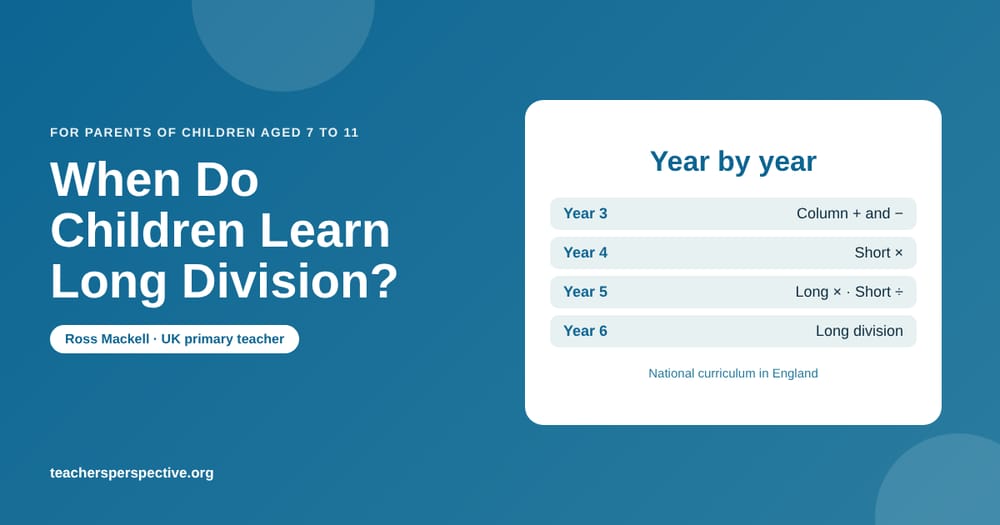
Quick answer: Children in England learn long division in Year 6 (age 10 to 11). The national curriculum expects them to divide numbers up to 4 digits by a 2-digit number using long division, and to interpret remainders as whole numbers, fractions or by rounding. Short division (the bus stop method) comes first, in Year 5, and many schools introduce it in Year 4.
In this guide
When do children learn long division?
Long division is a Year 6 objective in the national curriculum for England. By the end of primary school, children are expected to divide numbers with up to 4 digits by a 2-digit whole number using the formal written method of long division, for example 4,738 ÷ 15.
It's the last written method children learn in primary school, and it pulls together almost everything that comes before it: times tables, multiplication, subtraction, place value and remainders. That's why it feels so hard for children who have gaps lower down.
Here's the division journey in short:
| Year | Age | Division your child learns |
|---|---|---|
| Year 2 | 6 to 7 | Division facts for the 2, 5 and 10 times tables, sharing and grouping |
| Year 3 | 7 to 8 | Division facts for the 3, 4 and 8 times tables, 2-digit ÷ 1-digit |
| Year 4 | 8 to 9 | All division facts up to 12 × 12. Many schools start short division here |
| Year 5 | 9 to 10 | Short division (bus stop): up to 4 digits ÷ 1 digit, with remainders |
| Year 6 | 10 to 11 | Long division: up to 4 digits ÷ 2 digits. Remainders as fractions, decimals or rounded |
If you want to see the methods themselves, I've written step by step guides to the bus stop method and long division.
Every written method, year by year
Division is only part of the picture. Here's when each of the main written methods appears in the national curriculum. These are the end of year expectations, so your child should be secure with each one by the summer term.
| Year | Addition and subtraction | Multiplication and division |
|---|---|---|
| Year 1 (5 to 6) | Number bonds within 20. Add and subtract 1-digit and 2-digit numbers to 20 | Counting in 2s, 5s and 10s. Simple sharing with objects |
| Year 2 (6 to 7) | Add and subtract 2-digit numbers using objects, pictures and mental methods | 2, 5 and 10 times tables and their division facts |
| Year 3 (7 to 8) | Column addition and subtraction with up to 3 digits | 3, 4 and 8 times tables. 2-digit × 1-digit, moving towards a written method |
| Year 4 (8 to 9) | Column addition and subtraction with up to 4 digits | All times tables to 12 × 12. Short multiplication: 2-digit and 3-digit × 1-digit |
| Year 5 (9 to 10) | Column methods with more than 4 digits. Many schools add decimals here too | Short multiplication up to 4-digit × 1-digit. Long multiplication: 2-digit × 2-digit and beyond. Short division |
| Year 6 (10 to 11) | Fluent with all column methods, including decimals | Long multiplication up to 4-digit × 2-digit. Long division. Order of operations (BIDMAS) |
Year 3: column addition and subtraction
Year 3 is when the first formal written methods arrive. Children learn to line numbers up in columns and add or subtract with up to 3 digits, including exchanging (what we used to call carrying and borrowing). See column addition and subtraction for the full method.
Year 4: short multiplication and the times tables check
By the end of Year 4, children should know every times table up to 12 × 12. In June they sit the multiplication tables check, an online test of 25 questions with 6 seconds each. They also learn short multiplication, such as 347 × 6, set out in columns. Many schools use the grid method as a stepping stone first.
Year 5: long multiplication and short division
Year 5 is a big year. Children learn long multiplication for 2-digit numbers (for example 46 × 27) and short division for up to 4-digit numbers divided by a 1-digit number. They are also expected to interpret remainders sensibly, and to multiply and divide by 10, 100 and 1000, including with decimals.
Year 6: long division and putting it all together
In Year 6 children extend long multiplication to 4-digit × 2-digit numbers, learn long division, use written division where the answer has up to two decimal places, and use the order of operations. All of this is tested in the Year 6 SATs arithmetic paper in May.
Every one of these methods is part of the 15 core skills. Column addition and subtraction, short and long multiplication, short and long division: they are the written methods every child aged 7 to 11 needs to master.
My free guide for parents shows all 15 core skills in order, so you can see exactly where your child is and which one is holding them back.
Get the free 15 Core Skills guide →Why the order matters
Written methods are built like a staircase. Each one uses the step below it. Look at what's going on inside a single long division:
| Inside long division you need... | Which was learnt in... |
|---|---|
| Times tables facts, quickly | Years 2 to 4 |
| Multiplying a 2-digit number by a 1-digit number | Years 3 to 4 |
| Column subtraction with exchanging | Years 3 to 4 |
| Place value, to keep digits in the right columns | Years 1 to 4 |
| Understanding remainders | Years 4 to 5 |
So when a child in Year 6 struggles with long division, the problem is rarely long division itself. It's usually a crack lower down the staircase. They might be counting up in 15s on their fingers, or making a slip with exchanging in the subtraction step. Fix that step, and long division suddenly makes sense.
This is also why rushing ahead rarely helps. Teaching a Year 4 child long division before their times tables are secure tends to create confusion, not progress.
What your child needs before long division
Before your child tackles long division, check they can do each of these confidently, without help:
- Recall times tables facts to 12 × 12 in a few seconds. Try how to learn times tables fast.
- Multiply any 2-digit number by a 1-digit number, for example 15 × 7.
- Do a column subtraction with exchanging, for example 473 − 165.
- Do short division with a remainder, for example 853 ÷ 4. Here's how to write remainders as fractions and decimals.
- Estimate an answer by rounding, so they can spot when something has gone wrong.
If any of these wobble, spend a couple of weeks there first. It's the quickest route to long division in the end.
Signs your child is behind, and what to do
Every child develops at a slightly different pace, and a few weeks either way is nothing to worry about. These signs are worth acting on, though:
- In Year 4 or above, they still count on their fingers for number bonds to 10 or 20.
- In Year 5 or above, they can't recall most times tables quickly and need to count up.
- They avoid written methods and try to do everything in their head, then get lost.
- They can follow a method with you sitting next to them, but forget it a day later.
- They say they "hate maths" or feel stupid in maths lessons.
If you recognise your child here, don't panic. The fix is almost always the same: find the first method in the staircase that isn't secure, and work on that. Short, regular practice works far better than long sessions. Ten minutes a night, four or five nights a week, is plenty. My guide to helping your child with maths at home has more on how to set that up, and what to do if your child hates maths covers the confidence side.
It's also worth a short chat with your child's teacher. Ask which methods they're working on in class and which ones the teacher feels need more practice. Most teachers are glad to be asked.
Why schools teach things at different times
The national curriculum sets out what children should know by the end of each year, but schools decide how and when to teach it within the year. That's why one Year 4 class might start the bus stop method in the autumn while another waits until Year 5. Some schools follow a scheme such as White Rose or Maths No Problem, which sets its own order.
Schools also use different stepping stone methods. Your child might use chunking before short division, or the grid method before short multiplication. These aren't required by the curriculum, but they help children understand what's happening before they move to the faster formal methods. There's more on this in why maths is taught differently now.
This guide covers the curriculum in England. Scotland, Wales and Northern Ireland have their own curricula, so the timings there can be different. The government has also announced a revised national curriculum for England for first teaching from 2028. Until then, the timings above are what schools follow.
Keep going
Frequently asked questions
What age do children learn long division?
Children in England learn long division in Year 6, when they are 10 to 11 years old. The national curriculum expects them to divide numbers up to 4 digits by a 2-digit number using long division by the end of the year.
Do schools still teach long division?
Yes. Long division is part of the Year 6 national curriculum in England and appears in the Year 6 SATs arithmetic paper. Children usually learn short division (the bus stop method) first, in Year 4 or Year 5.
What year do children learn the bus stop method?
Short division, often called the bus stop method, is a Year 5 objective in the national curriculum. Many schools introduce it in Year 4 once children know their times tables.
When do children learn long multiplication?
Children learn long multiplication in Year 5, starting with 2-digit by 2-digit numbers such as 46 × 27. In Year 6 they extend it to 4-digit by 2-digit numbers.
When do children learn column addition and subtraction?
Formal column addition and subtraction start in Year 3 with numbers up to 3 digits. By Year 4 children work with up to 4 digits, and by Year 5 with larger numbers and decimals.
My child is in Year 6 and can't do long division. Are they behind?
Not necessarily, as many children only become confident with long division in the spring or summer of Year 6. Check the skills underneath it first: times tables, multiplying by a 1-digit number, column subtraction and short division. Gaps there are the most common reason long division doesn't stick.
Get all 15 core skills in one place
Long division is the top of a staircase of written methods that starts in Year 3. The 15 core skills are the written methods and facts every child aged 7 to 11 needs to master to succeed in maths.
My free guide for parents shows all 15, in order, so you can see exactly where your child is and what comes next.
Get the free 15 Core Skills guide →Sources and further reading

