
Every child makes mistakes in maths. That's normal, and it's how they learn. But after more than ten years teaching in UK primary classrooms, I can tell you that the same handful of mistakes come up again and again, in almost every class, every year.
The good news is that these mistakes are predictable, which means they are fixable. In this guide I'll walk you through the seven I see most often in children aged 7 to 11, what each one looks like on the page, why it happens, and what you can do about it at home.
Quick answer: The most common maths mistakes children make are: subtracting the smaller digit from the bigger one instead of exchanging, lining up columns wrongly, copying the question down incorrectly, forgetting to carry or exchange, times table slips, misunderstanding place value with zeros and decimals, and not checking whether an answer is sensible. Almost all of them come from a method that isn't fully secure, so the fix is short, regular practice of the method itself.
In this guide
The 7 mistakes at a glance
| Mistake | What it looks like | The quick fix |
|---|---|---|
| Flipping digits | 52 − 17 = 45 (did 7 − 2 instead of exchanging) | Always start with the top digit: "Can I take 7 from 2?" |
| Wrong columns | Ones lined up under tens | Squared paper, one digit per box, line up from the right |
| Copying wrongly | Question says 384, child writes 348 | Watch, Copy, Practise and point-and-check |
| Forgetting to carry | Carried digit written but not added | Write carried digits clearly under the line |
| Times table slips | 7 × 8 = 54 | Target the few facts that are missing |
| Zeros and decimals | 0.5 × 10 = 0.50 | Teach that digits move, not the decimal point |
| Not checking | An answer that can't be right | Estimate first, then compare |
1. Flipping the digits in subtraction
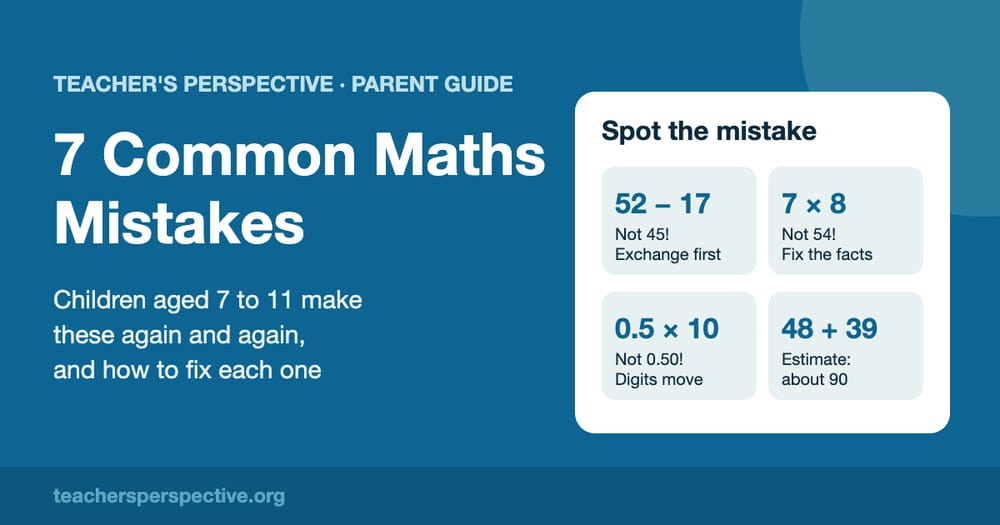
This is the single most common mistake I see. Faced with 52 − 17, a child looks at the ones column, sees a 2 and a 7, and does 7 − 2 = 5, because they've learned that you take the small number from the big one. They write 45 instead of 35.
It happens because, earlier on, "take the smaller from the bigger" usually worked. In column subtraction it doesn't. The top number always comes first. If the top digit is too small, you exchange one from the next column.
The fix: teach your child to say the question out loud from the top: "2 take away 7. Can I do that? No, so I exchange." Saying it in that order stops the flip. I explain exchanging step by step in my column subtraction guide, and the trickiest version, exchanging across a zero, in column subtraction with zeros.
▶ Video: the column subtraction mistake most children make, and how to fix it (6 minutes). Watch on YouTube
2. Lining up the columns wrongly
Every written method depends on digits being in the right column: ones under ones, tens under tens, hundreds under hundreds. When a child writes 345 + 62 with the 6 under the 3 instead of under the 4, every answer after that is wrong, however good their adding is.
This mistake gets more serious as numbers get bigger, and it causes chaos in long multiplication and decimal calculations, where digits have to line up by the decimal point.
The fix: use squared paper, one digit per square, and always line numbers up from the right (or from the decimal point). A quick reminder of place value helps children understand why the columns matter.
3. Copying the question wrongly
This one surprises parents. A child does the method perfectly, but the answer is wrong because they copied 384 as 348, or 6,029 as 6,209. In the classroom I see this all the time, especially when children copy from a board or a textbook into their book.
The fix: I use a routine called Watch, Copy, Practise. Before calculating, your child copies the question and then checks it digit by digit against the original, pointing at each one. It takes ten seconds and saves a lot of frustration.
Most of these mistakes come from one shaky method. In my experience, a child rarely needs to "get better at maths" in general. They need one or two of the core methods fixed.
My free guide lists the 15 core arithmetic skills every child needs by the end of Year 6, so you can find the exact one that's causing the mistakes.
Get the free 15 Core Skills guide4. Forgetting to carry or exchange
In column addition and short multiplication, children often work out that they need to carry a digit, write it down, and then forget to add it to the next column. In subtraction, they exchange from the tens but forget to cross out and reduce the tens digit.
The fix: agree where carried digits go (I teach underneath the answer line, small and clear) and make it a habit to touch the carried digit before adding the next column. For subtraction, the rule is simple: if you've exchanged, there must be a crossing out.
5. Times table slips
A child can set out short division perfectly and still get the answer wrong because they think 7 × 8 is 54. Times tables are the engine inside multiplication, division, fractions and much more, so one shaky fact can cause errors everywhere.
The fix: don't drill all the tables again. Find the specific facts your child doesn't know instantly. Most children only have a handful. My guide on how to learn times tables fast shows why there are really only 36 facts to learn.
6. Getting muddled with zeros and decimals
Zeros cause a lot of trouble. Children write 0.5 × 10 = 0.50, because they've learned to "add a zero" when multiplying by 10. Others read 3.25 and 3.5 and think 3.25 is bigger because 25 is bigger than 5.
The fix: stop saying "add a zero". When you multiply by 10, every digit moves one place to the left. My guide to multiplying and dividing by 10, 100 and 1,000 shows this with a place value chart, which makes it click for most children.
7. Not checking whether the answer makes sense
Children often finish a calculation and move straight on, even when the answer is clearly impossible. 48 + 39 = 717 can happen when digits are written side by side instead of carried, and it goes unnoticed because the child never asked, "Is that about right?"
The fix: before calculating, your child makes a quick estimate. 48 + 39 is about 50 + 40, so about 90. If their answer is nowhere near, they know to look again. Rounding and inverse operations are the two best checking tools at primary school.
How to fix mistakes at home
Mistakes are useful. They show you exactly which method needs work. Here's how I'd use them:
- Look at the working, not the answer. Ask your child to show every step so you can see where it went wrong.
- Name the mistake. Is it one of the seven above? If the same one keeps happening, you've found the thing to work on.
- Practise one method at a time. Ten minutes, three or four times a week, on that one method, is far better than long mixed sessions.
- Watch, Copy, Practise. Show the method on one example, have your child copy it step by step, then let them do a few alone.
- Stay calm. Children who are scared of getting it wrong rush, and rushing causes most of these mistakes. If maths has become a battle, my guide for when your child hates maths may help.
If you'd like every method taught properly for you, my video course Arithmetic Mastery 2.0 walks your child through all 15 core skills, showing each step slowly so these mistakes don't creep in. Your child can pause, rewind and rewatch as often as they need.
Want the methods taught step by step, without the mistakes? Arithmetic Mastery 2.0 teaches all 15 core arithmetic skills in short video lessons, each with practice sheets and answers.
It's built on the same Watch, Copy, Practise routine I use in class. Full course for £49.
See Arithmetic Mastery 2.0Frequently asked questions
What is the most common maths mistake children make?
In my experience, the most common is flipping the digits in column subtraction: taking the smaller digit from the larger one instead of exchanging. For example, a child works out 52 − 17 as 45 instead of 35.
Are careless mistakes in maths a sign my child is behind?
Not always. Occasional slips are normal. But if the same mistake keeps happening, it usually means one method isn't fully secure yet, and that's worth fixing before it affects harder topics.
How can I stop my child making silly mistakes in maths?
Ask them to estimate first, copy the question carefully and check it digit by digit, and show all their working. Then practise the specific method where the mistakes happen, little and often.
Should I correct my child's maths mistakes straight away?
Let them finish, then look at the working together. Ask them to find the step that went wrong. Children remember a mistake they found themselves far better than one pointed out to them.
Why does my child get answers right at home but wrong in tests?
Tests add time pressure, which makes children rush, skip their estimate and copy questions wrongly. Practising calm routines, like checking the copied question and estimating, helps those habits hold up under pressure.
Find the method behind your child's mistakes
My free parent guide lists the 15 core arithmetic skills every child needs by the end of primary school, in the order they're taught.
Use it to pinpoint the method that's causing the mistakes, and fix that first.
Get the free guideKeep going
Sources and further reading
- National curriculum in England: mathematics programmes of study (Department for Education)

