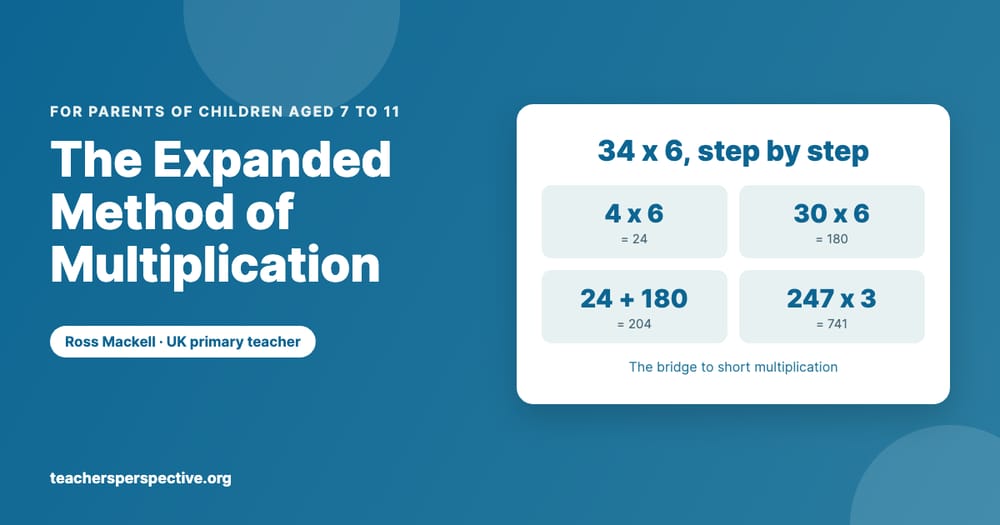

Quick answer: The expanded method of multiplication is a column method where you multiply each digit separately and write each answer on its own line. For 34 x 6: 4 x 6 = 24, then 30 x 6 = 180, then add them: 24 + 180 = 204. It's the step between the grid method and short multiplication, and most schools teach it in Year 3 or Year 4.
If your child has come home talking about "the expanded method" and you've never heard of it, you're not alone. Most parents learned one way to multiply at school, and it looked nothing like this.
Here's the reassuring part: the expanded method is just short multiplication with every step written out. It exists so children can see what's happening before they're asked to do it all in their head. When it's taught well, it's the reason short multiplication makes sense later.
This guide explains what it is, shows you how to do it with your child step by step, and points out the mistakes I see most often in class.
In this guide
What the expanded method is
The expanded method splits the top number into hundreds, tens and ones, multiplies each part by the bottom number, writes each answer on its own line, then adds the lines together.
That splitting is called partitioning. If your child can tell you that 34 is 30 and 4, they already understand the hardest part of this method. The video below goes through partitioning on the board if you'd like a refresher first.
▶ Video lesson: what partitioning is and why place value matters. Watch on YouTube
Where it fits in the multiplication journey
Children don't jump straight to short multiplication. Most schools in England build up through these stages, each one using the one before it:
| Stage | What it looks like for 34 x 6 |
|---|---|
| Repeated addition | 34 + 34 + 34 + 34 + 34 + 34 |
| Grid method | A grid with 30 and 4 across the top, 6 down the side: 180 and 24, then 180 + 24 |
| Expanded method | Columns, with 24 and 180 on separate lines, then added |
| Short multiplication | Columns, with the 2 carried and the answer 204 on one line |
If your child's school skips the expanded method, that's fine too. But if your child is stuck on short multiplication, dropping back to the expanded method for a week is one of the most effective fixes I know.
Step by step: 34 x 6
Step 1: Set it out in columns
Write the bigger number on top, with the ones lined up on the right. Write the single digit underneath in the ones column.
| 3 | 4 | ||
| x | 6 | ||
Step 2: Multiply the ones
4 x 6 = 24. Write 24 on the first line under the sum. Encourage your child to say what they're doing: "4 times 6 is 24."
Step 3: Multiply the tens
Now the 3. But it isn't really 3, it's 30, because it's in the tens column. So 30 x 6 = 180. Write 180 on the next line, lined up in the correct columns.
If your child knows 3 x 6 = 18, then 30 x 6 is just 18 tens, which is 180. My guide to multiplying by 10, 100 and 1,000 explains why.
Step 4: Add the lines
Add the two part answers using column addition: 24 + 180 = 204.
| 3 | 4 | ||
| x | 6 | ||
| 2 | 4 | ||
| 1 | 8 | 0 | |
| 2 | 0 | 4 |
4 x 6 = 24 and 30 x 6 = 180, so 34 x 6 = 204. Some schools ask children to write the small calculation (4 x 6, 30 x 6) next to each line.
Multiplication is built from several of the 15 core skills.
The expanded method only works when times tables, place value and column addition are already secure. My free guide shows all 15 core skills in the order children need them, so you can spot which one is holding your child back.
Get the free 15 Core Skills guide →3-digit numbers: 247 x 3
Exactly the same method, with one more line.
- Ones: 7 x 3 = 21
- Tens: 40 x 3 = 120
- Hundreds: 200 x 3 = 600
- Add the lines: 21 + 120 + 600 = 741
| 2 | 4 | 7 | ||
| x | 3 | |||
| 2 | 1 | |||
| 1 | 2 | 0 | ||
| 6 | 0 | 0 | ||
| 7 | 4 | 1 |
247 x 3 = 741
Always multiply the ones first. It feels backwards to some children, but it matches short multiplication, so it's a habit worth building now.
From expanded to short multiplication
Once your child is confident with the expanded method, short multiplication is the same steps squashed onto one line. Here's 247 x 3 again, the short way:
- 7 x 3 = 21. Write the 1 in the ones column and carry the 2 tens.
- 4 x 3 = 12 tens, plus the 2 carried = 14 tens. Write the 4 and carry the 1 hundred.
- 2 x 3 = 6 hundreds, plus the 1 carried = 7 hundreds. Write 7.
The answer is the same, 741. If you show your child the two methods side by side, they can see that the carried digits in short multiplication are exactly the extra tens and hundreds that had their own lines in the expanded method. That's the moment carrying stops being a mysterious rule. My short multiplication guide picks up from here.
Common mistakes (and what they tell you)
| What you see | What it means | What to do |
|---|---|---|
| 34 x 6 = 42 (writing 24 and 18) | Multiplied 3 x 6 instead of 30 x 6. Place value isn't secure. | Ask "What is the 3 really worth?" before each line. |
| Lines added up wrongly | The part answers weren't lined up in the right columns. | Use squared paper, one digit per square. |
| Long pauses on 7 x 8 or 6 x 9 | Times tables are being worked out, not remembered. | Practise the facts separately. See how to learn times tables fast. |
| Starts with the tens | Hasn't got the ones-first habit yet. | Say "ones first" every time until they say it for you. |
Practice questions (with answers)
Do one together first, then let your child try the rest. Ask them to check each one with a quick estimate: 46 x 3 is roughly 50 x 3, so about 150.
| Question | Answer |
|---|---|
| 27 x 5 | 135 |
| 46 x 3 | 138 |
| 58 x 4 | 232 |
| 125 x 6 | 750 |
| 309 x 7 | 2,163 |
Want a stretch? Try 23 x 14 with the expanded method. You'll need four lines: 3 x 4 = 12, 20 x 4 = 80, 3 x 10 = 30 and 20 x 10 = 200, which add up to 322. That's the beginning of long multiplication.
Questions parents ask about the expanded method
What is the expanded method of multiplication?
The expanded method is a written way of multiplying where you write the numbers in columns, multiply each digit separately (ones first, then tens, then hundreds), write every answer on its own line, and add the lines together at the end. For 34 x 6 you write 4 x 6 = 24 and 30 x 6 = 180, then add them to get 204.
What is the difference between expanded and short multiplication?
They use the same layout and the same steps. In the expanded method every part answer is written on its own line and added at the end. In short multiplication the carrying is done in your head (or as a small digit under the line), so the whole answer goes on a single line. Expanded comes first because children can see every step.
Is the expanded method the same as the grid method?
It uses the same idea, splitting a number into hundreds, tens and ones and multiplying each part, but it is laid out in columns instead of a grid. That column layout is why schools use it as the step between the grid method and short multiplication.
What year do children learn the expanded method?
Most schools in England introduce it in Year 3 or Year 4, when children start multiplying a 2-digit or 3-digit number by a 1-digit number. The national curriculum expects children to use the formal written layout for this by the end of Year 4, so many schools use the expanded method as the stepping stone.
Can you use the expanded method for long multiplication?
Yes. For a 2-digit by 2-digit sum like 23 x 14, you get four part answers (3 x 4, 20 x 4, 3 x 10 and 20 x 10) and add them. It works, but it gets long quickly, which is why children move on to long multiplication in Year 5 and Year 6.
Get the free 15 Core Skills guide
Multiplication methods are only a few of the 15 written skills every child aged 7 to 11 needs to master. If one earlier skill is shaky, every method after it feels harder than it should.
My free guide shows all 15 in the order children need to learn them, so you can see exactly where your child is and what to practise next.
- All 15 core skills, from number bonds to long division
- The order they build on each other
- What each one looks like when it's secure
- Written for parents, by a UK primary teacher
Free. Instant access. No card needed.
Keep going
Sources and further reading

