
Most parents I speak to know their child should "know their times tables", but not which ones, by when, or in what order. Schools in England follow the same national curriculum, so the expectations are the same wherever your child goes to school. The order you practise them in at home can make a big difference.
I'm Ross, a UK-qualified primary teacher with over ten years in the classroom. In this guide I'll set out exactly which times tables children learn in each year group, the order I recommend at home and why, and what to do if your child is behind.
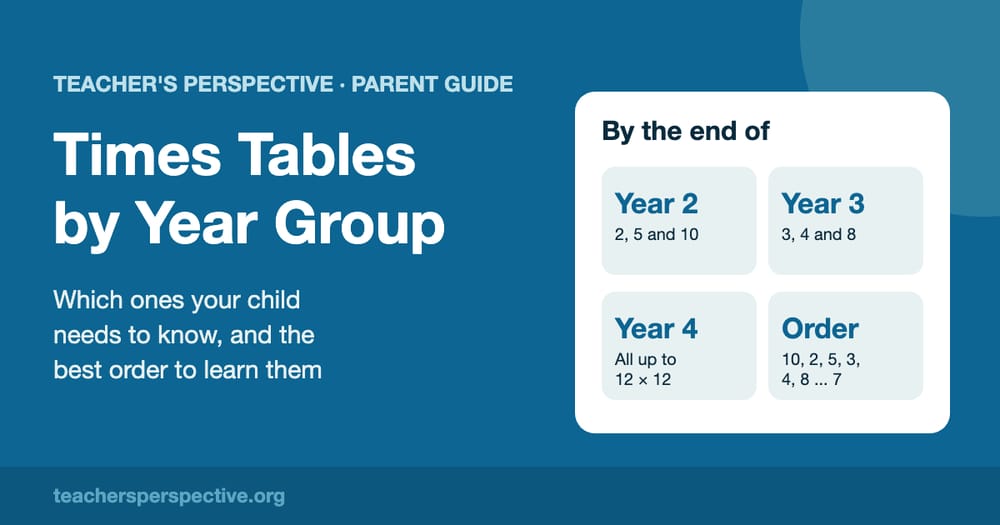
Quick answer: In England, children count in 2s, 5s and 10s in Year 1, learn the 2, 5 and 10 times tables in Year 2, the 3, 4 and 8 times tables in Year 3, and all the times tables up to 12 × 12 by the end of Year 4, when they sit the Multiplication Tables Check. At home, the easiest order is 10, 2, 5, then 3, 4 and 8, then 11, 9, 6, 12 and finally 7, because each new table builds on one your child already knows.
In this guide
Times tables by year group
This is what the national curriculum expects by the end of each year:
| Year group | Age | Times tables expected |
|---|---|---|
| Year 1 | 5 to 6 | Count in 2s, 5s and 10s |
| Year 2 | 6 to 7 | Recall the 2, 5 and 10 times tables, including the matching division facts |
| Year 3 | 7 to 8 | Recall the 3, 4 and 8 times tables |
| Year 4 | 8 to 9 | Recall all times tables up to 12 × 12, including division facts |
| Year 5 and 6 | 9 to 11 | Use times tables quickly for factors, multiples, fractions and written methods |
Notice that Year 4 is the big jump. The 6, 7, 9, 11 and 12 times tables all arrive in one year, as well as fluency in everything learned before. That's why Year 4 is when many children start to fall behind. My guide to what a Year 4 child should know in maths covers the rest of that year.
"Know" means more than chanting the table from the start. A child who knows the 8 times table can answer 7 × 8 straight away, out of order, and can also tell you that 56 ÷ 8 = 7.
The best order to learn times tables at home
Schools teach them in the year-group order above. At home, if your child needs to catch up or wants to get ahead, this is the order I use:
- 10 times table. Every answer ends in 0. It's the easiest win.
- 2 times table. Doubling. All the answers are even.
- 5 times table. Answers end in 5 or 0, and each one is half of the 10 times table answer.
- 3 times table. The first one without an obvious pattern, so it takes more practice.
- 4 times table. Double the 2 times table.
- 8 times table. Double the 4 times table.
- 11 times table. Up to 9 × 11 it's just the digit repeated (3 × 11 = 33).
- 9 times table. 10 times the number, take away the number once (7 × 9 = 70 − 7 = 63).
- 6 times table. Double the 3 times table.
- 12 times table. 10 times plus 2 times (7 × 12 = 70 + 14 = 84), or double the 6 times table.
- 7 times table. Last, because by now your child already knows almost every fact in it from other tables.
▶ Video lesson: how to help your child learn times tables fast. Watch on YouTube
Why this order works
Each table in that list leans on one your child has already learned. The 4s come from doubling the 2s, the 8s from doubling the 4s, and the 6s from doubling the 3s. That means your child isn't memorising 11 separate lists. They're learning a handful of patterns and a few tricky facts.
It also uses the fact that multiplication works both ways. 3 × 7 is the same as 7 × 3, so once your child knows the 3 times table, they already know 3 × 7 from the 7 times table. By the time you reach the 7s, the only new fact left is 7 × 7. Every other fact in the 7 times table has already come up in another table. Show your child this and the 7 times table suddenly looks much less scary. My guide to fact families explains how one fact gives you four.
Teacher tip: When your child learns a new table, ask "Which of these do you already know?" before you start. Usually it's more than half.
Seeing how much they already know is a quick confidence boost. Times tables underpin several of the 15 core skills in my free parent guide.
Get the free guideThe Year 4 Multiplication Tables Check
In June of Year 4, children in England take the Multiplication Tables Check (MTC). It's an online check with 25 questions, and your child has 6 seconds to answer each one. Questions can come from any table from 2 to 12, so your child needs instant recall, not counting up on their fingers.
There's no pass mark, but your child's school will tell you their score. I explain what's in it and how to prepare in my guide to the Year 4 times tables check.
Times tables in Years 5 and 6
After Year 4 there are no new tables to learn, but times tables get used constantly. Children need them for:
- Factors, multiples and prime numbers
- Square and cube numbers
- Equivalent fractions and simplifying
- Short and long multiplication
- Short division and long division
A child who has to stop and work out 7 × 8 in the middle of a long multiplication loses track and makes mistakes. That's why a Year 6 child who struggles with written methods often has a times tables gap underneath.
What if my child is behind on their times tables?
It's very common, and very fixable. Find out exactly which facts they don't know yet. Ask a mix of questions out of order and note which ones they hesitate on. Usually it's a small cluster, often in the 6, 7, 8 and 12 times tables. Then focus only on those facts for a week or two.
Don't start from the 2 times table again with an older child. It feels babyish and wastes time on facts they already know. If you're worried more generally, my guide to is my child behind in maths? can help you check.
How to practise times tables at home
- Little and often. Five minutes a day beats an hour on Sunday.
- Mix them up. Ask questions out of order once the table is learned in order.
- Ask the division facts too. "What's 42 ÷ 6?" as well as "What's 6 × 7?"
- Use the car and the kitchen. Quick questions on the school run work brilliantly.
- Keep a list of tricky facts. Stick it on the fridge and tick them off when they're secure.
- Celebrate speed, not just accuracy. Aim for an answer in under 3 seconds.
For more ideas, see how to learn times tables fast.
Frequently asked questions
What times tables should a Year 3 child know?
By the end of Year 3, children should know the 2, 5 and 10 times tables from Year 2, plus the 3, 4 and 8 times tables, including the matching division facts.
What age should a child know all their times tables?
The national curriculum expects children to know all the times tables up to 12 × 12 by the end of Year 4, when they are 8 or 9 years old.
What is the best order to learn times tables?
A good order at home is 10, 2, 5, 3, 4, 8, 11, 9, 6, 12 and then 7. Each table builds on one learned earlier, for example the 4 times table is double the 2 times table.
Which times table is the hardest?
Most children find the 7, 8 and 12 times tables the hardest, along with facts like 6 × 8, 7 × 8 and 8 × 12. Learning the 7s last helps, because most of its facts are already known from other tables.
Do children have to learn the 11 and 12 times tables?
Yes. The national curriculum in England includes all the times tables up to 12 × 12, and both the 11 and 12 times tables can come up in the Year 4 Multiplication Tables Check.
Get all 15 core skills in one place
Times tables are the foundation for the 15 core arithmetic skills every child needs by the end of primary school. My free parent guide lists all 15 in the order they're taught.
Use it to see where your child is now, and what to practise next.
Get the free guideKeep going
Sources and further reading
- National curriculum in England: mathematics programmes of study (Department for Education)
- Multiplication tables check assessment framework (Standards and Testing Agency)

