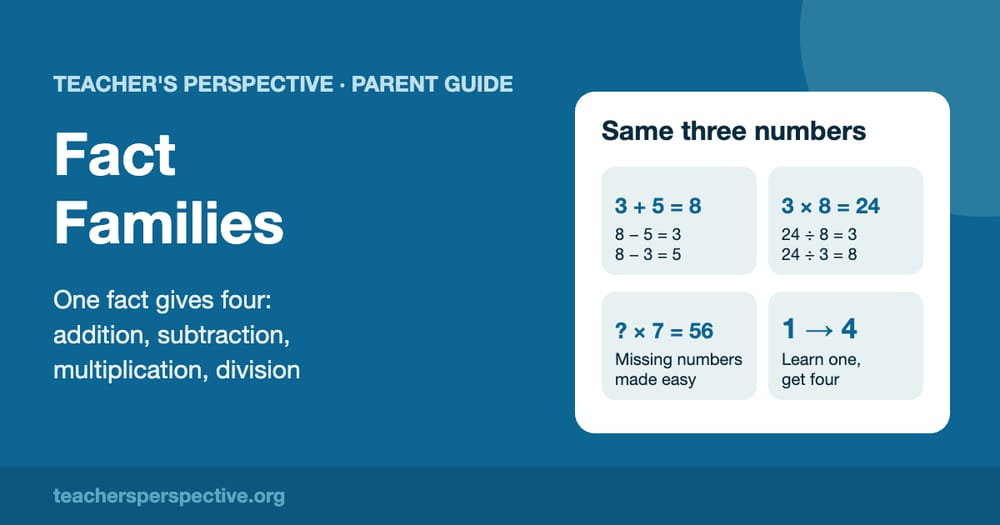

Fact families are one of those bits of primary maths that sound new to most parents, but the idea behind them is something you already use every day. If you know that 7 + 3 = 10, you also know that 10 − 3 = 7, without having to work it out. That link is what a fact family is all about.
I'm Ross, a UK-qualified primary teacher with over ten years in the classroom. In this guide I'll explain what fact families are, show examples for addition and subtraction and for multiplication and division, and share the simple routines I use to help children turn one fact into four.
Quick answer: A fact family is a group of related number facts that all use the same three numbers. For 3, 5 and 8, the addition and subtraction fact family is 3 + 5 = 8, 5 + 3 = 8, 8 − 3 = 5 and 8 − 5 = 3. For 4, 6 and 24, the multiplication and division fact family is 4 × 6 = 24, 6 × 4 = 24, 24 ÷ 4 = 6 and 24 ÷ 6 = 4. Knowing one fact gives your child four, which is why fact families make number bonds and times tables so much quicker to learn.
In this guide
What is a fact family?
A fact family is a set of number sentences that belong together because they use exactly the same three numbers. Two of the numbers are the parts and the biggest number is the whole.
There are two kinds of fact family in primary school:
- Addition and subtraction fact families, built on number bonds.
- Multiplication and division fact families, built on times tables.
Each family usually has four members. The two operations in a family are inverse operations: subtraction undoes addition, and division undoes multiplication. That is the whole secret, and once your child sees it, a lot of maths starts to click.
Addition and subtraction fact families
Take the numbers 6, 4 and 10. The whole is 10 and the parts are 6 and 4. That gives four facts:
| Numbers | Addition facts | Subtraction facts |
|---|---|---|
| 6, 4, 10 | 6 + 4 = 10 4 + 6 = 10 | 10 − 6 = 4 10 − 4 = 6 |
| 3, 5, 8 | 3 + 5 = 8 5 + 3 = 8 | 8 − 3 = 5 8 − 5 = 3 |
| 7, 9, 16 | 7 + 9 = 16 9 + 7 = 16 | 16 − 7 = 9 16 − 9 = 7 |
| 20, 30, 50 | 20 + 30 = 50 30 + 20 = 50 | 50 − 20 = 30 50 − 30 = 20 |
Notice two patterns. In the addition facts, the parts can go in any order and the answer is the same. In the subtraction facts, you always start with the whole, the biggest number, and take away one of the parts.
Multiplication and division fact families
Multiplication and division fact families work in exactly the same way. Take 3, 8 and 24. The whole is 24, and the parts are 3 and 8:
| Numbers | Multiplication facts | Division facts |
|---|---|---|
| 3, 8, 24 | 3 × 8 = 24 8 × 3 = 24 | 24 ÷ 3 = 8 24 ÷ 8 = 3 |
| 5, 7, 35 | 5 × 7 = 35 7 × 5 = 35 | 35 ÷ 5 = 7 35 ÷ 7 = 5 |
| 6, 9, 54 | 6 × 9 = 54 9 × 6 = 54 | 54 ÷ 6 = 9 54 ÷ 9 = 6 |
| 4, 12, 48 | 4 × 12 = 48 12 × 4 = 48 | 48 ÷ 4 = 12 48 ÷ 12 = 4 |
This is the big win. Once your child knows a times table fact, they get the matching division facts for free. They don't need to learn division separately at all. If they know 7 × 8 = 56, they know 56 ÷ 8 = 7 and 56 ÷ 7 = 8.
The easiest way to see a multiplication fact family is with an array: 3 rows of 8 dots shows all four facts at once.
▶ Video: how to learn times tables fast, the facts every multiplication fact family is built from. Watch on YouTube
The fact family house and triangle
Teachers often draw fact families as a house or a triangle, so children can see which number is the whole.
- The fact family house: the whole goes in the roof, and the two parts go in the windows below. The four facts are written on the floors of the house.
- The fact family triangle: the whole goes at the top corner and the parts go in the bottom two corners. Cover one number with your thumb and your child works out the missing one.
I like the house because it makes the rule obvious. When you subtract or divide, you always start in the roof.
One fact, four answers. Fast recall of number bonds and times tables is part of the 15 core skills every child needs before secondary school.
My free parent guide lists all 15 skills in the order they're taught, so you can see which facts your child needs secure first.
Get the free 15 Core Skills guideWhy fact families matter
- Less to learn. One known fact unlocks four. That makes number bonds and times tables much more manageable.
- Division gets easier. Children who use fact families find short division far less scary, because every step is just a times table fact in reverse.
- Checking answers. A child who works out 72 − 28 = 44 can check it with 44 + 28 = 72. This is a habit that saves marks in tests.
- Missing number questions. SATs and school tests often ask things like ? × 7 = 56 or 45 − ? = 18. Fact families turn these into simple recall.
Which year groups learn fact families?
| Year group | What children learn |
|---|---|
| Year 1 | Number bonds and related subtraction facts within 20. |
| Year 2 | Using the inverse link between addition and subtraction to check calculations, and the 2, 5 and 10 times tables with their division facts. |
| Year 3 | Multiplication and division facts for the 3, 4 and 8 times tables. |
| Year 4 | All times tables and division facts up to 12 × 12, ready for the times tables check. |
Schools don't always use the words "fact family", but the skill runs right through primary maths. By Year 5 and Year 6 children are expected to use it automatically, for example to check long calculations with the inverse.
How to practise fact families at home
- Give three numbers, get four facts. Say "5, 6 and 30" and ask your child to write the whole family. Start with addition families, then move to times tables.
- Cover one number. Draw a fact family triangle and cover a corner with your thumb. Can they work out the missing number?
- Build it with objects. Make an array of counters or Lego and ask for all four facts it shows.
- Work backwards. When practising a times table, follow each fact with a division question: "6 × 7 is 42, so what is 42 ÷ 7?"
- Keep it short. Five minutes a day beats an hour on Sunday. Little and often is what makes facts stick.
Common mistakes with fact families
- Starting subtraction or division with the small number. 3 − 8 or 6 ÷ 24 are not in the family. Remind your child to start with the whole.
- Mixing operations. A fact family uses either addition and subtraction or multiplication and division, never all four at once.
- Doubles. A family like 4, 4 and 8 only has two facts: 4 + 4 = 8 and 8 − 4 = 4. Children sometimes think they've made a mistake. They haven't.
- Not knowing the starting fact. Fact families only help if one fact is secure. If your child is still guessing 7 × 8, work on that fact first.
For more on the link between the four operations, see my guides to mental maths strategies and learning times tables fast.
Frequently asked questions
What is a fact family in maths?
A fact family is a group of related number facts that use the same three numbers. For example, 2, 5 and 10 make the family 2 × 5 = 10, 5 × 2 = 10, 10 ÷ 2 = 5 and 10 ÷ 5 = 2.
What is an example of a fact family for addition and subtraction?
For 4, 7 and 11: 4 + 7 = 11, 7 + 4 = 11, 11 − 4 = 7 and 11 − 7 = 4. The biggest number is the whole, and subtraction always starts with it.
What is a fact family for multiplication and division?
For 6, 8 and 48: 6 × 8 = 48, 8 × 6 = 48, 48 ÷ 6 = 8 and 48 ÷ 8 = 6. Knowing the times table fact gives you both division facts.
How many facts are in a fact family?
Usually four: two addition and two subtraction facts, or two multiplication and two division facts. Families made from a double, like 5, 5 and 10, only have two facts.
What year do children learn fact families?
Children start with addition and subtraction fact families in Year 1 and Year 2, using number bonds to 20. Multiplication and division fact families come in with the times tables from Year 2 to Year 4.
See every skill your child needs, in order
Fact families sit right at the start of the journey. My free parent guide lists the 15 core arithmetic skills every child needs by the end of primary school, in the order they're taught.
Use it to check what your child already knows and what to practise next.
Get the free guideKeep going
Sources and further reading
- National curriculum in England: mathematics programmes of study (Department for Education)

