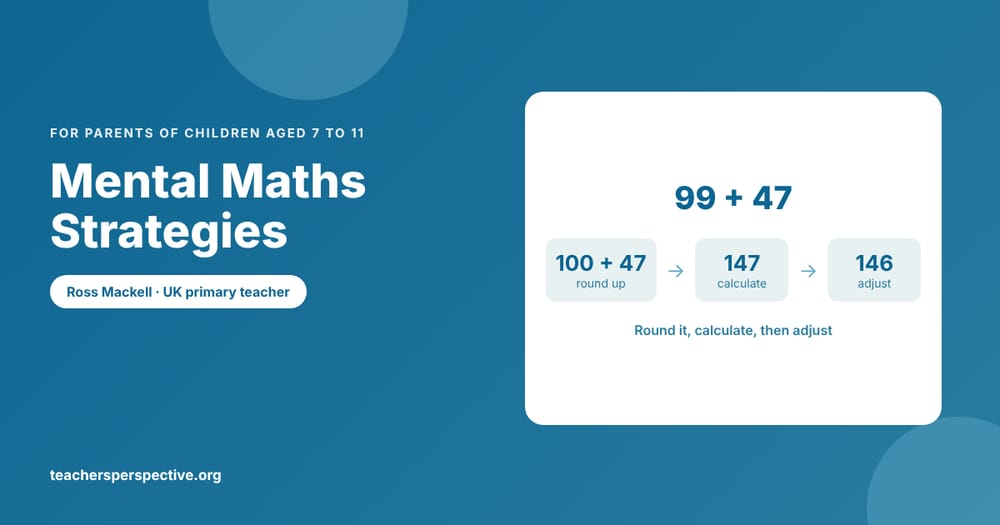

Ask your child to work out 99 + 47 in their head. Some children start counting on from 47, one at a time, and lose track somewhere around 80. Others say "100 + 47 is 147, take away 1, so 146" in about two seconds. Same child, same maths knowledge. The difference is a strategy.
Mental maths isn't about being a "maths person". It's a small set of tricks for making numbers friendlier, and every one of them can be taught. Children who have them feel quick and confident. Children who don't often decide they're bad at maths, when really nobody showed them the shortcuts.
I'm Ross, a UK-qualified primary teacher with over ten years in the classroom. In this guide I'll explain the 8 mental maths strategies children use in primary school, what they need to know first, when to use mental maths and when to write it down, quick games you can play at home, and practice questions with answers.
Quick answer: Mental maths strategies are ways of breaking numbers into easier pieces so a calculation can be done in your head. The most useful ones for ages 7 to 11 are bridging through 10, partitioning, rounding and adjusting, near doubles, doubling and halving, using known facts, counting up to find a difference, and multiplying by 10, 100 and 1000. They all rely on secure number bonds and times tables, so check those first.
In this guide
Why mental maths matters
Mental maths does three jobs. It makes everyday calculations quick. It lets your child check whether a written answer is sensible. And it frees up their working memory, so when they meet a long multiplication or a tricky word problem, they have brain space left for the hard part.
A child who has to count on their fingers to find 8 + 7 in the middle of a column subtraction is doing two jobs at once. That's usually when mistakes creep in. A child who just knows 8 + 7 = 15 can focus on the method.
The national curriculum expects children to use mental methods from Year 1 onwards, with increasingly large numbers as they move up the school. By Year 6 they are expected to do mental calculations with mixed operations and large numbers, and to use estimation to check answers.
What your child needs first
Every mental strategy sits on top of facts your child should know instantly, without counting. If these wobble, the strategies won't stick:
- Number bonds to 10, 20 and 100. 7 + 3, 13 + 7, 65 + 35. See my guide to number bonds to 10, 20 and 100.
- Place value. Knowing that 346 is 3 hundreds, 4 tens and 6 ones. Here's what place value means.
- Times tables up to 12 × 12. These unlock every multiplication and division strategy. Try how to learn times tables fast.
- Doubles and halves of numbers up to 20, then up to 100.
If your child is counting on their fingers for any of these, spend a week or two on the facts before teaching strategies. It will feel slower, but it's the fastest route.
8 mental maths strategies, with examples
1. Bridging through 10
Use number bonds to jump to the next multiple of 10, then add what's left.
8 + 7: 8 needs 2 to make 10. Take 2 from the 7, leaving 5. 10 + 5 = 15.
47 + 8: 47 needs 3 to make 50. 8 − 3 = 5. 50 + 5 = 55.
This works for subtraction too. 53 − 7: take 3 to get to 50, then 4 more. 46.
2. Partitioning
Split numbers into hundreds, tens and ones, deal with each part, then put them back together. This is the strategy behind most written methods, so it's worth getting right. More in what is partitioning in maths.
34 + 25: 30 + 20 = 50, 4 + 5 = 9, so 59.
23 × 4: 20 × 4 = 80, 3 × 4 = 12, so 92.
A good habit: add the tens first. Children who start with the ones often forget what they were holding.
3. Rounding and adjusting
Round one number to something friendly, calculate, then adjust. This is the strategy behind the 99 + 47 example at the top. It relies on rounding being secure.
99 + 47: 100 + 47 = 147. I added 1 too many, so 146.
64 − 19: 64 − 20 = 44. I took away 1 too many, so give it back. 45.
£3.99 × 3: £4 × 3 = £12, minus 3p, so £11.97.
4. Near doubles
If two numbers are close together, double one and adjust.
6 + 7: double 6 is 12, plus 1 more is 13.
25 + 26: double 25 is 50, plus 1 is 51.
150 + 149: double 150 is 300, minus 1 is 299.
5. Doubling and halving
Multiplying by 4 is doubling twice. Multiplying by 8 is doubling three times. Multiplying by 5 is multiplying by 10 and halving.
16 × 4: double 16 is 32, double again is 64.
48 × 5: 48 × 10 = 480, half of 480 is 240.
There's also a lovely trick for some multiplications: halve one number and double the other. 14 × 5 becomes 7 × 10 = 70. 25 × 16 becomes 50 × 8, then 100 × 4 = 400.
6. Using known facts
If you know one fact, you know lots of others. This is the most powerful idea in mental maths, and it's why times tables matter so much.
| I know... | So I also know... |
|---|---|
| 6 × 7 = 42 | 60 × 7 = 420, 6 × 70 = 420, 0.6 × 7 = 4.2, 42 ÷ 7 = 6 |
| 3 + 5 = 8 | 30 + 50 = 80, 300 + 500 = 800, 0.3 + 0.5 = 0.8 |
| 12 × 8 = 96 | 12 × 9 = 96 + 12 = 108 |
| Half of 18 is 9 | Half of 180 is 90, half of 1.8 is 0.9 |
Notice how many of these involve multiplying and dividing by 10, 100 and 1000. That skill turns one fact into a whole family of facts.
7. Counting up to find a difference
Subtraction doesn't always mean taking away. When two numbers are close together, it's much easier to count up from the smaller one. Shopkeepers used to give change this way.
1,003 − 997: from 997 to 1,000 is 3, then 3 more to 1,003. The difference is 6. (Compare that with a column subtraction full of exchanging across zeros.)
£10 − £6.35: £6.35 to £6.40 is 5p, to £7 is 60p, to £10 is £3. Total £3.65.
8. Multiplying and dividing by 10, 100 and 1000
The digits move, the decimal point stays still. 3.7 × 100 = 370. 4,500 ÷ 10 = 450. Children who "add a zero" get stuck as soon as decimals arrive (3.7 × 10 is not 3.70), so teach the digits moving from the start.
Mental maths is only as strong as the facts underneath it. Number bonds, place value, times tables and multiplying by 10, 100 and 1000 are all part of the 15 core skills every child aged 7 to 11 needs.
My free guide for parents shows all 15 core skills in order, so you can see exactly which one is holding your child back.
Get the free 15 Core Skills guide →Which strategy, when?
The best mental mathematicians look at the numbers before they start. Here's a quick guide you can share with your child:
| If the numbers look like... | Example | Try |
|---|---|---|
| One is close to a multiple of 10 | 57 + 29 | Rounding and adjusting: 57 + 30 − 1 |
| They make a 10 when added | 8 + 5 | Bridging through 10 |
| Two numbers close together | 35 + 36 | Near doubles |
| Subtraction, numbers close | 702 − 695 | Counting up |
| Multiplying by 4, 5 or 8 | 17 × 4 | Doubling and halving |
| Tens and ones that don't cross a boundary | 43 + 25 | Partitioning |
| Big round numbers or decimals | 0.8 × 6 | Known facts: 8 × 6 = 48, so 4.8 |
Mental or written?
Some children think written methods are "proper maths" and mental maths is cheating. Others try to do everything in their head and make careless slips. The truth is that both have a place. Use mental maths when the numbers are friendly. Use a written method like column addition and subtraction or short multiplication when the numbers are large or awkward.
A good test: if your child would need to hold more than two or three numbers in their head at once, write it down. Jottings are fine too. A quick number line or partial answer on scrap paper is still mental maths.
Mental maths is also the best way to check a written answer. If your child calculates 49 × 21 and gets 10,290, a quick estimate (50 × 20 = 1,000) tells them something has gone wrong.
Quick games to play at home
Mental maths is perfect for the gaps in the day: in the car, walking to school, waiting for dinner. A few minutes at a time is plenty.
- Ping pong bonds. You say a number, they say what it needs to make 10 (or 100, or 1,000). Go faster as they improve.
- Double trouble. Take turns doubling from a starting number. 3, 6, 12, 24, 48... How far can you get?
- Shop keeper. "I've got £5. I spend £2.65. What's my change?" Counting up does the work.
- Number plates. Add the digits on car number plates, or make the biggest number you can.
- Explain it. Ask "how did you work that out?" Different strategies for the same question are worth praising.
5 common mistakes and how to fix them
Mistake 1: Counting on in ones
Your child works out 38 + 25 by counting 39, 40, 41... and loses their place.
The fix: partition. Add the tens in one jump (38 + 20 = 58), then the ones (58 + 5 = 63).
Mistake 2: Adjusting the wrong way
For 64 − 19 they do 64 − 20 = 44, then take away another 1 to get 43.
The fix: draw it on a number line. They jumped back 20, which is 1 too far, so they need to come 1 forward. Answer 45.
Mistake 3: "Just add a zero"
They know 23 × 10 = 230, so they decide 2.3 × 10 = 2.30.
The fix: teach that the digits move one place to the left. 2.3 × 10 = 23.
Mistake 4: Trying to hold too much
They attempt 486 + 397 in their head and forget the first part of the answer.
The fix: encourage jottings. Writing 886 down after adding 400 is smart, not cheating.
Mistake 5: Strategies before facts
A child who doesn't know 7 + 3 = 10 can't bridge through 10, however many times you explain it.
The fix: go back and secure number bonds and times tables first. Strategies will make sense almost straight away.
Practice questions
Ask your child to say which strategy they used for each one. There's often more than one good way.
| Question | Answer | One good strategy |
|---|---|---|
| 9 + 6 | 15 | Bridging through 10 |
| 45 + 32 | 77 | Partitioning |
| 68 + 29 | 97 | 68 + 30 − 1 |
| 35 + 36 | 71 | Near doubles |
| 83 − 19 | 64 | 83 − 20 + 1 |
| 2,002 − 1,996 | 6 | Counting up |
| 18 × 4 | 72 | Double, then double again |
| 36 × 5 | 180 | × 10, then halve |
| 0.7 × 8 | 5.6 | Known fact: 7 × 8 = 56 |
| £10 − £4.45 | £5.55 | Counting up |
Five to ten minutes a day, a few times a week, will make a bigger difference than an hour at the weekend.
Keep going
Frequently asked questions
What are mental maths strategies?
Mental maths strategies are ways of working out a calculation in your head by breaking numbers into friendlier pieces. Examples include partitioning, bridging through 10, rounding and adjusting, doubling and halving, and counting up to find a difference.
How can I improve my child's mental maths?
Make sure number bonds and times tables are secure first, then teach one strategy at a time with a clear example. Practise for five to ten minutes a day, ask your child to explain how they worked it out, and use quick games in the car or at the table.
Should my child use mental maths or a written method?
Use mental maths when the numbers are friendly, such as 99 + 47 or 25 × 4. Use a written column method when the numbers are large or awkward, such as 4,738 + 2,986. Good mathematicians look at the numbers first and then choose.
Is mental maths tested in the Year 6 SATs?
There is no separate mental maths paper any more. Mental strategies are still used throughout the arithmetic and reasoning papers, and they save time on questions like 1,000 − 998 or 0.5 × 18.
Why does my child count on their fingers?
Finger counting usually means number bonds or times tables are not yet automatic. It is not a problem in itself, but it slows children down and uses up working memory. Practising number bonds to 10 and 20 is the best fix.
Get all 15 core skills in one place
Mental maths becomes easy once number bonds, place value and times tables are secure. The 15 core skills are the written methods and facts every child aged 7 to 11 needs to master to succeed in maths.
My free guide for parents shows all 15, in order, so you can see exactly where your child is and what comes next.
Get the free 15 Core Skills guide →Sources and further reading

