
If your child has come home talking about arrays, or you have spotted rows of dots on their maths homework, you are not alone in wondering what is going on. Arrays were not a big part of how most parents learned maths, but they are now one of the main pictures UK schools use to teach multiplication and division.
I'm Ross, a UK-qualified primary teacher with over ten years in the classroom. In this guide I'll explain what an array is in plain English, show you clear examples, explain which year groups use them, and give you simple ways to practise arrays at home.
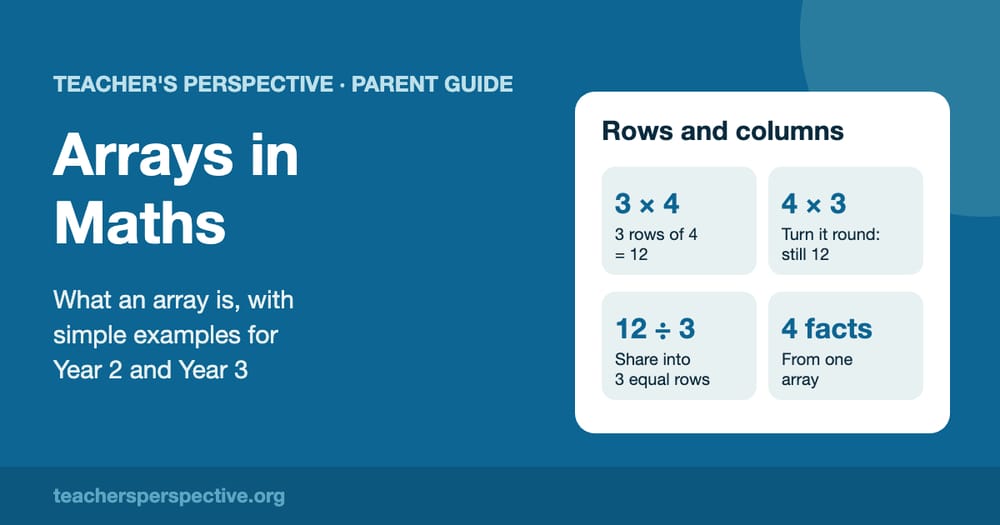
Quick answer: An array is a set of objects or pictures arranged in equal rows and equal columns. For example, 3 rows of 4 dots makes an array showing 3 × 4 = 12. Arrays help children see multiplication as repeated addition (4 + 4 + 4), see that 3 × 4 and 4 × 3 give the same answer, and see division as splitting a total into equal rows. Children meet arrays from Year 1 and use them heavily in Year 2 and Year 3 while they learn their times tables.
In this guide
What is an array in maths?
The meaning of an array in maths is simple: it is a group of things set out in neat rows and columns, where every row has the same number of things in it. The things can be counters, dots, stickers, cubes, sweets or drawings. What matters is the shape. An array always makes a rectangle or a square.
Here is an array of 12 dots, set out in 3 rows of 4:
| Array | Rows × columns | Total |
|---|---|---|
| ● ● ● ● ● ● ● ● ● ● ● ● | 3 rows of 4, so 3 × 4 | 12 |
| ● ● ● ● ● ● ● ● ● ● ● ● | 4 rows of 3, so 4 × 3 | 12 |
| ● ● ● ● ● ● ● ● ● ● | 2 rows of 5, so 2 × 5 | 10 |
| ● ● ● ● ● ● ● ● ● | 3 rows of 3, so 3 × 3 (a square number) | 9 |
If the rows are not equal, it is not an array. Four dots in one row and three in the next is just a group of seven dots, and it doesn't show a multiplication.
Rows and columns
Before arrays make sense, your child needs to know the difference between a row and a column. Rows go across, from left to right, like people sitting in a row at the cinema. Columns go up and down, like the columns holding up a building.
In the first array above there are 3 rows going across, and 4 columns going down. Schools usually describe an array by its rows first, so "3 rows of 4". Don't worry too much about which way round your child says it, though. As you'll see below, the answer is the same either way.
How arrays show multiplication
Arrays are a picture of multiplication as repeated addition. Look at 3 rows of 4 again. Your child can find the total in three ways, and each one is a step up from the last:
- Count in ones: 1, 2, 3, 4, 5... up to 12. This works, but it's slow and easy to lose track.
- Add the rows: 4 + 4 + 4 = 12. This is repeated addition.
- Count in fours: 4, 8, 12. Then, once they know the fact, simply recall 3 × 4 = 12.
The aim is to move your child from the first way to the last. The array is the bridge. It lets them see why 3 × 4 is 12, so the times table fact means something, rather than being a string of words they have memorised.
▶ Video lesson: multiplying with repeated addition, the idea arrays are built on. Watch on YouTube
Why 3 × 4 is the same as 4 × 3
This is one of the most useful things an array can show. Draw 3 rows of 4, then turn the page on its side. You now have 4 rows of 3. Nothing has been added or taken away, so the total is still 12.
Teachers call this the commutative property, and children in Year 2 are expected to understand that multiplication can be done in any order. The practical payoff is huge. If your child knows 3 × 8 = 24, they also know 8 × 3 = 24, which roughly halves the number of facts they need to learn. My guide to learning times tables fast explains how that leaves only 36 facts to learn.
Arrays are the picture behind the times tables. Times tables and the written methods built on them are part of the 15 core skills every child needs by the end of primary school.
My free parent guide lists all 15 in the order they're taught, so you can see exactly where arrays fit and what comes next.
Get the free 15 Core Skills guideArrays and division
The same array can also show division. Start with 12 counters and ask your child to share them into 3 equal rows. They get 4 in each row, so 12 ÷ 3 = 4. Ask them to put the 12 counters into rows of 4 instead, and they get 3 rows, so 12 ÷ 4 = 3.
One array gives four facts: 3 × 4 = 12, 4 × 3 = 12, 12 ÷ 3 = 4 and 12 ÷ 4 = 3. That group of four facts is called a fact family, and it's how children learn that multiplication and division are inverse operations that undo each other.
Arrays also show remainders clearly. Try putting 14 counters into rows of 4. You get 3 full rows and 2 counters left over, so 14 ÷ 4 = 3 remainder 2. Seeing the leftovers makes remainders far less confusing later on.
Which year groups use arrays?
| Year group | How arrays are used |
|---|---|
| Year 1 | Solving simple multiplication and division problems with real objects, pictures and arrays, with adult support. |
| Year 2 | Showing the 2, 5 and 10 times tables, and showing that multiplication can be done in any order but division can't. |
| Year 3 | Building the 3, 4 and 8 times tables, and starting to link arrays to written methods. |
| Year 4 and beyond | Arrays grow into the grid method, area of rectangles and the expanded method of multiplication. |
Arrays are mentioned by name in the Year 1 national curriculum, and searches like "arrays in maths Year 2" and "arrays in maths Year 3" are where most parents meet them. By Year 4 children rarely draw dot arrays any more, but the idea hasn't gone away. The grid method is really a big array split into tens and ones.
Arrays in real life
Once you start looking, arrays are everywhere. Pointing them out is one of the easiest ways to make the idea stick:
- An egg box: 2 rows of 6 makes 12 eggs.
- A muffin or cupcake tray: often 3 rows of 4.
- A bar of chocolate: count the rows and columns of squares before you eat it.
- Window panes, tiles on a wall and parking spaces.
- Seats in a classroom or a cinema.
- A calendar: 7 columns of days.
How to practise arrays at home
You don't need worksheets. Five minutes with things you already have is plenty:
- Make it with objects. Use pasta, coins or Lego. Say "Make me 4 rows of 5." Then ask how many altogether and how they worked it out.
- Turn it round. Rotate the array and ask what multiplication it shows now. This builds the any-order idea.
- Write the facts. Ask your child to write all four facts the array shows: two multiplications and two divisions.
- Draw it. Move from objects to drawing dots, then to just writing the number sentence. That step from objects, to pictures, to numbers is exactly how schools teach it.
- Hunt for arrays. On the way to school or at the supermarket, challenge them to spot an array and tell you its multiplication.
Common mistakes with arrays
- Unequal rows. Children sometimes squash in an extra counter. Check every row has the same number.
- Mixing up rows and columns. Remind them rows go across and columns go down, then show that the total doesn't change either way.
- Counting in ones forever. Counting in ones is fine at first, but nudge them towards adding the rows, then counting in steps, then recalling the fact.
- Messy drawings. If the dots don't line up, it's easy to miscount. Squared paper helps a lot.
Arrays are a stepping stone, not the finish line. The goal is fast, confident recall of times tables, so your child can use them in short multiplication and short division later on.
Frequently asked questions
What is an array in maths for kids?
An array is a group of objects set out in equal rows and columns, like eggs in an egg box. Children count the rows and the number in each row to find a multiplication, for example 2 rows of 6 is 2 × 6 = 12.
What year do children learn arrays?
Children first meet arrays in Year 1, using real objects and pictures. They use them most in Year 2 and Year 3 while learning the 2, 3, 4, 5, 8 and 10 times tables.
How do arrays help with multiplication?
Arrays show multiplication as equal rows, so children can see that 3 × 4 means 3 rows of 4, or 4 + 4 + 4. They also show that 3 × 4 and 4 × 3 give the same answer, which halves the facts to learn.
Can arrays be used for division?
Yes. Sharing a total into equal rows shows division. 12 counters in 3 equal rows gives 4 in each row, so 12 ÷ 3 = 4. Any counters left over show the remainder.
What is the difference between a row and a column?
Rows go across from left to right. Columns go up and down. An array with 3 rows of 4 has 3 rows and 4 columns.
Know exactly what your child needs to learn next
Arrays lead into times tables, and times tables lead into every written method your child will use. My free parent guide lists the 15 core arithmetic skills every child needs by the end of primary school, in the order they're taught.
Use it to see where your child is now, and what to practise next.
Get the free guideKeep going
Sources and further reading
- National curriculum in England: mathematics programmes of study (Department for Education)

