
If your child has come home talking about "exchanging", you might be wondering what it means. When most of us were at school, we called it carrying and borrowing. Exchanging is the same idea with a different name, and it's the step where most children go wrong in column addition and subtraction.
I'm Ross, a UK-qualified primary teacher with over ten years in the classroom. In this guide I'll explain what exchanging is, show you exactly how it works in addition and in subtraction, walk through worked examples, and point out the mistakes I see most often so you can spot them at home.
Quick answer: Exchanging means swapping 10 of one place value for 1 of the next place value up, or 1 for 10 of the next one down. In column addition, when a column adds up to 10 or more, you exchange 10 ones for 1 ten and carry it into the next column. In column subtraction, when the top digit is too small, you exchange 1 ten for 10 ones from the column to the left. Schools say "exchanging" instead of "carrying" and "borrowing" because nothing is borrowed: the value of the number stays exactly the same.
In this guide
What does exchanging mean?
Exchanging is swapping one place value for an equal amount in another place value. The two swaps children need are:
- 10 ones for 1 ten (and 1 ten for 10 ones)
- 10 tens for 1 hundred (and 1 hundred for 10 tens)
Think of it like money. A £10 note and ten £1 coins are worth the same. If you need to pay £3 and you only have a £10 note, you change it for ten £1 coins first. Nothing has been lost or borrowed. You've just changed how the same amount is made up. That is exactly what happens in a column sum.
This only makes sense if your child understands place value: that the 4 in 342 is worth 40, not 4. If that part is shaky, start with my guide to what place value is.
Why schools say exchanging instead of carrying and borrowing
"Borrowing" suggests you take something and give it back later, which never happens. Children who learn "borrow one" as a rule often don't know what the 1 is worth, so they can't tell when they've made a mistake. "Exchanging" keeps the meaning in view: you're swapping 1 ten for 10 ones, and the total stays the same.
| Older word | What schools say now | What it means |
|---|---|---|
| Carrying | Exchanging (in addition) | 10 ones become 1 ten, written in the next column |
| Borrowing | Exchanging (in subtraction) | 1 ten becomes 10 ones, moved into the column to the right |
| Regrouping | Exchanging | The American word for the same idea |
Column addition with exchange, step by step
Let's work through 368 + 257. Line the numbers up so the ones, tens and hundreds sit in their own columns, then always start from the ones.
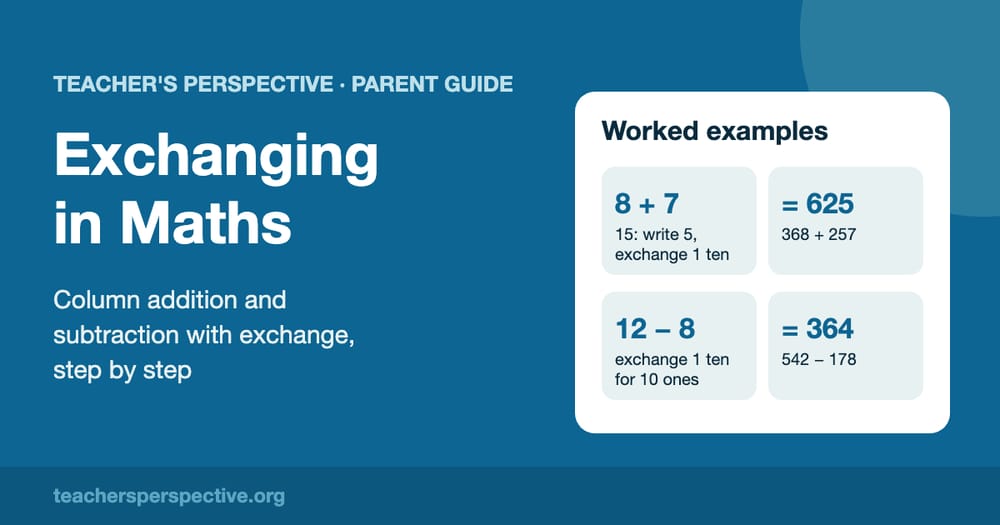
- Ones: 8 + 7 = 15. That's 1 ten and 5 ones. Write 5 in the ones column and exchange the 10 ones for 1 ten: write a small 1 under the line in the tens column.
- Tens: 6 + 5 = 11, plus the exchanged 1 makes 12. That's 12 tens, which is 1 hundred and 2 tens. Write 2 in the tens column and a small 1 in the hundreds column.
- Hundreds: 3 + 2 = 5, plus the exchanged 1 makes 6. Write 6.
- Answer: 368 + 257 = 625.
A quick check: 368 is close to 370 and 257 is close to 260, and 370 + 260 = 630. The answer 625 is close, so it's sensible.
▶ Video lesson: adding with exchanging, step by step. Watch on YouTube
For the full method from the start, see my guide to column addition and subtraction.
Column subtraction with exchange, step by step
Now 542 − 178. Again, start from the ones, and always take the bottom number away from the top number.
- Ones: 2 − 8. You can't take 8 from 2, so exchange 1 ten from the tens column. Cross out the 4 tens and write 3. The 2 ones become 12 ones. Now 12 − 8 = 4.
- Tens: 3 − 7. You can't take 7 from 3, so exchange 1 hundred. Cross out the 5 hundreds and write 4. The 3 tens become 13 tens. Now 13 − 7 = 6.
- Hundreds: 4 − 1 = 3.
- Answer: 542 − 178 = 364.
Check it with the inverse: 364 + 178 = 542. If the addition gives you the number you started with, the subtraction is right. My guide to inverse operations explains this check.
Teacher tip: Ask "Is the top digit big enough?" before every column. If yes, just subtract. If no, exchange first, then subtract.
That single question stops most subtraction mistakes before they happen. It's one of the 15 core skills in my free parent guide.
Get the free guideExchanging across a zero
The hardest version is when there's a zero in the way, like 403 − 168. In the ones, 3 − 8 needs an exchange, but there are no tens to exchange. So you go one step further left:
- Exchange 1 hundred for 10 tens. The 4 hundreds become 3, and the 0 tens become 10.
- Now exchange 1 of those tens for 10 ones. The 10 tens become 9, and the 3 ones become 13.
- Ones: 13 − 8 = 5. Tens: 9 − 6 = 3. Hundreds: 3 − 1 = 2.
- Answer: 403 − 168 = 235.
This is where most children get stuck, so I've written a separate guide just for column subtraction with zeros.
The most common exchanging mistakes
- Taking the smaller digit from the bigger one. For 542 − 178, a child writes 8 − 2 = 6 in the ones column. It feels right to them, but the answer comes out as 436 instead of 364.
- Forgetting to reduce the next column. They turn 2 into 12 but leave the 4 tens as 4.
- Writing 15 in one column. In addition, they write the whole 15 under the ones instead of exchanging the ten.
- Forgetting the exchanged 1. They write the small 1 in the tens column, then don't add it.
- Messy columns. Digits drift out of line, so tens get added to hundreds. Squared paper fixes this almost straight away.
I go through these in more detail in 7 common maths mistakes children make.
When do children learn exchanging?
In England, the national curriculum expects children to add and subtract numbers with up to three digits using the formal column method in Year 3, and up to four digits in Year 4. By Year 5 and Year 6 they use it with larger numbers and decimals, and it comes up again and again in the Year 6 SATs arithmetic paper. If your child is in Year 5 or 6 and still unsure about exchanging, it's worth fixing now, because so much later work depends on it.
How to help your child with exchanging at home
- Make it physical first. Use 10p and 1p coins, or bundles of 10 straws. Have your child actually swap a 10p for ten 1p coins before taking some away.
- Say the value out loud. Encourage "I'm exchanging 1 ten for 10 ones", not "I'm borrowing 1".
- Use squared paper. One digit per square keeps the columns straight.
- Start without exchange. Do a few sums like 465 − 132 first, so the method feels easy, then add one exchange, then two.
- Always check. Estimate before, and use the inverse after.
- Little and often. Five sums a day for a week does more than one long session at the weekend.
Frequently asked questions
What does exchanging mean in maths?
Exchanging means swapping one place value for an equal amount of another, for example 10 ones for 1 ten, or 1 hundred for 10 tens. It's used in column addition and column subtraction when a column has too much or too little.
Is exchanging the same as carrying and borrowing?
Yes. Carrying (in addition) and borrowing (in subtraction) are the older names. Schools now say exchanging, because nothing is really borrowed. You're swapping one value for another worth the same.
What is column addition with exchange?
It's column addition where a column adds up to 10 or more. You write the ones digit in that column and exchange the ten into the next column on the left, where it's added on. For example, in 368 + 257 the ones make 15, so you write 5 and exchange 1 ten.
How do you exchange in subtraction?
If the top digit in a column is smaller than the bottom digit, take 1 from the column to the left, reduce that digit by 1, and add 10 to the column you're working on. Then subtract as normal.
What year do children learn exchanging?
In England, children use the formal column method with exchange for 3-digit numbers in Year 3 and for 4-digit numbers in Year 4, then with larger numbers and decimals in Years 5 and 6.
Get all 15 core skills in one place
Exchanging is one of the 15 core arithmetic skills every child needs by the end of primary school. My free parent guide lists all 15 in the order they're taught.
Use it to see where your child is now, and what to practise next.
Get the free guideKeep going
Sources and further reading
- National curriculum in England: mathematics programmes of study (Department for Education)

