
If your child has come home talking about "groups of", arrays or the grid method, you might be wondering when multiplication is actually supposed to be taught, and whether your child is where they should be.
I'm Ross, a UK-qualified primary teacher with over ten years in the classroom. This guide sets out exactly when children learn multiplication in English primary schools, year by year, so you can see what your child should know now and what's coming next.
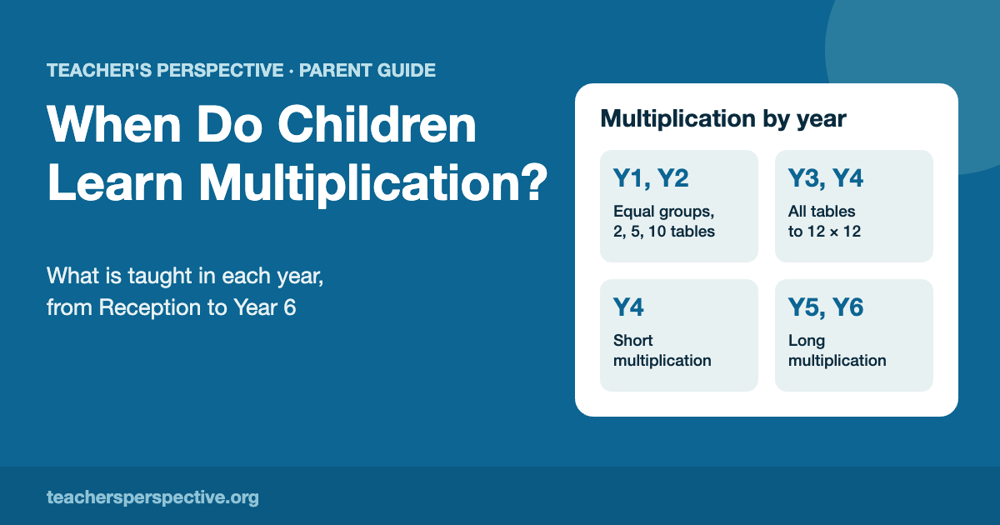
Quick answer: Children start with doubling and counting in 2s in Reception. Multiplication is formally taught from Year 1 (groups of objects), the × sign arrives in Year 2, children should know all their times tables up to 12 × 12 by the end of Year 4, short multiplication is taught in Year 4, and long multiplication follows in Years 5 and 6.
In this guide
When children learn multiplication: at a glance
This is what the national curriculum for England expects in each year. Schools follow the same order, though some teach a step a little earlier.
| Year (age) | What your child learns about multiplication | Example |
|---|---|---|
| Reception (4 to 5) | Doubling small numbers and counting in 2s | Double 3 is 6 |
| Year 1 (5 to 6) | Counting in 2s, 5s and 10s; equal groups with objects, pictures and arrays | 4 pairs of socks: 2, 4, 6, 8 socks |
| Year 2 (6 to 7) | The × sign; the 2, 5 and 10 times tables; multiplying in any order | 5 × 3 = 15, so 3 × 5 = 15 |
| Year 3 (7 to 8) | The 3, 4 and 8 times tables; 2-digit × 1-digit numbers | 45 × 3 = 135 |
| Year 4 (8 to 9) | All times tables up to 12 × 12; short multiplication of 2-digit and 3-digit numbers by 1-digit numbers | 326 × 4 = 1,304 |
| Year 5 (9 to 10) | Up to 4-digit × 1-digit and 2-digit numbers, including long multiplication; × 10, 100 and 1,000 | 43 × 27 = 1,161 |
| Year 6 (10 to 11) | Long multiplication up to 4-digit × 2-digit; multiplying decimals by whole numbers | 2,357 × 34 = 80,138 |
Reception: doubling comes first
Before the word "multiply" is ever used, children in Reception double small numbers and start counting in 2s. They notice that two hands have ten fingers and that a pair of shoes means two shoes. By the end of Reception, most children can recall some doubles, such as double 4 is 8, without counting.
This matters more than it looks. Doubling is the first times table your child learns, even though nobody calls it that yet.
Years 1 and 2: equal groups and the × sign
Year 1
In Year 1 children count in 2s, 5s and 10s and solve simple problems with real objects, pictures and arrays. A typical question is "there are 3 plates with 5 grapes on each. How many grapes altogether?" Children count the groups to find the answer.
The big idea here is equal groups. Multiplication only works when every group is the same size, and children need to see that with their own eyes before they ever write a number sentence.
Year 2
Year 2 is when the × sign is formally introduced. Children learn the 2, 5 and 10 times tables and write them as number sentences, such as 5 × 3 = 15. They learn to see multiplication as repeated addition: 5 × 3 is 5 + 5 + 5.
They also learn that you can multiply in any order. 5 × 3 and 3 × 5 both make 15, which halves the number of facts they need to learn. This is where fact families start, linking each multiplication to its division facts.
Years 3 and 4: times tables and the first written method
Year 3
In Year 3 children learn the 3, 4 and 8 times tables and start multiplying a 2-digit number by a 1-digit number, such as 45 × 3. Most schools teach this with a mental or informal method first, like partitioning (40 × 3 = 120 and 5 × 3 = 15, so 135) or the grid method, before moving towards a formal written method.
Year 4
Year 4 is the big one. By the end of the year children are expected to know all their times tables up to 12 × 12. In June they sit the Multiplication Tables Check, a 25-question online test with 6 seconds per question.
Year 4 is also when children learn short multiplication, the formal written method for multiplying 2-digit and 3-digit numbers by a 1-digit number. They learn to multiply three numbers together, and what happens when you multiply by 0 and by 1.
Teacher tip: Ask your child "what is 7 × 8?" and count how long they take. If they answer within about 3 seconds, the fact is secure. If they count up in 7s or 8s, that times table needs more practice before the written methods will feel easy.
Knowing times tables by heart is one of the 15 core skills in my free parent guide, along with every written method that depends on it.
Get the free guideYears 5 and 6: long multiplication and decimals
Year 5
In Year 5 children multiply numbers with up to 4 digits by a 1-digit number using short multiplication, and by a 2-digit number using long multiplication. They also learn to multiply by 10, 100 and 1,000 and meet factors, multiples and prime numbers and square and cube numbers.
Year 6
Year 6 is about getting fast and accurate with long multiplication, up to 4-digit numbers multiplied by 2-digit numbers, such as 2,357 × 34. Children also learn to multiply decimals with up to two decimal places by whole numbers, such as 3.45 × 6 = 20.7, and use the order of operations.
All of this appears on the Year 6 SATs arithmetic paper, where long multiplication questions are worth 2 marks each.
Why the order matters
Each step in the timeline holds up the next one. Equal groups lead to repeated addition. Repeated addition leads to times tables. Times tables are used at every single step of short and long multiplication. If one step is missing, everything above it wobbles.
From the classroom: When a Year 5 or Year 6 child gets long multiplication wrong, the method is rarely the real problem. Usually one times table fact is slow or wrong, and a single slip early on spoils the whole answer. Fix the fact and the method suddenly "clicks".
You can see how the written methods fit together in my guide to the formal written methods.
What if your child is behind?
Use the table above to find the last step your child is secure on, not the year group they're in. Then work forward from there. A few quick checks:
- Can they count in 2s, 5s and 10s without stopping? If not, start there with objects and counting games.
- Can they answer 6 × 4 or 3 × 8 in a few seconds? If not, focus on times tables before any written method.
- Can they do 34 × 6 on paper? If they know the facts but not the layout, short multiplication is the next step.
Being behind in multiplication is very common and very fixable, because the steps are so clear. If you're worried more generally, my guide on whether your child is behind in maths has more checks you can do at home.
How to help with multiplication at home
- Use equal groups in real life. "There are 4 of us and we each need 3 biscuits. How many biscuits?"
- Practise one times table at a time. Five minutes a day beats an hour on Sunday. My guide on how to learn times tables fast shows which order to go in.
- Use the facts they know. If they know 5 × 7 = 35, then 6 × 7 is just one more 7: 42.
- Use the school's method. Your child's school publishes a calculation policy showing exactly how they teach each step. Using the same method avoids confusion.
- Link it to division. Every time they learn 4 × 6 = 24, ask "so what is 24 ÷ 6?" See when children learn division for how the two fit together.
Frequently asked questions
What age do children learn multiplication?
Children in England start with doubling and counting in 2s in Reception (age 4 to 5). Multiplication is formally taught from Year 1 (age 5 to 6) using objects and pictures, the × sign arrives in Year 2 (age 6 to 7), all times tables up to 12 × 12 are expected by the end of Year 4 (age 8 to 9), and long multiplication is taught in Years 5 and 6.
When do children learn multiplication in school in the UK?
Multiplication is taught in every year of primary school in England. Year 1 counts in 2s, 5s and 10s, Year 2 learns the 2, 5 and 10 times tables, Year 3 the 3, 4 and 8 times tables, and Year 4 all the times tables up to 12 × 12 plus short multiplication. Years 5 and 6 move on to long multiplication and multiplying decimals.
When do children learn their times tables?
The 2, 5 and 10 times tables are taught in Year 2, the 3, 4 and 8 times tables in Year 3, and the 6, 7, 9, 11 and 12 times tables in Year 4. Children sit the Multiplication Tables Check in June of Year 4, so they should know all their times tables up to 12 × 12 by then.
What year do children learn long multiplication?
Long multiplication starts in Year 5, when children multiply numbers up to 4 digits by a 2-digit number. They keep practising it in Year 6, and it appears on the Year 6 SATs arithmetic paper.
My child is in Year 4 and still counts on their fingers for times tables. Are they behind?
They are behind the expected level for the end of Year 4, but it is very common and very fixable. Pick one times table at a time, practise it for 5 minutes a day, and use the facts they already know to work out the harder ones. Most children can close this gap in a few months with short, regular practice.
Get all 15 core skills in one place
Multiplication builds on the skills that come before it. My free parent guide lists the 15 core arithmetic skills every child needs by the end of primary school, in the order they're taught.
Use it to find exactly which step your child is on and what to practise next.
Get the free guideKeep going

