
If your child has come home talking about "sharing", "groups of" or a "bus stop", you might be wondering when division is actually supposed to be taught, and whether your child is where they should be.
I'm Ross, a UK-qualified primary teacher with over ten years in the classroom. This guide sets out exactly when children learn division in English primary schools, year by year, so you can see what your child should know now and what's coming next.
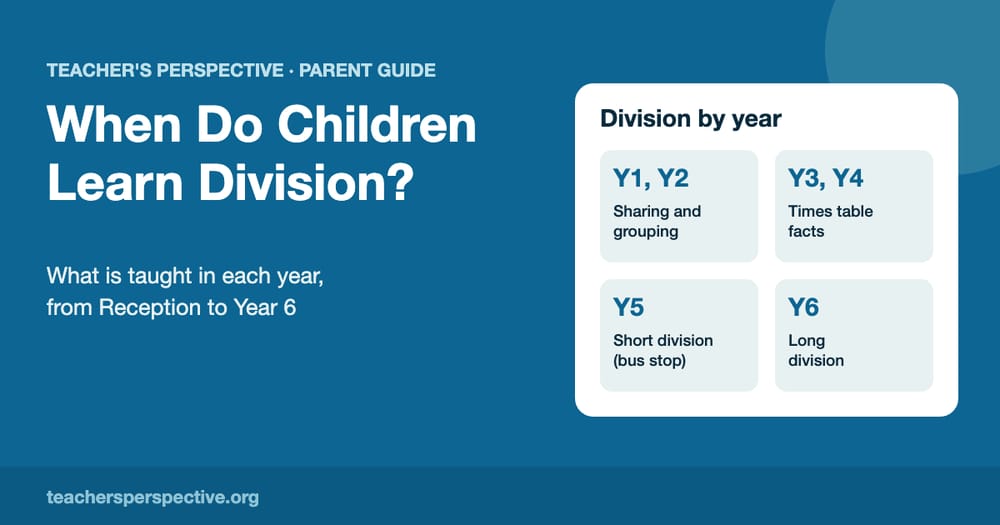
Quick answer: Children start dividing informally in Reception by sharing things equally. Division is formally taught from Year 1 (sharing and grouping), the ÷ sign arrives in Year 2, children should know all division facts up to 12 × 12 by the end of Year 4, short division (the bus stop method) is expected by Year 5, and long division is taught in Year 6.
In this guide
When children learn division: at a glance
This is what the national curriculum for England expects in each year. Schools follow the same order, though some teach a step a little earlier.
| Year (age) | What your child learns about division | Example |
|---|---|---|
| Reception (4 to 5) | Sharing objects equally and halving | Share 6 grapes between 2 plates |
| Year 1 (5 to 6) | Sharing and grouping with objects, pictures and arrays | How many groups of 2 can you make from 10 socks? |
| Year 2 (6 to 7) | The ÷ sign; division facts for the 2, 5 and 10 times tables | 20 ÷ 5 = 4 |
| Year 3 (7 to 8) | Division facts for the 3, 4 and 8 times tables; dividing 2-digit numbers | 48 ÷ 4 = 12 |
| Year 4 (8 to 9) | All division facts up to 12 × 12; dividing mentally; often the first written method | 84 ÷ 7 = 12 |
| Year 5 (9 to 10) | Short division (bus stop method) up to 4 digits ÷ 1 digit, with remainders | 4,236 ÷ 6 = 706 |
| Year 6 (10 to 11) | Long division (4 digits ÷ 2 digits); remainders as fractions and decimals | 2,544 ÷ 12 = 212 |
Reception: sharing comes first
Before the word "division" is ever used, children in Reception practise sharing. They share toys, snacks and counters between friends and check that everyone has the same. They also start halving and noticing whether an amount can be split fairly.
This matters more than it looks. Sharing equally is the idea that sits under every division your child will ever do, including long division in Year 6.
Years 1 and 2: sharing, grouping and the ÷ sign
Year 1
In Year 1 children solve simple division problems using real objects, pictures and arrays. They meet the two ways of thinking about division:
- Sharing: 12 sweets shared between 3 children. How many each?
- Grouping: 12 sweets put into bags of 3. How many bags?
Both give the answer 4, but they feel different to a child. Good teaching uses both, because grouping is the idea that later makes the written methods work.
Year 2
Year 2 is when the ÷ sign is formally introduced. Children learn the division facts for the 2, 5 and 10 times tables, so 30 ÷ 10 = 3 should become a fact they just know. They also learn that you can multiply in any order (3 × 4 = 4 × 3) but you can't divide in any order (12 ÷ 3 is not the same as 3 ÷ 12).
This is also where fact families and inverse operations start to appear. If a child knows 5 × 4 = 20, they can work out 20 ÷ 4 = 5 and 20 ÷ 5 = 4.
Years 3 and 4: times tables and the first written method
Year 3
In Year 3 children add the 3, 4 and 8 times tables and divide 2-digit numbers by 1-digit numbers, such as 48 ÷ 4 or 52 ÷ 4. Many schools use a number line or chunking here before moving on to a formal layout.
Year 4
Year 4 is the big one. By the end of the year children are expected to know all multiplication and division facts up to 12 × 12. In June they sit the Multiplication Tables Check, a 25-question online test with 6 seconds per question.
Many schools also teach the bus stop method in Year 4, starting with 2-digit and 3-digit numbers divided by a 1-digit number.
Teacher tip: Before any written method, ask your child "7 times what makes 56?" If they can answer in a few seconds, they're ready for the bus stop method. If they count up on their fingers, the times tables need work first.
Knowing division facts by heart is one of the 15 core skills in my free parent guide, along with the written methods that depend on it.
Get the free guideYears 5 and 6: short division and long division
Year 5
By Year 5 the national curriculum expects children to divide numbers up to 4 digits by a 1-digit number using short division (the bus stop method) and to deal with remainders sensibly. For example, if 50 children go on a trip and each car holds 4, you need 13 cars, not 12 remainder 2.
Year 6
Year 6 brings long division: dividing up to 4-digit numbers by a 2-digit number, such as 2,544 ÷ 12. Children also learn to write remainders as fractions or decimals, and division appears on the Year 6 SATs arithmetic paper.
If you want to know more about this step, I've written a full guide on when children learn long division.
Why the order matters
Each step in the timeline holds up the next one. A child who doesn't understand grouping finds the bus stop method confusing, because the method is really just grouping written down. A child who doesn't know their times tables can follow the bus stop steps but gets stuck at every single digit.
From the classroom: When a Year 5 or Year 6 child tells me they "can't do division", the written method is almost never the real problem. Nine times out of ten they're missing their times tables, so every step takes too long and they lose their place.
What if your child is behind?
Use the table above to find the last step your child is secure on, not the year group they're in. Then work forward from there. A few quick checks:
- Can they share 12 counters between 3 people and explain what they did? If not, start with real objects.
- Can they answer 35 ÷ 5 or 24 ÷ 3 without counting? If not, focus on times tables before any written method.
- Can they do 96 ÷ 4 on paper? If they know the facts but not the layout, the bus stop method is the next step.
Being behind in division is very common and very fixable, because the steps are so clear. If you're worried more generally, my guide on whether your child is behind in maths has more checks you can do at home.
How to help with division at home
- Share real things. Snacks, Lego, playing cards. Ask "how many each?" and "how many groups?"
- Practise times tables little and often. Five minutes a day beats an hour on Sunday.
- Always ask the times table question. Turn 42 ÷ 6 into "6 times what makes 42?"
- Use the school's method. Your child's school publishes a calculation policy showing exactly how they teach each step. Using the same method avoids confusion.
- Talk about remainders in real life. "We have 14 biscuits and 4 people. What do we do with the extra 2?"
For a step-by-step teaching order you can follow at the kitchen table, see my guide on how to teach division to kids.
Frequently asked questions
What age do children learn division?
Children in England start dividing informally at age 4 to 5 in Reception, by sharing objects equally. Division is formally taught from Year 1 (age 5 to 6), the ÷ sign appears in Year 2 (age 6 to 7), short division is expected by Year 5 (age 9 to 10) and long division in Year 6 (age 10 to 11).
When is division taught in school?
Division is taught in every year of primary school in England. It starts with sharing and grouping in Year 1, moves to division facts for the 2, 5 and 10 times tables in Year 2, then 3, 4 and 8 in Year 3, all facts up to 12 × 12 in Year 4, short division in Year 5 and long division in Year 6.
What year do children learn the bus stop method?
The national curriculum expects short division, which schools call the bus stop method, by Year 5. Many schools introduce it in Year 4, and some begin a simpler version with 2-digit numbers in Year 3. Check your school's calculation policy to see exactly when your child's school starts it.
When do kids learn long division?
Long division is a Year 6 objective in England. Children are expected to divide numbers up to 4 digits by a 2-digit number and to show remainders as whole numbers, fractions or decimals. It also appears on the Year 6 SATs arithmetic paper.
My child is in Year 4 and can't divide. Are they behind?
Not necessarily, but it is worth checking one thing: their times tables. By the end of Year 4 children should know multiplication and division facts up to 12 × 12. A child who has to count up in steps to answer 42 ÷ 7 will find every later division method hard, so start there.
Get all 15 core skills in one place
Division builds on the skills that come before it. My free parent guide lists the 15 core arithmetic skills every child needs by the end of primary school, in the order they're taught.
Use it to find exactly which step your child is on and what to practise next.
Get the free guide
