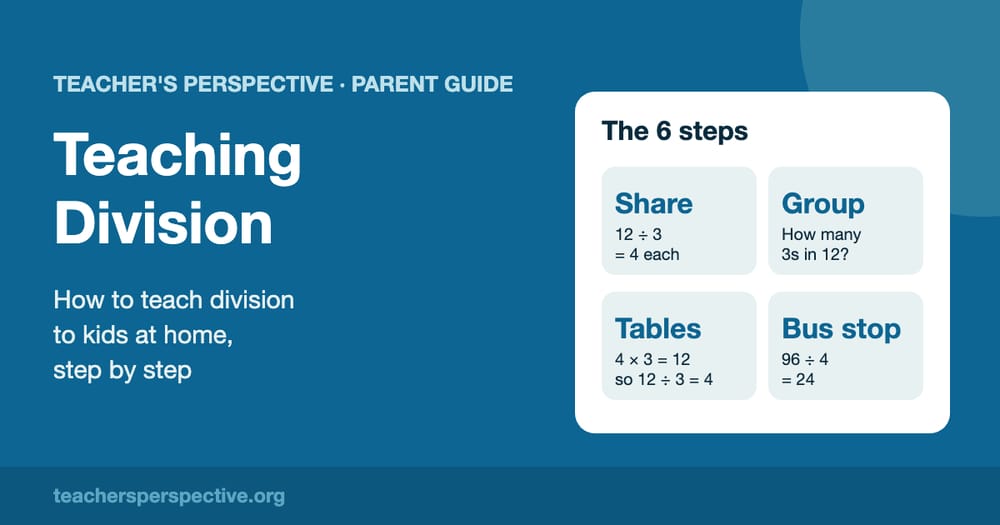

Division is the operation children find hardest, and it's often the one parents feel least sure about teaching. The good news is that division isn't a new idea your child has to learn from scratch. It's built on things they already know: sharing, counting in groups and times tables.
I'm Ross, a UK-qualified primary teacher with over ten years in the classroom. In this guide I'll show you how to teach division to your child in the same order schools teach it, from sharing sweets on the kitchen table all the way to the bus stop method, with examples at every step.
Quick answer: Teach division in this order: (1) sharing equally, using real objects; (2) grouping, or "how many groups of 3 are in 12?"; (3) linking division to times tables, so 4 × 5 = 20 means 20 ÷ 5 = 4; (4) division facts by heart; (5) remainders; and (6) the written method, short division, which schools call the bus stop method. Most children who struggle with division are missing step 3 or 4, not the written method itself.
In this guide
The order to teach division
| Step | What your child learns | Example |
|---|---|---|
| 1. Sharing | Splitting a total equally between groups | Share 12 sweets between 3 people: 4 each |
| 2. Grouping | Counting how many equal groups fit | How many 3s make 12? 4 |
| 3. Times tables link | Division is the inverse of multiplication | 4 × 3 = 12, so 12 ÷ 3 = 4 |
| 4. Division facts | Recall facts quickly | 56 ÷ 8 = 7 |
| 5. Remainders | What's left when it doesn't divide exactly | 14 ÷ 4 = 3 r 2 |
| 6. Short division | The written bus stop method | 96 ÷ 4 = 24 |
Don't skip ahead. If your child is stuck on the bus stop method, the gap is almost always further up this list.
Step 1: Start with sharing
Get 12 sweets, coins or pasta shapes and 3 plates. Ask your child to share them out equally, one at a time, like dealing cards. Then count how many are on each plate: 4. Now say the sum together: "12 shared between 3 is 4", and write it as 12 ÷ 3 = 4.
Repeat with different numbers. Children need to see that the ÷ sign means "shared equally" before it means anything else.
Step 2: Move on to grouping
Grouping is the other way to think about division, and it's the one that leads to the written method. With the same 12 sweets, ask: "How many groups of 3 can we make?" Your child makes piles of 3 until they run out. There are 4 piles, so again 12 ÷ 3 = 4.
You can do the same on a number line by jumping in 3s from 0 to 12 and counting the jumps. My guide on how to use a number line shows this.
Step 3: Link division to times tables
This is the most important step. Division is the inverse of multiplication: one undoes the other. If your child knows 6 × 4 = 24, they also know 24 ÷ 4 = 6 and 24 ÷ 6 = 4.
A fact family shows all four facts that go together:
- 6 × 4 = 24
- 4 × 6 = 24
- 24 ÷ 4 = 6
- 24 ÷ 6 = 4
Practise asking the question both ways round: "What's 7 × 5?" then "So what's 35 ÷ 5?" More on this in my guides to fact families and inverse operations.
Teacher tip: When your child sees 42 ÷ 7, teach them to ask "7 times what makes 42?"
Turning every division into a times table question is the single biggest shortcut in primary maths. It's one of the 15 core skills in my free parent guide.
Get the free guideStep 4: Learn division facts by heart
Once your child understands the link, they need speed. By the end of Year 4, children in England are expected to know multiplication and division facts up to 12 × 12. If times tables are still slow, division will be slow too, so this is where to spend practice time. My guide to learning times tables fast has a routine that works.
Step 5: Introduce remainders
Go back to the sweets. Share 14 sweets between 4 plates. Each plate gets 3, and there are 2 left over that can't be shared equally. That's a remainder: 14 ÷ 4 = 3 r 2.
A quick check: 3 × 4 = 12, and 12 + 2 = 14. The remainder must always be smaller than the number you're dividing by. If your child gets a remainder of 5 when dividing by 4, they can fit another group in. In Year 5 and 6, remainders are also written as fractions and decimals; see remainders as fractions and decimals.
Step 6: Teach short division (the bus stop method)
Only now is your child ready for the written method. Take 96 ÷ 4. Write 96 under the "bus stop" and 4 outside it.
- Tens: How many 4s go into 9? 2, because 2 × 4 = 8. Write 2 on top. There's 1 left over, so write a small 1 next to the 6, making 16.
- Ones: How many 4s go into 16? 4, because 4 × 4 = 16. Write 4 on top.
- Answer: 96 ÷ 4 = 24. Check: 24 × 4 = 96.
Notice that every step is a times table question. That's why steps 3 and 4 matter so much.
▶ Video lesson: short division explained for parents. Watch on YouTube
For more examples, including what to do with zeros and remainders, see my full guide to the bus stop method. When your child is ready for dividing by 2-digit numbers, move on to long division.
What to expect by year group
| Year | What children are expected to do |
|---|---|
| Year 1 | Solve simple sharing and grouping problems with objects and pictures |
| Year 2 | Know division facts for the 2, 5 and 10 times tables and use the ÷ sign |
| Year 3 | Division facts for the 3, 4 and 8 times tables; divide 2-digit numbers by 1-digit numbers |
| Year 4 | Recall all division facts up to 12 × 12; many schools start the bus stop method here |
| Year 5 | Short division of up to 4-digit numbers by 1-digit numbers, with remainders |
| Year 6 | Long division by 2-digit numbers, and remainders as fractions or decimals |
If you're unsure where your child should be, my year-by-year guides cover it, starting with Year 3 and Year 4.
Common problems and how to fix them
- "I don't know my tables." Go back to step 4. Five minutes of times tables a day will fix more division problems than any worksheet.
- Dividing the wrong way round. In 24 ÷ 6, some children try 6 ÷ 24. Read it as "24 shared into groups of 6" so the big number comes first.
- Remainders bigger than the divisor. Check by asking "Can I fit one more group in?"
- Forgetting to carry the remainder in the bus stop. In 96 ÷ 4, they write 2 on top but then do 6 ÷ 4 instead of 16 ÷ 4.
- Losing confidence. If division leads to tears, drop back a step and do a few easy wins with objects. Confidence comes before speed.
Frequently asked questions
How do you explain division to a child?
Start with sharing: give them some objects and ask them to share them equally between a few plates. Then show that division is the same as asking how many equal groups fit into a number. Once that makes sense, link it to times tables, so 3 × 5 = 15 means 15 ÷ 5 = 3.
What is the easiest way to teach division?
The easiest way is to teach it as the inverse of times tables. If your child knows their times tables, every division question becomes "what times this number makes that number?"
What age do children learn division?
In England, children start simple sharing and grouping in Year 1 (age 5 to 6), learn the ÷ sign in Year 2, start written methods in Year 3 and Year 4 (age 7 to 9), and are expected to use formal short division by Year 5. Long division comes in Year 6.
Should my child learn times tables before division?
Yes, at least partly. Your child can learn what division means with objects before they know their tables, but they need times tables to divide quickly and to use short division.
What is the bus stop method?
The bus stop method is the name UK primary schools use for short division. The number being divided goes inside a shape that looks like a bus shelter, the divisor waits outside, and the answer is built up on top, one digit at a time.
Get all 15 core skills in one place
Division builds on the skills before it. My free parent guide lists the 15 core arithmetic skills every child needs by the end of primary school, in the order they're taught.
Use it to see which step your child is on, and what to practise next.
Get the free guideKeep going
Sources and further reading
- National curriculum in England: mathematics programmes of study (Department for Education)

