
Year 2 is the last year of Key Stage 1, and it's the year a lot of the maths your child will need for the rest of primary school is laid down. If you're wondering what a Year 2 child should know in maths, or whether your child is on track, this guide walks you through it.
I'm Ross, a UK-qualified primary teacher with over ten years in the classroom. Below I've turned the Year 2 maths curriculum for England into plain English, one area at a time, with examples of what each skill looks like and what to do at home if your child isn't there yet.
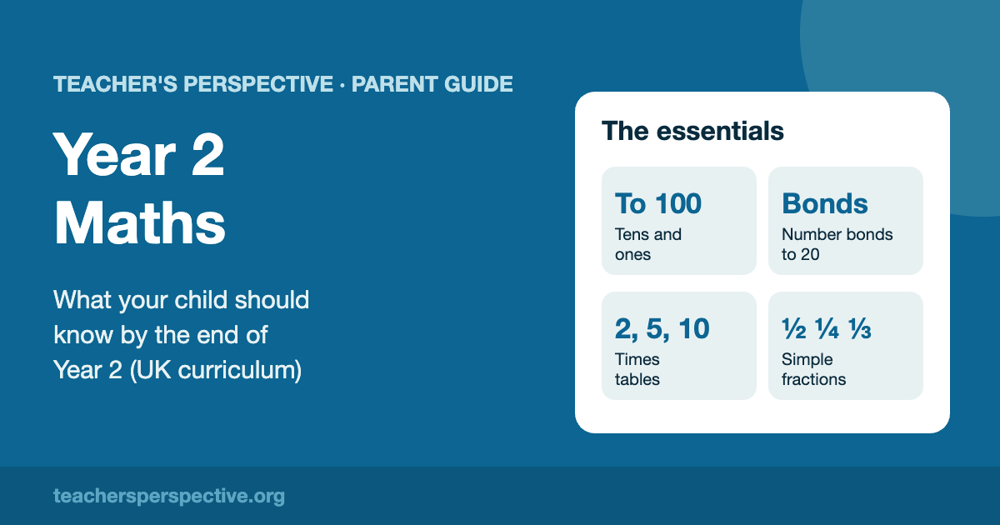
Quick answer: By the end of Year 2, children are expected to count, read and write numbers to 100, understand tens and ones, know their number bonds to 20 by heart, add and subtract 2-digit numbers, know the 2, 5 and 10 times tables, find simple fractions like ½, ¼ and ⅓, and tell the time to five minutes. The most important of these are number bonds and place value, because almost everything in Year 3 builds on them.
In this guide
The big picture
| Area | The headline expectation by the end of Year 2 |
|---|---|
| Place value | Read, write and order numbers to 100, and know what each digit in a 2-digit number is worth. |
| Addition and subtraction | Know number bonds to 20 by heart, and add and subtract 2-digit numbers. |
| Multiplication and division | Know the 2, 5 and 10 times tables and related division facts. |
| Fractions | Find ½, ¼, ⅓, ²⁄₄ and ¾ of shapes, lengths and small amounts. |
| Measurement | Use cm and m, g and kg, ml and l, money in £ and p, and tell the time to 5 minutes. |
| Shape and statistics | Describe 2D and 3D shapes, and read pictograms, tally charts and block diagrams. |
Year 2 is also when Key Stage 1 SATs used to be compulsory. Since 2023/24 they have been optional, so some schools still use the papers and some don't. Either way, your child's teacher will judge whether they are working at the expected standard by the end of the year.
Number and place value
- Count in steps of 2, 3 and 5 from 0, and in tens from any number, forwards and backwards (so 23, 33, 43...).
- Read and write numbers to at least 100 in digits and in words.
- Know the value of each digit in a 2-digit number: in 47, the 4 is worth 40 and the 7 is worth 7.
- Compare and order numbers from 0 to 100 using <, > and =.
- Show numbers in different ways, such as with tens and ones blocks or on a number line.
Understanding that 47 is 4 tens and 7 ones is called place value, and splitting it into 40 and 7 is called partitioning. If your child only does one thing to get ready for Year 3, make it this.
▶ Video lesson: partitioning and place value, explained simply. Watch on YouTube
Addition and subtraction
- Know number bonds to 20 by heart (like 7 + 6 = 13 and 13 − 6 = 7), and use them to work out facts to 100 (70 + 30 = 100).
- Add and subtract a 2-digit number and ones (35 + 4), a 2-digit number and tens (35 + 20), two 2-digit numbers (35 + 27), and three 1-digit numbers (4 + 7 + 6).
- Know that addition can be done in any order (3 + 8 = 8 + 3) but subtraction can't.
- Use the inverse to check: if 35 + 27 = 62, then 62 − 27 should be 35.
- Solve simple word problems, including ones with missing numbers like 15 + ? = 22.
Most Year 2 children add and subtract with objects, drawings and number lines rather than formal written methods. The column method usually comes in Year 3. What matters most now is fast, confident number bonds, because a child who has to count on their fingers for 8 + 7 will find everything later slow and tiring.
Multiplication and division
- Recall the 2, 5 and 10 times tables and the division facts that go with them (so 35 ÷ 5 = 7).
- Recognise odd and even numbers.
- Write multiplication and division using ×, ÷ and =.
- Know that multiplication can be done in any order (2 × 5 = 5 × 2) but division can't.
- Solve problems using arrays, repeated addition and sharing.
Each times table fact gives a whole fact family: 5 × 4 = 20, 4 × 5 = 20, 20 ÷ 5 = 4 and 20 ÷ 4 = 5. Learning them this way means your child learns four facts for the price of one.
Year 2 is where the foundations are laid. Number bonds, place value and early times tables lead into the formal written methods that make up the 15 core skills every child needs by the end of primary school.
My free parent guide lists all 15 in the order they're taught, so you can see what's coming after Year 2.
Get the free 15 Core Skills guideFractions
- Recognise, find, name and write ⅓, ¼, ²⁄₄ and ¾ of a length, a shape, a set of objects or an amount.
- Know that ²⁄₄ is the same as ½.
- Work out simple fractions of amounts, such as ½ of 6 = 3 or ¼ of 12 = 3.
- Count in halves and quarters, for example 1, 1½, 2, 2½.
The key idea is that a fraction means equal parts. A shape cut into four pieces of different sizes is not split into quarters. If you want to go further, my guide to fractions of amounts shows how this develops in later years.
Measurement, money and time
- Measure length in cm and m, mass in g and kg, capacity in ml and l, and temperature in °C, using rulers, scales and jugs.
- Compare and order measurements using <, > and =.
- Recognise £ and p coins and notes, make amounts in different ways, and work out change.
- Tell the time to five minutes, including quarter past and quarter to, and draw the hands on a clock.
- Know there are 60 minutes in an hour and 24 hours in a day.
Shape and statistics
- Describe 2D shapes by their sides and lines of symmetry, and 3D shapes by their faces, edges and vertices.
- Sort shapes and spot 2D shapes on the faces of 3D shapes (a circle on the bottom of a cylinder).
- Describe position, direction and movement, including quarter, half and three-quarter turns.
- Read and make simple pictograms, tally charts, block diagrams and tables, and answer questions about them.
Signs your child may be behind in Year 2 maths
- They still count on their fingers for number bonds like 6 + 4 or 9 + 5.
- They think the 3 in 37 is worth 3, not 30.
- They can chant the 2, 5 or 10 times table but can't jump straight to 7 × 5.
- They count every object one by one instead of counting in 2s, 5s or 10s.
- They panic or guess when a sum is written as a word problem.
None of these mean something is wrong. They just tell you where to focus. If you're worried more generally, my guide on how to tell if your child is behind in maths is a good next step.
How to help your Year 2 child with maths at home
- Number bonds every day. Two minutes of quick-fire questions at breakfast or in the car does more than a weekly worksheet. Start with bonds to 10, then 20.
- Count in 2s, 5s and 10s. Count stairs in 2s, coins in 5s and 10s, and count back too.
- Use real money. Let your child pay for something small and work out the change.
- Read clocks together. Ask "What time is it?" and "How long until tea?" on an analogue clock.
- Talk about tens and ones. Ask "How many tens in 64? How many ones?" with a pile of pasta grouped into tens.
- Keep it short and positive. Ten minutes that ends on a success beats forty minutes of frustration. If maths already feels like a battle, see what to do when your child hates maths.
Frequently asked questions
What should a Year 2 child know in maths?
By the end of Year 2 a child should read, write and order numbers to 100, understand tens and ones, know number bonds to 20, add and subtract 2-digit numbers, know the 2, 5 and 10 times tables, find simple fractions like ½ and ¼, and tell the time to five minutes.
What times tables should a Year 2 child know?
Year 2 children are expected to recall the 2, 5 and 10 times tables, including the related division facts, and to recognise odd and even numbers. The 3, 4 and 8 times tables follow in Year 3.
Are Year 2 SATs still compulsory?
No. Key Stage 1 SATs became optional from the 2023/24 school year. Some schools still use the papers to help with teacher assessment, but there is no national requirement to sit them.
Should a Year 2 child be using the column method?
Not usually. Year 2 children mostly add and subtract using objects, drawings, number lines and mental methods. Formal column addition and subtraction are normally introduced in Year 3.
How can I tell if my child is behind in Year 2 maths?
Common signs are relying on fingers for number bonds to 10 and 20, not knowing that the 4 in 45 is worth 40, and counting objects one by one instead of in 2s, 5s or 10s. Ask your child's teacher whether they are working at the expected standard.
Know exactly what comes after Year 2
Year 2 skills lead straight into the written methods your child will use for the rest of primary school. My free parent guide lists the 15 core arithmetic skills every child needs by the end of primary school, in the order they're taught.
Use it to see where your child is now, and what to practise next.
Get the free guideKeep going
Sources and further reading
- National curriculum in England: mathematics programmes of study (Department for Education)
- Primary assessments: future dates (Standards and Testing Agency)

