
Maths homework can turn a calm evening into an argument in about four minutes. Your child is stuck, you try to help, you explain it the way you learned it, and suddenly they're in tears saying "that's not how my teacher does it!"
I'm Ross, a UK-qualified primary teacher with over ten years in the classroom. I've seen this from both sides: as the teacher who set the homework and as the person parents ask for help afterwards. Here's what actually works.
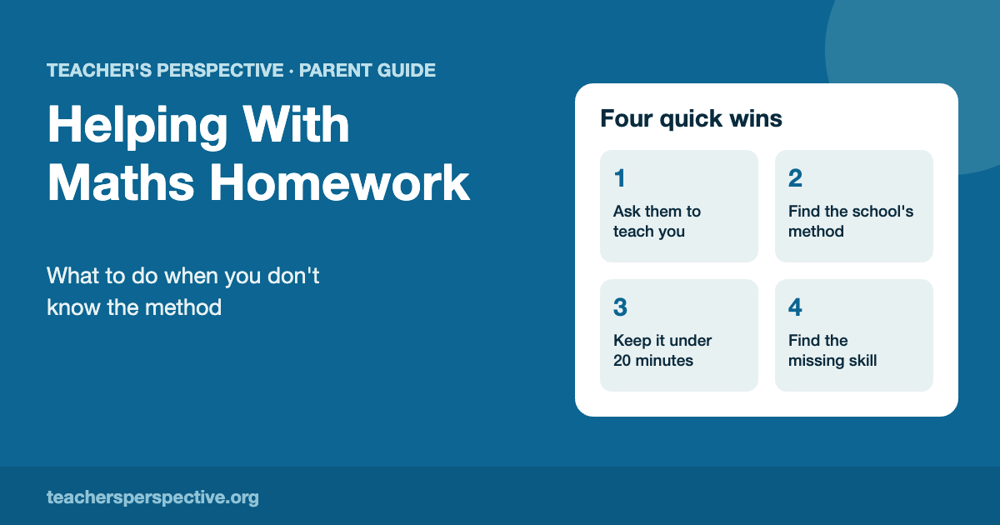
Quick answer: Ask your child to explain the method first, then check your school's calculation policy so you use the same steps. Keep sessions to 10 to 20 minutes, help them get started rather than giving answers, and if they keep getting stuck on the same thing, look for the skill underneath it (usually times tables or place value) and tell the teacher.
In this guide
Why maths homework is so hard to help with
It's not you. Primary maths really is taught differently now. Your child might be using a number line, partitioning, chunking or the bus stop method, when you learned a single written method and a lot of practice.
Schools teach in a careful order: objects first, then pictures, then numbers and written methods. Homework usually practises one small step in that order. When a parent jumps straight to the final method, it can feel to the child like being taught something completely new, at bedtime, by someone who isn't their teacher.
From the classroom: The homework sheets that came back with the most crossings-out were almost always the ones where a kind parent had taught a different method. The child wasn't wrong and neither was the parent. They were just using two different maps of the same road.
7 ways to help your child with maths homework
1. Ask them to teach you first
Start with "show me how your teacher does it." Children often know more than they think, and explaining it out loud helps them remember. It also tells you which method the school uses before you say anything.
2. Find your school's calculation policy
Almost every primary school publishes a calculation policy on its website. It shows each method, year by year, with examples. Search your school's name plus "calculation policy". It's the single most useful document for helping with homework, and most parents don't know it exists.
3. Help them start, not finish
Most stuck children are stuck at the first step. Ask a question that gets them going, such as "what do we do with the ones first?" or "what times table do we need here?", then step back.
4. Keep it short
For most primary children, 10 to 20 minutes is enough. After that, concentration drops and mistakes go up. If it's not finished, that's fine. A short note to the teacher is better than an hour-long battle.
5. Check the basics underneath
A lot of homework struggles are really times tables struggles. A child doing short division who doesn't know their 7 times table has to stop and count at every step. Quick practice of the basic facts, away from homework time, often fixes the homework too.
6. Let mistakes stay on the page
It's tempting to correct every answer, but the teacher needs to see what your child can do alone. Help them check their work, and if something is still wrong, leave it with a short note. That tells the teacher exactly what to reteach.
7. Praise the effort, not just the answer
"You kept going even when it was hard" builds the confidence that makes the next sheet easier. Children who think they're "bad at maths" stop trying, and that becomes the real problem. If your child already feels that way, my guide on what to do when your child hates maths may help.
Teacher tip: Before you start the homework, ask your child: "What's the first step?" If they can't tell you, the problem isn't this sheet. It's a skill from earlier that's missing.
My free parent guide lists the 15 core arithmetic skills every child needs, in the order schools teach them, so you can see exactly which one is missing.
Get the free guideWhat to do when you don't know the method
This happens to almost every parent, so don't worry. Try these, in order:
- Ask your child to show you an example from their book or a worked example on the sheet.
- Look up the method in your school's calculation policy.
- Look up the method by its school name. I have step-by-step guides to the common ones, such as the formal written methods, column addition and subtraction, short multiplication and long division.
- If you're still unsure, stop. Write "we didn't understand the method for question 3" on the sheet. That's a perfectly good piece of homework for a teacher to receive.
When maths homework ends in tears
If homework regularly ends in arguments or tears, change the plan, not the child:
- Stop for the night. Nothing useful is learned once a child is upset. Come back to it another day, or send a note.
- Change the time. Straight after school or just before bed are the hardest times. Try after a snack and a break.
- Sit beside them, not opposite. It feels like working together rather than being tested.
- Start with a question they can definitely answer. One quick win makes the next question feel possible.
If the tears are about maths in general rather than one sheet, it's worth reading the real reason your child is struggling.
How to tell a bad night from a real gap
Every child has a bad homework night. The pattern to watch for is the same kind of question causing trouble week after week.
| What you notice | What it usually means | What to do |
|---|---|---|
| Counts on fingers for times tables or division | Times table facts aren't secure yet | 5 minutes a day of times tables practice |
| Lines up columns wrongly in written methods | Place value isn't secure | Practise what each digit is worth with place value charts |
| Knows the method but gets lost halfway | Too many steps for their working memory, often because the facts are slow | Practise facts, then do one example together, slowly |
| Gets upset before even reading the question | Low confidence from past struggles | Easy wins first, then build up |
If you're seeing several of these, it's worth checking whether your child is behind in maths and looking at the most common maths mistakes children make.
When to talk to the teacher
Talk to the teacher if homework is taking much longer than it should most weeks, if your child is upset about maths regularly, or if you've noticed the same gap for more than a few weeks. Teachers genuinely want to know. A short, friendly message such as "she's finding the bus stop method hard at home, is there anything we should practise?" usually gets a helpful answer.
Want every method shown step by step?
Arithmetic Mastery 2.0 is my video course for parents of 7 to 11 year olds. It walks through all 15 core written methods the way schools teach them, so your child can pause, rewind and copy each step at their own pace, and you never have to guess the method again.
It's a one-off £49 for the full course.
See the full courseFrequently asked questions
How can I help my child with maths homework if I don't understand it?
Ask your child to teach you the method first, then look up your school's calculation policy, which shows each method step by step. Don't teach your own old method unless the teacher says it's fine, because two different methods at once is the most common cause of homework confusion.
Should I teach my child the way I learned maths?
Usually not at first. The answer is the same, but the layout and the steps are often different, and children get muddled switching between two methods. Learn the school's way, and save your method for later as a way to check answers once your child is confident.
How long should primary maths homework take?
For most primary children, 10 to 20 minutes is plenty. If homework regularly takes much longer, or ends in tears, that is useful information for the teacher. Stop, write a short note on the sheet saying where your child got stuck, and send it back.
Should I correct my child's maths homework?
Help them check it, but don't fix every answer for them. Teachers use homework to see what a child can do on their own. A few wrong answers with a note from you is more useful to the teacher than a perfect sheet that hides the gap.
Why does my child get so upset doing maths homework?
Usually because they feel stuck and don't know how to get started. Most often the hard part isn't the homework itself but a skill underneath it, like times tables or place value. Find and fix that skill and the homework battles usually ease off.
Find the skill that's missing
Most homework struggles come from one missing skill underneath. My free parent guide lists the 15 core arithmetic skills every child needs by the end of primary school, in the order they're taught.
Use it to find the gap, fix it, and watch the homework get easier.
Get the free guide
