
If your child cries over maths homework, still counts on their fingers in Year 5, or seems to forget everything they learned yesterday, you might have searched for dyscalculia and wondered if that's what is going on.
I'm Ross, a UK-qualified primary teacher with over ten years in the classroom. In this guide I'll explain what dyscalculia is, the signs to look for at ages 7 to 11, how it differs from an ordinary gap in skills, and exactly what to do next. I'm a teacher, not an assessor, so this guide can't tell you whether your child has dyscalculia. It will help you work out the right next step.
Quick answer: Dyscalculia is a specific learning difficulty that affects how a child understands and works with numbers. Signs include counting every object one by one, always counting from one, relying on fingers long after classmates have stopped, a poor sense of how big numbers are, and forgetting number facts despite lots of practice. It affects around 6% of people, so most children who struggle with maths don't have it. Only a qualified specialist assessor can diagnose it.
In this guide
What is dyscalculia?
Dyscalculia is a specific learning difficulty, like dyslexia, but with numbers instead of words. The British Dyslexia Association describes it as the most severe form of maths learning difficulty.
At its heart is number sense: knowing that 8 is bigger than 5, that 7 is "one more than 6", or that 100 is a lot more than 10. Most children pick this up without anyone noticing. A child with dyscalculia finds it genuinely hard, so every calculation built on top of it is hard too.
It's more common than many people think. Around 6% of people are estimated to have dyscalculia, about the same as dyslexia, yet researchers at Loughborough University found that a dyslexic child is far more likely to be diagnosed and supported. It's also important to keep it in proportion: around 1 in 4 people find maths difficult for all sorts of other reasons.
Signs of dyscalculia at ages 7 to 11
These are the signs the British Dyslexia Association and other UK specialists point to. On their own, any one of them is common. What matters is a pattern of several, lasting over time, despite good teaching.
Counting and number sense
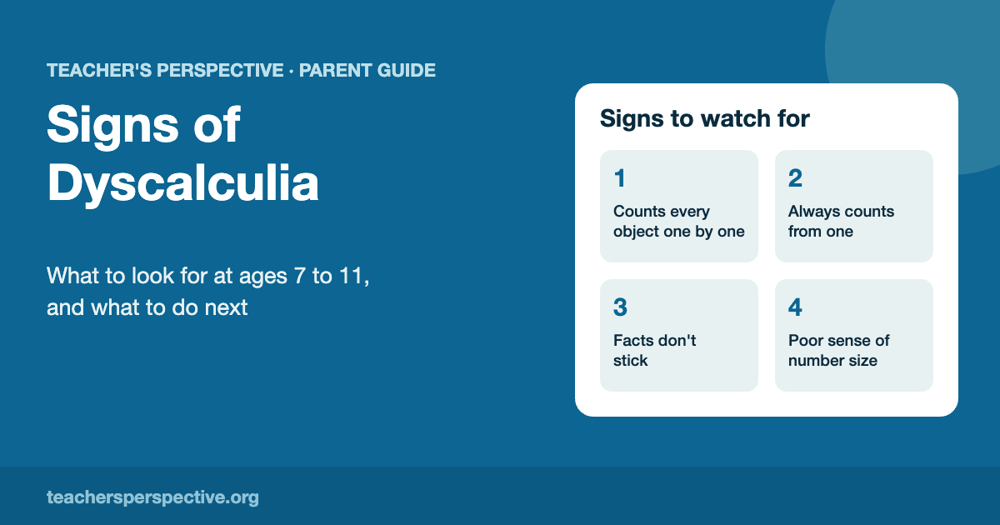
- Counts every object one by one, even with 3 or 4 things, instead of just seeing how many there are.
- Always starts counting from one and finds it hard to count on from another number, or count backwards.
- Struggles to match a number to an amount, for example linking "7", "seven" and seven counters.
- Has a poor sense of how big numbers are. Guessing whether 4 oranges cost £4, £20 or £100 feels like a lottery.
Number facts and calculations
- Relies on fingers for simple sums long after classmates have stopped.
- Can't remember number facts or times tables, even after lots of practice. A fact learned on Monday is gone by Wednesday.
- Gets lost partway through a calculation and can't find their place again.
- Mixes up the symbols +, −, × and ÷, or uses the wrong operation.
Everyday life and feelings
- Finds telling the time and handling money especially hard.
- Has always struggled with maths, but usually copes well with reading and other subjects.
- Becomes anxious or upset at the sight of numbers, and avoids games that involve counting or scores.
Dyscalculia or a gap in skills?
This is the question I get asked most by worried parents. In my experience, most children who struggle with maths in primary school don't have dyscalculia. They have one or two missing skills, often from a year or two earlier, and everything built on top of those skills keeps collapsing.
| What you notice | More likely a skills gap | Worth asking about dyscalculia |
|---|---|---|
| Counting | Counts on confidently from any number | Always counts from one, even for small amounts |
| Number facts | Slow at some times tables but improves with practice | Facts don't stick at all, even after weeks of practice |
| Written methods | Gets stuck at one particular step | Can't make sense of what the numbers mean, whatever the method |
| Size of numbers | Knows 80 is bigger than 18 | Isn't sure which of two numbers is bigger |
| Response to help | Improves quickly once the missing skill is taught | Makes very slow progress, even with good one-to-one help |
From the classroom: I've taught plenty of Year 5 and Year 6 children whose parents feared dyscalculia. Most of the time the real issue was that the child had never become secure with place value or their times tables, so every new method felt impossible. Once we went back and filled that gap, they moved forward fast. That doesn't mean dyscalculia isn't real. It means it's worth ruling out the simpler explanation first.
If this sounds like your child, my guides on whether your child is behind in maths and the real reason your child is struggling go into gaps in more detail.
Teacher tip: Before you worry about a label, find the first skill your child isn't secure on. Work backwards through the year groups until you reach something they can do confidently. The step just above that is where to start.
My free parent guide lists the 15 core arithmetic skills every child needs, in the order schools teach them, so you can see exactly where your child's gap is.
Get the free guideA simple check you can do at home
This isn't a test for dyscalculia, but it shows you a lot about your child's number sense in five minutes. Keep it relaxed and make it feel like a game.
- Dots. Roll a dice and cover it after a second. Can they tell you the number without counting the dots?
- Counting on. Say "start at 17 and count on 5". Do they continue from 17, or go back to 1?
- Bigger or smaller. Write two numbers, such as 46 and 64. Can they quickly tell you which is bigger and why?
- One more, one less. "What's one more than 39? One less than 60?"
- Estimating. Put a handful of pasta on the table. Ask them to guess how many before counting. Is their guess sensible?
A child who finds most of these easy is very unlikely to have a number sense problem, and is more likely to have a gap in a particular skill. A child who struggles with several of them, consistently, is worth talking to school about.
What to do if you're worried
- Talk to the class teacher. Ask what they see in class and whether your child is making progress. Teachers see your child alongside 29 others, which is useful information.
- Ask to speak to the SENCo. Every school has a Special Educational Needs Coordinator. They can arrange an informal assessment and put support in place.
- Ask what support can start now. According to the British Dyslexia Association, a child doesn't need a diagnosis to get help. Number lines, times table squares, extra time and small-group work can all start straight away.
- Consider a formal assessment. A diagnosis must come from a Specialist Teacher Assessor with a level 7 qualification in dyscalculia assessment or an equivalent AMBDA award. Screening tests on a computer can't diagnose dyscalculia on their own.
- Keep notes. Write down what you notice at home, with dates. It helps the school and any assessor see the pattern.
How to help at home, whatever the cause
The good news is that the same things help a child with dyscalculia and a child with an ordinary gap. You don't need to wait for an answer to start.
- Use real objects. Counters, Lego, coins and pasta make numbers something your child can see and touch.
- Use a number line. It shows how numbers relate to each other. See my guide to number lines.
- Play games with dice and cards. Snakes and ladders, dominoes and simple card games build number sense without feeling like work.
- Go back before you go forward. Secure number bonds and counting before times tables, and times tables before written methods.
- Keep it short and calm. Ten minutes a day, ending on a success. Anxiety makes maths harder for every child.
- Praise effort, not speed. If your child already feels "bad at maths", my guide on what to do when your child hates maths may help.
If it turns out to be a gap in skills
Arithmetic Mastery 2.0 is my video course for parents of 7 to 11 year olds. It teaches the 15 core written methods step by step, the way schools teach them, so your child can pause, rewind and repeat each one as many times as they need. It isn't a treatment for dyscalculia, but it's built for exactly the kind of gaps most struggling children have.
It's a one-off £49 for the full course, with a 30-day money-back guarantee.
See the full courseFrequently asked questions
What are the first signs of dyscalculia?
Early signs include taking a long time to learn to count objects, needing to count every item to know how many there are (even with 3 or 4 things), always counting from one, and relying on fingers long after classmates have stopped. The key sign is that the difficulty lasts, even with good teaching and regular practice.
How common is dyscalculia?
The British Dyslexia Association estimates that around 6% of people have dyscalculia, which is roughly one or two children in every class. Around 1 in 4 people find maths difficult for other reasons, so most children who struggle with maths do not have dyscalculia.
What is the difference between dyscalculia and being bad at maths?
Dyscalculia is a specific learning difficulty with number sense: understanding how big numbers are and how they relate to each other. A child who is simply behind usually has particular skills missing, such as times tables or a written method, and catches up quickly once those are taught. A child with dyscalculia keeps struggling with basic number ideas even after lots of good teaching.
Who can diagnose dyscalculia in the UK?
A formal diagnosis must be made by a Specialist Teacher Assessor with a level 7 qualification in dyscalculia assessment, or an equivalent AMBDA dyscalculia award, according to the British Dyslexia Association. Computer screening tests used by some schools can suggest signs of dyscalculia but cannot diagnose it.
Does my child need a diagnosis to get help at school?
No. Schools can and should put support in place without a diagnosis, such as number lines, times table squares, extra time and small-group work. Start by talking to your child's class teacher and the school's SENCo.
Find the skill that's missing
Whatever is behind your child's struggles, the first step is knowing which skills they have and which they don't. My free parent guide lists the 15 core arithmetic skills every child needs by the end of primary school, in the order they're taught.
Use it to find the gap and know exactly what to practise next.
Get the free guideKeep going

