
Ask your child which is bigger: 1/3 or 1/4. A lot of children say 1/4, because 4 is bigger than 3. It's the opposite, and that one idea is behind most of the fraction mistakes I see in Year 5 and Year 6.
Comparing and ordering fractions comes up in every year group from Year 3 to Year 6, and it's a regular in the SATs reasoning papers. It's also the skill that tells you whether your child actually understands what a fraction is, or is just following rules about tops and bottoms.
I'm Ross, a UK-qualified primary teacher with over ten years in the classroom. In this guide I'll show you how to compare fractions with the same denominator, with the same numerator, and with different denominators, a quick trick using one half, how to order a list, how it comes up in SATs, the mistakes I see most often, and practice questions with answers.
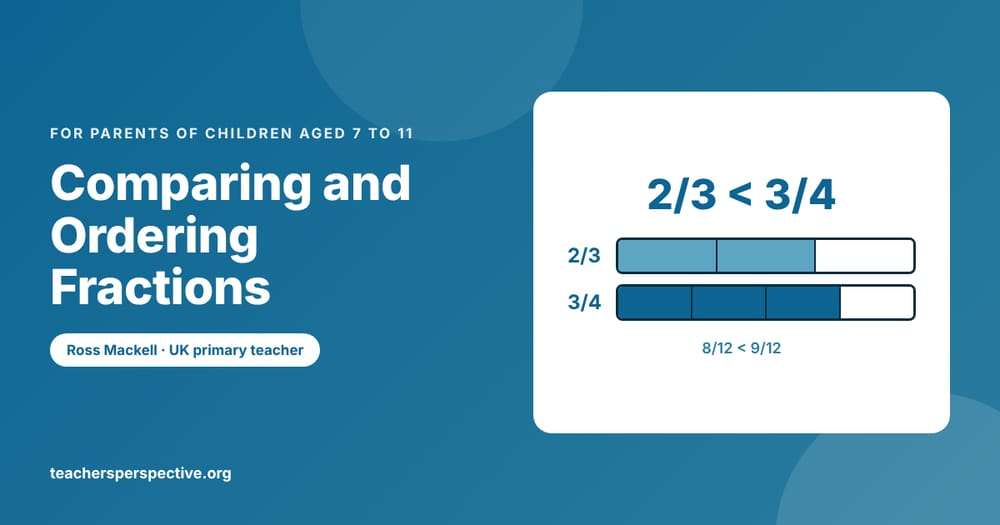
Quick answer: if the denominators are the same, the bigger numerator wins: 5/8 is bigger than 3/8. If the numerators are the same, the smaller denominator wins, because the pieces are bigger: 1/3 is bigger than 1/4. If both are different, turn them into equivalent fractions with the same denominator and compare again: 2/3 = 8/12 and 3/4 = 9/12, so 3/4 is bigger. To order a list, give every fraction the same denominator first.
In this guide
What your child needs first
Comparing fractions is built on three things:
- Knowing what the numbers in a fraction mean. The denominator (bottom) is how many equal pieces the whole is cut into. The numerator (top) is how many of those pieces you have.
- Equivalent fractions. Your child needs to know that 2/3 and 8/12 are the same amount, and how to make one from the other. Equivalent fractions and simplifying covers this.
- Times tables. Finding a common denominator means finding a common multiple. If your child knows their tables, this is quick. If not, start with how to learn times tables fast.
In the national curriculum, children compare and order unit fractions and fractions with the same denominator in Year 3. In Year 5 they compare and order fractions whose denominators are all multiples of the same number. In Year 6 they compare and order fractions, including fractions greater than 1.
Same denominator
This is the easy one. If the pieces are the same size, whoever has more pieces has more.
Example 1: 3/8 or 5/8?
- Both fractions are cut into eighths, so the pieces are the same size.
- 5 pieces is more than 3 pieces.
- 5/8 is bigger, so 3/8 < 5/8.
Same numerator
This is where children's instincts let them down. Get a piece of paper, a bar of chocolate or a pizza and show it.
Example 2: 1/3 or 1/4?
- Cut one strip of paper into 3 equal pieces and another the same size into 4.
- Each third is bigger than each quarter, because the strip is shared between fewer pieces.
- 1/3 is bigger, so 1/3 > 1/4.
The same works when the numerators match but aren't 1. 2/5 is bigger than 2/7: you have two pieces each time, but fifths are bigger pieces than sevenths.
Different denominators
When the numerators and denominators are both different, your child can't compare them directly. They need to make the pieces the same size first.
Example 3: 2/3 or 3/4?
- Find a number both denominators go into. 3 and 4 both go into 12.
- Change 2/3 into twelfths: 3 × 4 = 12, so multiply the top by 4 as well. 2/3 = 8/12.
- Change 3/4 into twelfths: 4 × 3 = 12, so multiply the top by 3. 3/4 = 9/12.
- Now the pieces are the same size: 9/12 is bigger than 8/12.
- 3/4 is bigger.
Quick tip: if one denominator is a multiple of the other, you only need to change one fraction. To compare 5/8 and 3/4, change 3/4 into 6/8. Then 6/8 is bigger than 5/8.
Example 4: 7/4 or 1 2/3?
- Turn the improper fraction into a mixed number: 7/4 = 1 3/4. (Mixed numbers and improper fractions explains how.)
- Both have 1 whole, so compare the fraction parts: 3/4 and 2/3.
- From Example 3, 3/4 is bigger.
- 7/4 is bigger.
Comparing fractions is really a test of equivalent fractions and times tables. Both are part of the 15 core skills every child aged 7 to 11 needs, and almost every fraction topic in Year 5 and Year 6 depends on them.
My free guide for parents shows all 15 core skills in order, so you can see exactly which one is holding your child back.
Get the free 15 Core Skills guide →The one half trick
Sometimes there's a quicker way than finding a common denominator. Compare each fraction to one half.
Example 5: 3/7 or 5/8?
- Half of 7 is 3.5. 3 is less than 3.5, so 3/7 is a bit less than a half.
- Half of 8 is 4. 5 is more than 4, so 5/8 is more than a half.
- One is below a half and one is above, so 5/8 is bigger.
A simple way for children to check: double the numerator. If double the top is bigger than the bottom, the fraction is more than a half. This trick is brilliant for estimating and for checking answers, and it often saves a lot of working in SATs.
Ordering a list of fractions
Ordering is just comparing, several times. The cleanest method is to give every fraction the same denominator.
Example 6: order 1/2, 3/8 and 3/4, smallest first
- Find a denominator they all go into. 2, 8 and 4 all go into 8.
- Rewrite them: 1/2 = 4/8, 3/8 stays 3/8, 3/4 = 6/8.
- Order the eighths: 3/8, 4/8, 6/8.
- Write them back in their original form: 3/8, 1/2, 3/4.
That last step matters. Children often leave the answer as 3/8, 4/8, 6/8, and the question asked for the fractions it gave them. Another option is to convert each fraction to a decimal and compare those. See fractions, decimals and percentages for how.
Comparing fractions in SATs
Comparing and ordering fractions usually shows up in the Year 6 SATs reasoning papers. These are the question types to practise:
| Question type | Example | Answer |
|---|---|---|
| Which is greater? | 3/5 or 4/7 | 3/5 |
| Order smallest first | 2/3, 5/6, 7/12 | 7/12, 2/3, 5/6 |
| Write < or > | 5/8 ___ 3/4 | 5/8 < 3/4 |
| More than a half | Circle the one bigger than 1/2: 3/7, 4/9, 5/8 | 5/8 |
| Mixed and improper | 11/4 or 2 1/2 | 11/4 |
Fractions also come up a lot on the arithmetic paper, usually as calculations. The guide to the Year 6 SATs arithmetic paper shows what to expect.
5 common mistakes and how to fix them
Mistake 1: Thinking a bigger denominator means a bigger fraction
Your child says 1/8 is bigger than 1/4.
The fix: fold two strips of paper the same size, one into quarters and one into eighths, and hold a single piece of each side by side. Seeing it does more than any rule.
Mistake 2: Comparing numerators when the denominators are different
Your child says 3/8 is bigger than 2/3, because 3 is bigger than 2.
The fix: the pieces aren't the same size, so you can't count them yet. Use the half trick (3/8 is less than a half, 2/3 is more), or make a common denominator: 9/24 and 16/24.
Mistake 3: Only changing the denominator
Your child turns 2/3 into 2/12 to match a denominator of 12.
The fix: whatever you multiply the bottom by, you multiply the top by. 3 × 4 = 12, so 2 × 4 = 8. 2/3 = 8/12.
Mistake 4: Thinking "one piece short" means equal
Your child says 4/5 and 5/6 are the same, because each is one piece away from a whole.
The fix: ask which missing piece is smaller. 5/6 is missing a sixth, 4/5 is missing a fifth. A sixth is smaller, so 5/6 is closer to a whole and bigger.
Mistake 5: Ignoring the whole numbers
Your child compares 2 1/3 and 1 3/4 by looking only at 1/3 and 3/4.
The fix: always compare the whole numbers first. 2 and a bit is always more than 1 and a bit. Only look at the fractions if the whole numbers are the same.
Practice questions
Same three steps I use for every skill: watch, copy, practise. Do the first one out loud yourself, then let your child have a go at a similar one before they try the rest on their own. Cover the last column and ask your child to fill in the gaps.
| Question | Answer |
|---|---|
| Which is bigger: 3/7 or 5/7? | 5/7 |
| Which is bigger: 1/6 or 1/9? | 1/6 |
| Which is bigger: 3/4 or 5/8? | 3/4 (6/8) |
| Which is bigger: 2/3 or 7/10? | 7/10 (21/30 vs 20/30) |
| Which is bigger: 4/5 or 7/9? | 4/5 (36/45 vs 35/45) |
| Order smallest first: 1/2, 2/5, 7/10 | 2/5, 1/2, 7/10 |
| Order smallest first: 5/6, 3/4, 2/3 | 2/3, 3/4, 5/6 |
| Which is bigger: 9/4 or 2 1/3? | 2 1/3 |
Bonus question: find a fraction that sits between 1/3 and 1/2. (One answer: 5/12, because 1/3 = 4/12 and 1/2 = 6/12.)
Ten minutes, a few times a week, is plenty. Only move on when they're getting three in a row right.
Keep going
Frequently asked questions
How do you compare fractions with different denominators?
Change them into equivalent fractions with the same denominator, then compare the numerators. For 2/3 and 3/4, use twelfths: 2/3 = 8/12 and 3/4 = 9/12. 9/12 is bigger, so 3/4 is bigger.
How do you order fractions from smallest to largest?
Find a denominator that all the fractions can share, rewrite each fraction with that denominator, then put them in order by their numerators. Finally, write the fractions back in their original form.
Which is bigger, 1/3 or 1/4?
1/3 is bigger. When the numerators are the same, the fraction with the smaller denominator is bigger, because the whole is cut into fewer, larger pieces. A third of a pizza is more than a quarter of the same pizza.
How do you know if a fraction is bigger than a half?
Double the numerator. If double the numerator is bigger than the denominator, the fraction is more than a half. For 5/8, double 5 is 10, which is more than 8, so 5/8 is more than a half.
What year do children learn to compare and order fractions?
In England, children compare unit fractions and fractions with the same denominator in Year 3. In Year 5 they compare fractions whose denominators are multiples of the same number, and in Year 6 they compare and order any fractions, including fractions greater than 1.
Get all 15 core skills in one place
Comparing fractions is easy once equivalent fractions and times tables are secure. The 15 core skills are the written methods and facts every child aged 7 to 11 needs to master to succeed in maths.
My free guide for parents shows all 15, in order, so you can see exactly where your child is and what comes next.
Get the free 15 Core Skills guide →Sources and further reading
- Department for Education, National curriculum in England: mathematics programmes of study (fractions, Years 3, 5 and 6)
- Standards and Testing Agency, Key stage 2 mathematics test framework
- Ross Mackell, Teacher's Perspective on YouTube

